


[May 27, 2023] Latest CKAD PDF Dumps & Real Tests Free Updated Today
CKAD Dumps With 100% Verified Q&As - Pass Guarantee or Full Refund
What kind of architectures and processes does Kubernetes support?
The architecture of Kubernetes is based on the concepts of pods, services, and nodes. Reliable service-oriented architecture. Just like other content management systems. You can use different architectures according to your specific purpose. Each container is defined using a Dockerfile. The system is based on the Linux kernel and is compatible with all major operating systems and programming languages. Testing is for developers. Production is for running applications in production. Labs are used to develop new containers, test them, and create new best practices. You can use the same process in each environment you use Kubernetes. However, there are some differences according to your operating system and your application. Training
Times when you want to change the number of nodes in your Kubernetes cluster. It's not easy to do this without complicated commands, but Kubernetes simplifies this. CNCF CKAD Dumps is what you need to ensure your success. Panel for managing your Kubernetes cluster. You can also integrate it with other services, for example, cloud providers. Only takes a few clicks to install it on your own hardware or on cloud providers. On DigitalOcean, you can install it using the extensions menu in the dashboard.
The CKAD certification exam is a performance-based exam that tests the candidate's ability to design, build, and deploy Kubernetes-based applications. The exam is conducted online and consists of a set of performance-based tasks that require the candidate to perform real-world tasks using a Kubernetes cluster. The candidate is required to demonstrate their ability to use Kubernetes to deploy and manage containerized applications, configure Kubernetes objects, and troubleshoot common issues.
NEW QUESTION # 15
Exhibit:
Context
You are tasked to create a secret and consume the secret in a pod using environment variables as follow:
Task
* Create a secret named another-secret with a key/value pair; key1/value4
* Start an nginx pod named nginx-secret using container image nginx, and add an environment variable exposing the value of the secret key key 1, using COOL_VARIABLE as the name for the environment variable inside the pod
- A. Solution:


- B. Solution:

Answer: A
NEW QUESTION # 16
Exhibit:
Given a container that writes a log file in format A and a container that converts log files from format A to format B, create a deployment that runs both containers such that the log files from the first container are converted by the second container, emitting logs in format B.
Task:
* Create a deployment named deployment-xyz in the default namespace, that:
* Includes a primary
lfccncf/busybox:1 container, named logger-dev
* includes a sidecar Ifccncf/fluentd:v0.12 container, named adapter-zen
* Mounts a shared volume /tmp/log on both containers, which does not persist when the pod is deleted
* Instructs the logger-dev
container to run the command
which should output logs to /tmp/log/input.log in plain text format, with example values:
* The adapter-zen sidecar container should read /tmp/log/input.log and output the data to /tmp/log/output.* in Fluentd JSON format. Note that no knowledge of Fluentd is required to complete this task: all you will need to achieve this is to create the ConfigMap from the spec file provided at /opt/KDMC00102/fluentd-configma p.yaml , and mount that ConfigMap to /fluentd/etc in the adapter-zen sidecar container
- A. Solution:


- B. Solution:

Answer: B
NEW QUESTION # 17
Refer to Exhibit.
Task:
A Dockerfile has been prepared at -/human-stork/build/Dockerfile
1) Using the prepared Dockerfile, build a container image with the name macque and lag 3.0. You may install and use the tool of your choice.
2) Using the tool of your choice export the built container image in OC-format and store it at -/human stork/macque 3.0 tar
Answer:
Explanation:
Solution:


NEW QUESTION # 18
Context
Anytime a team needs to run a container on Kubernetes they will need to define a pod within which to run the container.
Task
Please complete the following:
* Create a YAML formatted pod manifest
/opt/KDPD00101/podl.yml to create a pod named app1 that runs a container named app1cont using image Ifccncf/arg-output with these command line arguments: -lines 56 -F
* Create the pod with the kubect1 command using the YAML file created in the previous step
* When the pod is running display summary data about the pod in JSON format using the kubect1 command and redirect the output to a file named /opt/KDPD00101/out1.json
* All of the files you need to work with have been created, empty, for your convenience
Answer:
Explanation:
See the solution below.
Explanation
Solution:


NEW QUESTION # 19
Context
Task:
1- Update the Propertunel scaling configuration of the Deployment web1 in the ckad00015 namespace setting maxSurge to 2 and maxUnavailable to 59
2- Update the web1 Deployment to use version tag 1.13.7 for the Ifconf/nginx container image.
3- Perform a rollback of the web1 Deployment to its previous version
Answer:
Explanation:
Solution:


NEW QUESTION # 20
Context
Task:
Modify the existing Deployment named broker-deployment running in namespace quetzal so that its containers.
1) Run with user ID 30000 and
2) Privilege escalation is forbidden
The broker-deployment is manifest file can be found at:
Answer:
Explanation:
Solution:


NEW QUESTION # 21
Exhibit:
Context
You are tasked to create a ConfigMap and consume the ConfigMap in a pod using a volume mount.
Task
Please complete the following:
* Create a ConfigMap named another-config containing the key/value pair: key4/value3
* start a pod named nginx-configmap containing a single container using the
nginx image, and mount the key you just created into the pod under directory /also/a/path
- A. Solution:


- B. Solution:
Answer: A
NEW QUESTION # 22
Refer to Exhibit.
Task
A deployment is falling on the cluster due to an incorrect image being specified. Locate the deployment, and fix the problem.
Answer:
Explanation:
create deploy hello-deploy --image=nginx --dry-run=client -o yaml > hello-deploy.yaml Update deployment image to nginx:1.17.4: kubectl set image deploy/hello-deploy nginx=nginx:1.17.4
NEW QUESTION # 23 
Context
You sometimes need to observe a pod's logs, and write those logs to a file for further analysis.
Task
Please complete the following;
* Deploy the counter pod to the cluster using the provided YAMLspec file at /opt/KDOB00201/counter.yaml
* Retrieve all currently available application logs from the running pod and store them in the file
/opt/KDOB0020l/log_Output.txt, which has already been created
Answer:
Explanation:
See the solution below.
Explanation
Solution:


NEW QUESTION # 24 
Context
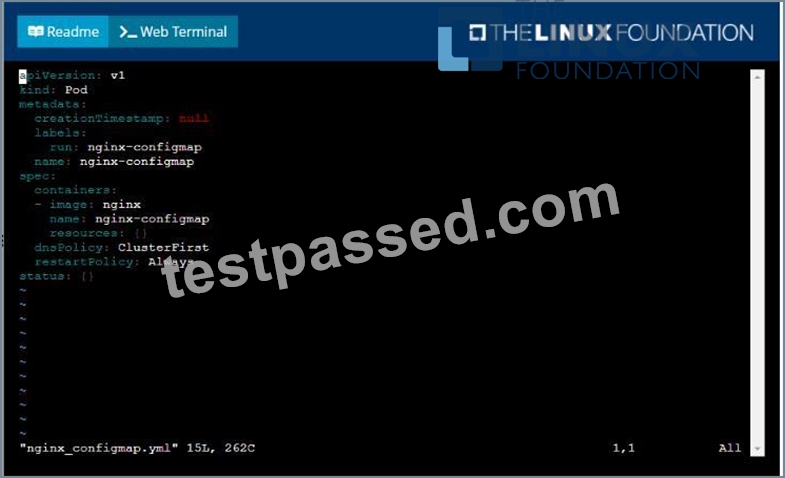
You are tasked to create a ConfigMap and consume the ConfigMap in a pod using a volume mount.
Task
Please complete the following:
* Create a ConfigMap named another-config containing the key/value pair: key4/value3
* start a pod named nginx-configmap containing a single container using the nginx image, and mount the key you just created into the pod under directory /also/a/path See the solution below.
Answer:
Explanation:
Explanation
Solution:


NEW QUESTION # 25
Refer to Exhibit.
Task:
1) First update the Deployment cka00017-deployment in the ckad00017 namespace:
*To run 2 replicas of the pod
*Add the following label on the pod:
Role userUI
2) Next, Create a NodePort Service named cherry in the ckad00017 nmespace exposing the ckad00017-deployment Deployment on TCP port 8888
Answer:
Explanation:
Solution:


NEW QUESTION # 26
Context
Anytime a team needs to run a container on Kubernetes they will need to define a pod within which to run the container.
Task
Please complete the following:
* Create a YAML formatted pod manifest
/opt/KDPD00101/podl.yml to create a pod named app1 that runs a container named app1cont using image Ifccncf/arg-output with these command line arguments: -lines 56 -F
* Create the pod with the kubect1 command using the YAML file created in the previous step
* When the pod is running display summary data about the pod in JSON format using the kubect1 command and redirect the output to a file named /opt/KDPD00101/out1.json
* All of the files you need to work with have been created, empty, for your convenience
Answer:
Explanation:
Solution:


NEW QUESTION # 27
Refer to Exhibit.
Task:
Update the Pod ckad00018-newpod in the ckad00018 namespace to use a NetworkPolicy allowing the Pod to send and receive traffic only to and from the pods web and db
Answer:
Explanation:
Solution:

NEW QUESTION # 28
Refer to Exhibit.
Task:
1- Update the Propertunel scaling configuration of the Deployment web1 in the ckad00015 namespace setting maxSurge to 2 and maxUnavailable to 59
2- Update the web1 Deployment to use version tag 1.13.7 for the Ifconf/nginx container image.
3- Perform a rollback of the web1 Deployment to its previous version
Answer:
Explanation:
Solution:


NEW QUESTION # 29
Refer to Exhibit.
Context
You are tasked to create a ConfigMap and consume the ConfigMap in a pod using a volume mount.
Task
Please complete the following:
* Create a ConfigMap named another-config containing the key/value pair: key4/value3
* start a pod named nginx-configmap containing a single container using the nginx image, and mount the key you just created into the pod under directory /also/a/path
Answer:
Explanation:
Solution:


NEW QUESTION # 30
Context
Context
As a Kubernetes application developer you will often find yourself needing to update a running application.
Task
Please complete the following:
* Update the app deployment in the kdpd00202 namespace with a maxSurge of 5% and a maxUnavailable of 2%
* Perform a rolling update of the web1 deployment, changing the Ifccncf/ngmx image version to 1.13
* Roll back the app deployment to the previous version
Answer:
Explanation:
Solution:


NEW QUESTION # 31
Context
Task:
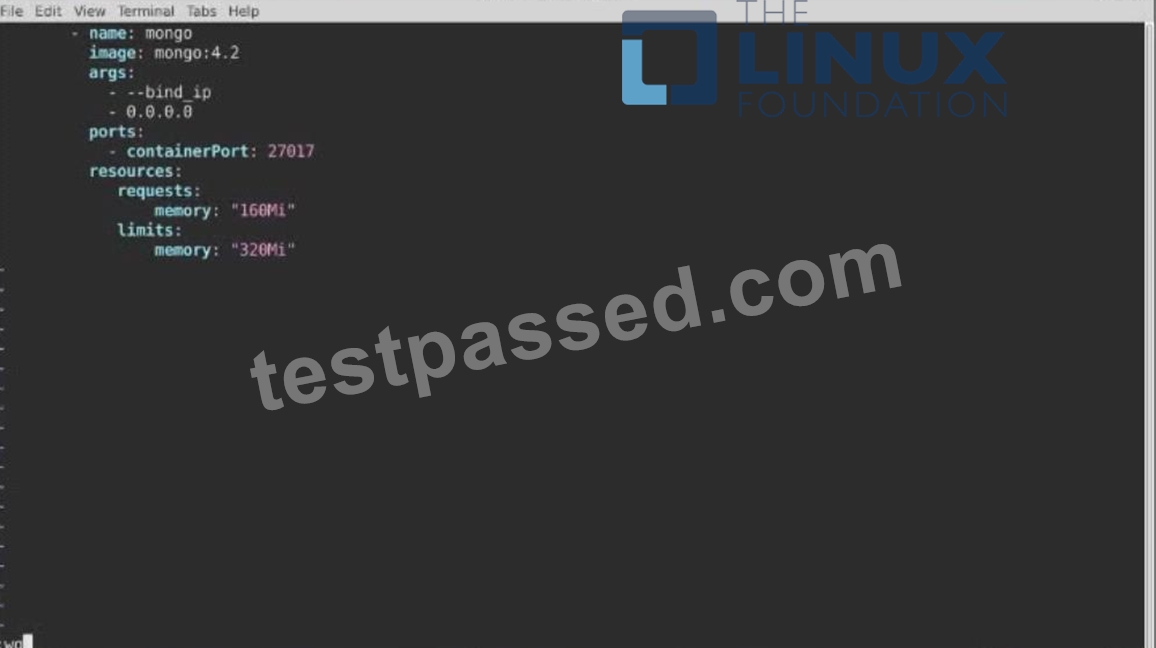
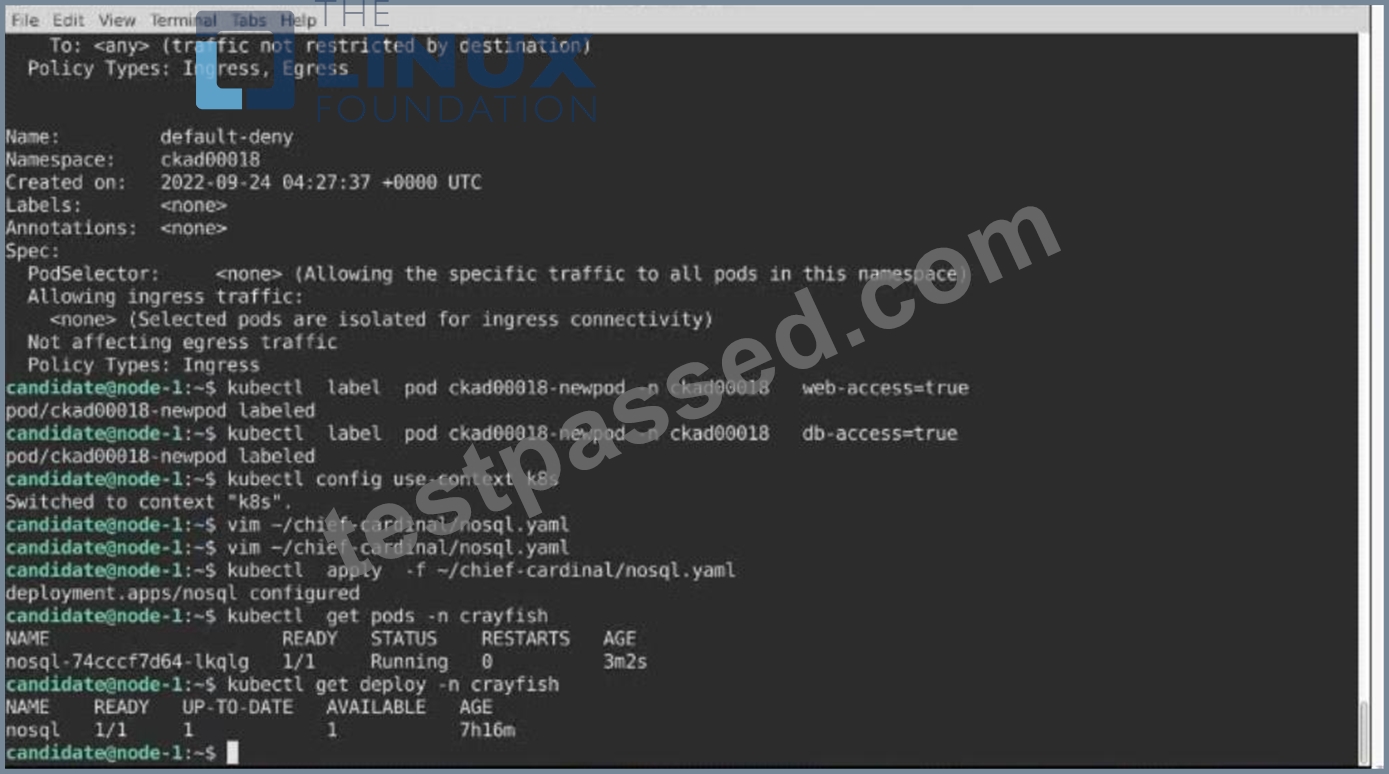
The pod for the Deployment named nosql in the craytisn namespace fails to start because its container runs out of resources.
Update the nosol Deployment so that the Pod:
1) Request 160M of memory for its Container
2) Limits the memory to half the maximum memory constraint set for the crayfah name space.
Answer:
Explanation:
Solution:

NEW QUESTION # 32 
Task
You have rolled out a new pod to your infrastructure and now you need to allow it to communicate with the web and storage pods but nothing else. Given the running pod kdsn00201 -newpod edit it to use a network policy that will allow it to send and receive traffic only to and from the web and storage pods.

Answer:
Explanation:
See the solution below.
Explanation
apiVersion: networking.k8s.io/v1
kind: NetworkPolicy
metadata:
name: internal-policy
namespace: default
spec:
podSelector:
matchLabels:
name: internal
policyTypes:
- Egress
- Ingress
ingress:
- {}
egress:
- to:
- podSelector:
matchLabels:
name: mysql
ports:
- protocol: TCP
port: 3306
- to:
- podSelector:
matchLabels:
name: payroll
ports:
- protocol: TCP
port: 8080
- ports:
- port: 53
protocol: UDP
- port: 53
protocol: TCP
NEW QUESTION # 33
Exhibit:
Context
A project that you are working on has a requirement for persistent data to be available.
Task
To facilitate this, perform the following tasks:
* Create a file on node sk8s-node-0 at /opt/KDSP00101/data/index.html with the content Acct=Finance
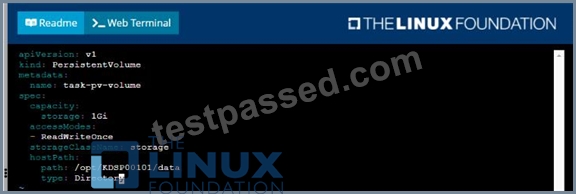
* Create a PersistentVolume named task-pv-volume using hostPath and allocate 1Gi to it, specifying that the volume is at /opt/KDSP00101/data on the cluster's node. The configuration should specify the access mode of ReadWriteOnce . It should define the StorageClass name exam for the PersistentVolume , which will be used to bind PersistentVolumeClaim requests to this PersistenetVolume.
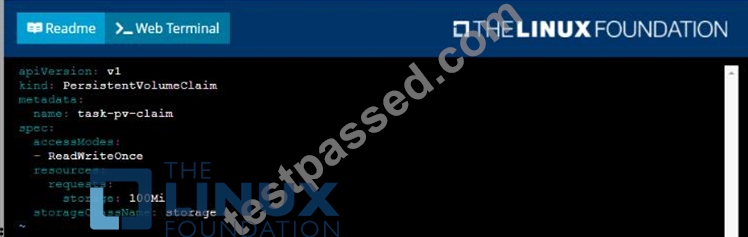
* Create a PefsissentVolumeClaim named task-pv-claim that requests a volume of at least 100Mi and specifies an access mode of ReadWriteOnce
* Create a pod that uses the PersistentVolmeClaim as a volume with a label app: my-storage-app mounting the resulting volume to a mountPath /usr/share/nginx/html inside the pod

- A. Solution:







- B. Solution:
Answer: B
NEW QUESTION # 34
Context
Context
Your application's namespace requires a specific service account to be used.
Task
Update the app-a deployment in the production namespace to run as the restrictedservice service account. The service account has already been created.
Answer:
Explanation:
Solution: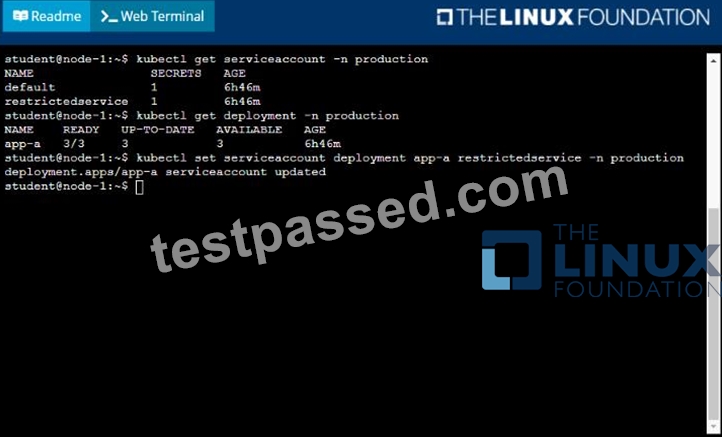
NEW QUESTION # 35
Context
Task:
Create a Pod named nginx resources in the existing pod resources namespace.
Specify a single container using nginx:stable image.
Specify a resource request of 300m cpus and 1G1 of memory for the Pod's container.
Answer:
Explanation:
Solution:


NEW QUESTION # 36
......
The Linux Foundation CKAD (Linux Foundation Certified Kubernetes Application Developer) Certification Exam is a highly sought-after certification for professionals who want to demonstrate their expertise in designing and deploying applications on Kubernetes. Kubernetes is an open-source platform that automates the deployment, scaling, and management of containerized applications. The CKAD certification is designed to validate the candidate's skills in Kubernetes application development and deployment.
2023 Valid CKAD test answers & Linux Foundation Exam PDF: https://www.testpassed.com/CKAD-still-valid-exam.html
Pass Linux Foundation CKAD Exam With Practice Test Questions Dumps Bundle: https://drive.google.com/open?id=1T0_IVvrQlE2FL6PfkaAY1rtOcAJLygId