


Updated Nov 07, 2021 Verified AZ-500 dumps Q&As - 100% Pass
New 2021 Latest Questions AZ-500 Dumps - Use Updated Microsoft Exam
NEW QUESTION 41
You have an Azure subscription that contains a user named Admin1 and resource group named RG1.
In Azure Monitor, you create the alert rules shown in the following table.
Admin1 performs the following actions on RG1:
Adds a virtual network named Lock1.
Which rules will trigger an alert as a result of the actions of Admin1? To answer, select the appropriate options in the answer area.
NOTE: Each correct selection is worth one point.
Answer:
Explanation:
NEW QUESTION 42
You have an Azure Active Directory (Azure AD) tenant that contains the users shown in the following table.
You create and enforce an Azure AD Identity Protection sign-in risk policy that has the following settings:
* Assignments: Include Group1, exclude Group2
* Conditions: Sign-in risk level: Medium and above
* Access Allow access, Require multi-factor authentication
You need to identify what occurs when the users sign in to Azure AD.
What should you identify for each user? To answer, select the appropriate options in the answer area.
NOTE: Each correct selection is worth one point.
Answer:
Explanation:
Explanation:
References:
http://www.rebeladmin.com/2018/09/step-step-guide-configure-risk-based-azure-conditional-access-policies/
https://docs.microsoft.com/en-us/azure/active-directory/identity-protection/concept-identity-protection-policies
https://docs.microsoft.com/en-us/azure/active-directory/identity-protection/concept-identity-protection-risks
NEW QUESTION 43
You are evaluating the security of the network communication between the virtual machines in Sub2.
For each of the following statements, select Yes if the statement is true. Otherwise, select No.
NOTE: Each correct selection is worth one point.
Answer:
Explanation:
NEW QUESTION 44
You have an Azure subscription that is linked to an Azure Active Directory (Azure AD) tenant.
From the Azure portal, you register an enterprise application.
Which additional resource will be created in Azure AD?
- A. an X.509 certificate
- B. a service principal
- C. a managed identity
- D. a user account
Answer: B
Explanation:
Reference:
https://docs.microsoft.com/en-us/azure/active-directory/develop/active-directory-how-applications-are-added
NEW QUESTION 45
You have an Azure Sentinel deployment.
You need to create a scheduled query rule named Rule1.
What should you use to define the query rule logic for Rule1?
- A. GraphQL
- B. a Transact-SQL statement
- C. a Kusto query
- D. a JSON definition
Answer: C
Explanation:
Reference:
https://docs.microsoft.com/en-us/azure/sentinel/tutorial-detect-threats-custom
NEW QUESTION 46
You have an Azure subscription that contains the following resources:
A virtual network named VNET1 that contains two subnets named Subnet1 and Subnet2.
A virtual machine named VM1 that has only a private IP address and connects to Subnet1.
You need to ensure that Remote Desktop connections can be established to VM1 from the internet.
Which three actions should you perform in sequence? To answer, move the appropriate actions from the list of actions to the answer area and arrange then in the correct order.
Answer:
Explanation:
NEW QUESTION 47
You have the Azure key vaults shown in the following table.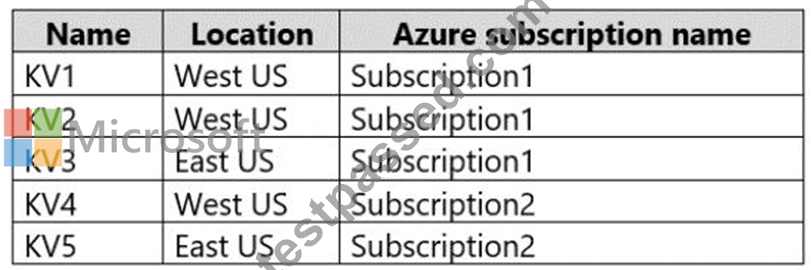
KV1 stores a secret named Secret1 and a key for a managed storage account named Key1.
You back up Secret1 and Key1.
To which key vaults can you restore each backup? To answer, select the appropriate options in the answer area.
NOTE: Each correct selection is worth one point.
Answer:
Explanation:
NEW QUESTION 48
You have an Azure subscription that contains the virtual machines shown in the following table.
You create the Azure policies shown in the following table.
You create the resource locks shown in the following table.
For each of the following statements, select Yes if the statement is true. Otherwise, select No.
NOTE: Each correct selection is worth one point.
Answer:
Explanation:
NEW QUESTION 49
You have an Azure Active Directory (Azure AD) tenant named contoso.com that contains the users shown in the following table.
You create and enforce an Azure AD Identity Protection user risk policy that has the following settings:
* Assignment: Include Group1, Exclude Group2
* Conditions: Sign-in risk of Medium and above
* Access: Allow access, Require password change
For each of the following statements, select Yes if the statement is true. Otherwise, select No.
NOTE: Each correct selection is worth one point.
Answer:
Explanation:
Explanation
Box 1: Yes
User1 is member of Group1. Sign in from unfamiliar location is risk level Medium.
Box 2: Yes
User2 is member of Group1. Sign in from anonymous IP address is risk level Medium.
Box 3: No
Sign-ins from IP addresses with suspicious activity is low.
Note:
Azure AD Identity protection can detect six types of suspicious sign-in activities:
* Users with leaked credentials
* Sign-ins from anonymous IP addresses
* Impossible travel to atypical locations
* Sign-ins from infected devices
* Sign-ins from IP addresses with suspicious activity
* Sign-ins from unfamiliar locations
These six types of events are categorized in to 3 levels of risks - High, Medium & Low:
References:
http://www.rebeladmin.com/2018/09/step-step-guide-configure-risk-based-azure-conditional-access-policies/
NEW QUESTION 50
You create an Azure subscription with Azure AD Premium P2.
You need to ensure that you can use Azure Active Directory (Azure AD) Privileged Identity Management (PIM) to secure Azure roles.
Which three actions should you perform in sequence? To answer, move the appropriate actions from the list of actions to the answer area and arrange them in the correct order.
Answer:
Explanation:
Explanation
NEW QUESTION 51
You are evaluating the security of the network communication between the virtual machines in Sub2.
For each of the following statements, select Yes if the statement is true. Otherwise, select No.
NOTE: Each correct selection is worth one point.
Answer:
Explanation:
Explanation
Box 1: Yes
NSG1 has the inbound security rules shown in the following table.
Box 2: Yes
Box 3: No
Note:
Sub2 contains the virtual machines shown in the following table.
NEW QUESTION 52
You plan to use Azure Resource Manager templates to perform multiple deployments of identically configured Azure virtual machines. The password for the administrator account of each deployment is stored as a secret in different Azure key vaults.
You need to identify a method to dynamically construct a resource ID that will designate the key vault containing the appropriate secret during each deployment. The name of the key vault and the name of the secret will be provided as inline parameters.
What should you use to construct the resource ID?
- A. a linked template
- B. a key vault access policy
- C. a parameters file
- D. an automation account
Answer: C
Explanation:
Explanation
You reference the key vault in the parameter file, not the template. The following image shows how the parameter file references the secret and passes that value to the template.
Reference:
https://docs.microsoft.com/en-us/azure/azure-resource-manager/resource-manager-keyvault-parameter
NEW QUESTION 53
You have an Azure Active Directory (Azure AD) tenant named contoso.com. The tenant contains the users shown in the following table.
You configure an access review named Review1 as shown in the following exhibit.
Use the drop-down menus to select the answer choice that completes each statement based on the information presented in the graphic.
NOTE: Each correct selection is worth one point.
Answer:
Explanation:
Box 1: User3 only
Use the Members (self) option to have the users review their own role assignments.
Box 2: User3 will receive a confirmation request
Use the Should reviewer not respond list to specify what happens for users that are not reviewed by the reviewer within the review period. This setting does not impact users who have been reviewed by the reviewers manually. If the final reviewer's decision is Deny, then the user's access will be removed.
No change - Leave user's access unchanged
Remove access - Remove user's access
Approve access - Approve user's access
Take recommendations - Take the system's recommendation on denying or approving the user's continued access References:
https://docs.microsoft.com/bs-latn-ba/azure/active-directory/privileged-identity-management/pim-how-to-start-se
NEW QUESTION 54
You have an Azure subscription that contains a web app named App1 and an Azure key vault named Vault1.
You need to configure App1 to store and access the secrets in Vault1.
How should you configure App1? To answer, select the appropriate options in the answer area.
NOTE: Each correct selection is worth one point.
Answer:
Explanation:
Reference:
https://docs.microsoft.com/en-us/azure/app-service/overview-managed-identity?tabs=dotnet
NEW QUESTION 55
You need to ensure that users can access VM0. The solution must meet the platform protection requirements.
What should you do?
- A. On Firewall, configure a DNAT rule.
- B. Move VM0 to Subnet1.
- C. On Firewall, configure a network traffic filtering rule.
- D. Assign RT1 to AzureFirewallSubnet.
Answer: B
Explanation:
Azure Firewall has the following known issue:
Conflict with Azure Security Center (ASC) Just-in-Time (JIT) feature.
If a virtual machine is accessed using JIT, and is in a subnet with a user-defined route that points to Azure Firewall as a default gateway, ASC JIT doesn't work. This is a result of asymmetric routing - a packet comes in via the virtual machine public IP (JIT opened the access), but the return path is via the firewall, which drops the packet because there is no established session on the firewall.
Solution: To work around this issue, place the JIT virtual machines on a separate subnet that doesn't have a user-defined route to the firewall.
Scenario:
Following the implementation of the planned changes, the IT team must be able to connect to VM0 by using JIT VM access.
References:
https://docs.microsoft.com/en-us/azure/firewall/overview
Implement platform protection
Testlet 2
Case Study
This is a case study. Case studies are not timed separately. You can use as much exam time as you would like to complete each case. However, there may be additional case studies and sections on this exam. You must manage your time to ensure that you are able to complete all questions included on this exam in the time provided.
To answer the questions included in a case study, you will need to reference information that is provided in the case study. Case studies might contain exhibits and other resources that provide more information about the scenario that is described in the case study. Each question is independent of the other questions in this case study.
At the end of this case study, a review screen will appear. This screen allows you to review your answers and to make changes before you move to the next section of the exam. After you begin a new section, you cannot return to this section.
To start the case study
To display the first question in this case study, click the Next button. Use the buttons in the left pane to explore the content of the case study before you answer the questions. Clicking these buttons displays information such as business requirements, existing environment, and problem statements. If the case study has an All Information tab, note that the information displayed is identical to the information displayed on the subsequent tabs. When you are ready to answer a question, click the Question button to return to the question.
Overview
Contoso, Ltd. is a consulting company that has a main office in Montreal and two branch offices in Seattle and New York.
The company hosts its entire server infrastructure in Azure.
Contoso has two Azure subscriptions named Sub1 and Sub2. Both subscriptions are associated to an Azure Active Directory (Azure AD) tenant named contoso.com.
Existing Environment
Azure AD
Contoso.com contains the users shown in the following table.
Contoso.com contains the security groups shown in the following table.
Sub1
Sub1 contains six resource groups named RG1, RG2, RG3, RG4, RG5, and RG6.
User9 creates the virtual networks shown in the following table.
Sub1 contains the locks shown in the following table.
Sub1 contains the Azure policies shown in the following table.
Sub2
Sub2 contains the virtual networks shown in the following table.
Sub2 contains the virtual machines shown in the following table.
All virtual machines have public IP addresses and the Web Server (IIS) role installed. The firewalls for each virtual machine allow ping requests and web requests.
Sub2 contains the network security groups (NSGs) shown in the following table.
NSG1 has the inbound security rules shown in the following table.
NSG2 has the inbound security rules shown in the following table.
NSG3 has the inbound security rules shown in the following table.
NSG4 has the inbound security rules shown in the following table.
NSG1, NSG2, NSG3, and NSG4 have the outbound security rules shown in the following table.
Technical requirements
Contoso identifies the following technical requirements:
* Deploy Azure Firewall to VNetwork1 in Sub2.
* Register an application named App2 in contoso.com.
* Whenever possible, use the principle of least privilege.
* Enable Azure AD Privileged Identity Management (PIM) for contoso.com.
NEW QUESTION 56
You plan to use Azure Log Analytics to collect logs from 200 servers that run Windows Server 2016.
You need to automate the deployment of the Microsoft Monitoring Agent to all the servers by using an Azure Resource Manager template.
How should you complete the template? To answer, select the appropriate options in the answer area.
NOTE: Each correct selection is worth one point.
Answer:
Explanation:

References:
https://blogs.technet.microsoft.com/manageabilityguys/2015/11/19/enabling-the-microsoft-monitoring-agent-in-windows-json-templates/
NEW QUESTION 57
You need to ensure that you can meet the security operations requirements.
What should you do first?
- A. Turn on Auto Provisioning in Security Center.
- B. Modify the Security Center workspace configuration.
- C. Upgrade the pricing tier of Security Center to Standard.
- D. Integrate Security Center and Microsoft Cloud App Security.
Answer: C
Explanation:
The Standard tier extends the capabilities of the Free tier to workloads running in private and other public
clouds, providing unified security management and threat protection across your hybrid cloud workloads. The
Standard tier also adds advanced threat detection capabilities, which uses built-in behavioral analytics and
machine learning to identify attacks and zero-day exploits, access and application controls to reduce exposure
to network attacks and malware, and more.
Scenario: Security Operations Requirements
Litware must be able to customize the operating system security configurations in Azure Security Center.
References:
https://docs.microsoft.com/en-us/azure/security-center/security-center-pricing
Manage security operations
Question Set 3
NEW QUESTION 58
You have an Azure subscription that contains the Azure Active Directory (Azure AD) resources shown in the following table.
You create the groups shown in the following table.
Which resources can you add to Group5 and Group6? To answer, select the appropriate options in the answer area.
NOTE: Each correct selection is worth one point.
Answer:
Explanation:
NEW QUESTION 59
You need to create an Azure key vault. The solution must ensure that any object deleted from the key vault be retained for 90 days.
How should you complete the command? To answer, select the appropriate options in the answer area.
NOTE: Each correct selection is worth one point.
Answer:
Explanation:
Explanation
Box 1: -EnablePurgeProtection
If specified, protection against immediate deletion is enabled for this vault; requires soft delete to be enabled as well.
Box 2: -EnableSoftDelete
Specifies that the soft-delete functionality is enabled for this key vault. When soft-delete is enabled, for a grace period, you can recover this key vault and its contents after it is deleted.
References:
https://docs.microsoft.com/en-us/powershell/module/azurerm.keyvault/new-azurermkeyvault
NEW QUESTION 60
You have an Azure subscription.
You plan to create a workflow automation in Azure Security Center that will automatically remediate a security vulnerability.
What should you create first?
- A. an automation account
- B. an Azure function app
- C. an alert rule
- D. an Azure logic app
- E. a managed identity
Answer: A
NEW QUESTION 61
You network contains an on-premises Active Directory domain that syncs to an Azure Active Directory (Azure AD) tenant. The tenant contains the users shown in the following table.
The tenant contains the groups shown in the following table.
You configure a multi-factor authentication (MFA) registration policy that and the following settings:
Assignments:
Include: Group1
Exclude Group2
Controls: Require Azure MFA registration
Enforce Policy: On
For each of the following statements, select Yes if the statement is true. Otherwise, select No.
Answer:
Explanation:
Explanation
NEW QUESTION 62
......
Latest AZ-500 Exam Dumps Microsoft Exam from Training: https://www.testpassed.com/AZ-500-still-valid-exam.html
Pass Microsoft AZ-500 PDF Dumps Recently Updated 295 Questions: https://drive.google.com/open?id=1QehJhfJsSTH9-W7KvfoAfJxTNhtVYNON