


Excellent DP-420 PDF Dumps With 100% TestPassed Exam Passing Guaranted [Dec-2025]
100% Pass Your DP-420 Designing and Implementing Cloud-Native Applications Using Microsoft Azure Cosmos DB at First Attempt with TestPassed
To prepare for the DP-420 certification exam, candidates should have a solid understanding of cloud computing, distributed systems, and NoSQL databases. They should also be familiar with Microsoft Azure and have experience working with Azure Cosmos DB. Microsoft offers a range of training resources to help candidates prepare for the exam, including online courses, study guides, and practice exams.
NEW QUESTION # 51
You plan to create an Azure Cosmos DB database named db1 that will contain two containers. One of the containers will contain blog posts, and the other will contain users. Each item in the blog post container will include:
* A single blog post
* All the comments associated to the blog post
* The names of the users who created the blog post and added the comments.
You need to design a solution to update usernames m the user container without causing data integrity issues.
The solution must minimize administrative and development effort. What should you include in the solution?
To answer, select the appropriate options in the answer area.
NOTE: Each correct selection is worth one point.
Answer:
Explanation:
Explanation:
NEW QUESTION # 52
You are designing an Azure Cosmos DB Core (SQL) API solution to store data from IoT devices. Writes from the devices will be occur every second.
The following is a sample of the data.
You need to select a partition key that meets the following requirements for writes:
Minimizes the partition skew
Avoids capacity limits
Avoids hot partitions
What should you do?
- A. Use timestamp as the partition key.
- B. Create a new synthetic key that contains deviceId and sensor1Value.
- C. Create a new synthetic key that contains deviceId and a random number.
- D. Create a new synthetic key that contains deviceId and deviceManufacturer.
Answer: C
Explanation:
Use a partition key with a random suffix. Distribute the workload more evenly is to append a random number at the end of the partition key value. When you distribute items in this way, you can perform parallel write operations across partitions.
Reference: https://docs.microsoft.com/en-us/azure/cosmos-db/sql/synthetic-partition-keys
NEW QUESTION # 53
You have a database in an Azure Cosmos DB for NoSQL account that is configured for multi-region writes.
You need to use the Azure Cosmos DB SDK to implement the conflict resolution policy for a container. The solution must ensure that any conflict sent to the conflict feed.
Solution: You set ConfilictResolutionMode to Custom. You Set ResolutionProcedures to a custom stored procedure. You configure the custom stored procedure to use the conflictingItems parameter to resolve conflict.
Does this meet the goal?
- A. No
- B. Yes
Answer: B
Explanation:
Explanation
Setting ConflictResolutionMode to Custom and configuring a custom stored procedure with the
"conflictingItems" parameter will allow you to implement a custom conflict resolution policy. This will ensure that any conflicts are sent to the conflict feed for resolution.
NEW QUESTION # 54
You have an Azure Cosmos DB container named container1.
You need to insert an item into contained. The solution must ensure that the item is deleted automatically after two hours.
How should you complete the item definition? To answer, select the appropriate options in the answer area.
NOTE: Each correct selection is worth one point.
Answer:
Explanation:
Explanation
NEW QUESTION # 55
You maintain a relational database for a book publisher. The database contains the following tables.
The most common query lists the books for a given authorId.
You need to develop a non-relational data model for Azure Cosmos DB Core (SQL) API that will replace the relational database. The solution must minimize latency and read operation costs.
What should you include in the solution?
- A. Create a container that contains a document for each Author and a document for each Book. In each Book document, embed authorId.
- B. Create a container for Author and a container for Book. In each Author document, embed booked for each book by the author. In each Book document embed author of each author.
- C. Create Author, Book, and Bookauthorlnk documents in the same container.
- D. Create a container for Author and a container for Book. In each Author document and Book document embed the data from Bookauthorlnk.
Answer: B
Explanation:
Explanation
Store multiple entity types in the same container.
NEW QUESTION # 56
You need to select the partition key for con-iot1. The solution must meet the IoT telemetry requirements.
What should you select?
- A. the temperature
- B. the device ID
- C. the humidity
- D. the timestamp
Answer: B
Explanation:
Explanation
The partition key is what will determine how data is routed in the various partitions by Cosmos DB and needs to make sense in the context of your specific scenario. The IoT Device ID is generally the "natural" partition key for IoT applications.
Scenario: The iotdb database will contain two containers named con-iot1 and con-iot2.
Ensure that Azure Cosmos DB costs for IoT-related processing are predictable.
Reference:
https://docs.microsoft.com/en-us/azure/architecture/solution-ideas/articles/iot-using-cosmos-db
NEW QUESTION # 57
You have an Azure Cosmos DB Core (SQL) API account named account1 that has the disableKeyBasedMetadataWriteAccess property enabled.
You are developing an app named App1 that will be used by a user named DevUser1 to create containers in account1. DevUser1 has a non-privileged user account in the Azure Active Directory (Azure AD) tenant.
You need to ensure that DevUser1 can use App1 to create containers in account1.
What should you do? To answer, select the appropriate options in the answer area.
NOTE: Each correct selection is worth one point.
Answer:
Explanation:
Explanation:
Box 1: Resource tokens
Resource tokens provide access to the application resources within a database. Resource tokens:
Provide access to specific containers, partition keys, documents, attachments, stored procedures, triggers, and UDFs.
Box 2: Azure Resource Manager API
You can use Azure Resource Manager to help deploy and manage your Azure Cosmos DB accounts, databases, and containers.
Reference:
https://docs.microsoft.com/en-us/azure/cosmos-db/secure-access-to-data
https://docs.microsoft.com/en-us/rest/api/resources/
NEW QUESTION # 58
The settings for a container in an Azure Cosmos DB Core (SQL) API account are configured as shown in the following exhibit.
Which statement describes the configuration of the container?
- A. Items stored in the collection will expire only if the item has a time to live value.
- B. All items will be deleted after one year.
- C. All items will be deleted after one hour.
- D. Items stored in the collection will be retained always, regardless of the items time to live value.
Answer: A
Explanation:
When DefaultTimeToLive is -1 then your Time to Live setting is On (No default) Time to Live on a container, if present and the value is set to "-1", it is equal to infinity, and items don't expire by default.
Time to Live on an item:
This Property is applicable only if DefaultTimeToLive is present and it is not set to null for the parent container.
If present, it overrides the DefaultTimeToLive value of the parent container.
Reference: https://docs.microsoft.com/en-us/azure/cosmos-db/sql/time-to-live
NEW QUESTION # 59
You have an Azure Cosmos DB for NoSQL account. The account hosts a container that has the change feed enabled. You are building an app by using the Azure Cosmos DB SDK. The app will read items from the change feed by using a pull model. You need to ensure that multiple threads can read the change feed in parallel. What should you include?
- A. the Pagesize value
- B. a stream-based iterator
- C. the changeFeedStartFew value
- D. the FeedRange value
Answer: D
NEW QUESTION # 60
You have a database in an Azure Cosmos DB Core (SQL) API account. The database is backed up every two hours.
You need to implement a solution that supports point-in-time restore.
What should you do first?
- A. Create a new account that has a periodic backup policy.
- B. Configure the Backup & Restore settings for the account.
- C. Configure the Point In Time Restore settings for the account.
- D. Enable Continuous Backup for the account.
Answer: D
NEW QUESTION # 61
You plan to create an Azure Cosmos DB container named account that will contain items in the following format.
You need to define a query that will return the ids of all accounts that have ever recorded a negative value for balance.
How should you complete the query? To answer, select the appropriate options in the answer are a.
NOTE: Each correct selection is worth one point.
Answer:
Explanation:
NEW QUESTION # 62
You have an Azure subscription.
You need to deploy the following resources to an Azure Cosmos DB for NoSQL account:
* A container
* A user-defined function (UDF)
The solution must minimize the possibility of the deployment failing.
How should you complete the template? To answer, select the appropriate options in the answer area.
NOTE: Each correct selection is worth one point.
Answer:
Explanation:
Explanation:
NEW QUESTION # 63
You have an Azure Cosmos DB Core (SQL) API account.
You configure the diagnostic settings to send all log information to a Log Analytics workspace.
You need to identify when the provisioned request units per second (RU/s) for resources within the account were modified.
You write the following query.
AzureDiagnostics
| where Category == "ControlPlaneRequests"
What should you include in the query?
- A. | where OperationName startswith "SqlContainersDelete"
- B. | where OperationName startswith "MongoCollectionsThroughputUpdate"
- C. | where OperationName startswith "AccountUpdateStart"
- D. | where OperationName startswith "SqlContainersThroughputUpdate"
Answer: C
Explanation:
The following are the operation names in diagnostic logs for different operations:
RegionAddStart, RegionAddComplete
RegionRemoveStart, RegionRemoveComplete
AccountDeleteStart, AccountDeleteComplete
RegionFailoverStart, RegionFailoverComplete
AccountCreateStart, AccountCreateComplete
*AccountUpdateStart*, AccountUpdateComplete
VirtualNetworkDeleteStart, VirtualNetworkDeleteComplete
DiagnosticLogUpdateStart, DiagnosticLogUpdateComplete
Reference: https://docs.microsoft.com/en-us/azure/cosmos-db/audit-control-plane-logs
NEW QUESTION # 64
You have an Azure Cosmos DB Core (SQL) API account used by an application named App1.
You open the Insights pane for the account and see the following chart.
Use the drop-down menus to select the answer choice that answers each question based on the information presented in the graphic.
NOTE: Each correct selection is worth one point.
Answer:
Explanation:
Explanation:
Box 1: incorrect connection URLs
400 Bad Request: Returned when there is an error in the request URI, headers, or body. The response body will contain an error message explaining what the specific problem is.
The HyperText Transfer Protocol (HTTP) 400 Bad Request response status code indicates that the server cannot or will not process the request due to something that is perceived to be a client error (for example, malformed request syntax, invalid request message framing, or deceptive request routing).
Box 2: 6 thousand
201 Created: Success on PUT or POST. Object created or updated successfully.
Note:
200 OK: Success on GET, PUT, or POST. Returned for a successful response.
404 Not Found: Returned when a resource does not exist on the server. If you are managing or querying an index, check the syntax and verify the index name is specified correctly.
Reference: https://docs.microsoft.com/en-us/rest/api/searchservice/http-status-codes
NEW QUESTION # 65
You have a multi-region Azure Cosmos DB account named account1 that has a default consistency level of strong.
You have an app named App1 that is configured to request a consistency level of session.
How will the read and write operations of App1 be handled? To answer, select the appropriate options in the answer area.
NOTE: Each correct selection is worth one point.
Answer:
Explanation:
Explanation
Box 1 = Write and replicate data to every region synchronously
This is because the write concern is mapped to the default consistency level configured on your Azure Cosmos DB account2, which is strong in this case. Strong consistency ensures that every write operation is synchronously committed to every region associated with your Azure Cosmos DB account1. The request level consistency level of session only applies to the read operations of App11.
Box 2: That has the lowest estimated latency to the client
This is because the read operations of App1 will use the session consistency level that is specified in the request options. Session consistency is a client-centric consistency model that guarantees monotonic reads, monotonic writes, and read-your-own-writes within a session. A session is scoped to a client connection or a stored procedure execution. Session consistency allows clients to read from any region that has the lowest latency to the client.
NEW QUESTION # 66
You are developing an application that will use an Azure Cosmos DB Core (SQL) API account as a data source.
You need to create a report that displays the top five most ordered fruits as shown in the following table.
A collection that contains aggregated data already exists. The following is a sample document:
{
"name": "apple",
"type": ["fruit", "exotic"],
"orders": 10000
}
Which two queries can you use to retrieve data for the report? Each correct answer presents a complete solution.
NOTE: Each correct selection is worth one point.
- A.

- B.

- C.

- D.

Answer: B,C
Explanation:
Explanation
ARRAY_CONTAINS returns a Boolean indicating whether the array contains the specified value. You can check for a partial or full match of an object by using a boolean expression within the command.
Reference: https://docs.microsoft.com/en-us/azure/cosmos-db/sql/sql-query-array-contains
NEW QUESTION # 67
You have an Azure Cosmos DB Core (SQL) API account named account1 that has the disableKeyBasedMetadataWriteAccess property enabled.
You are developing an app named App1 that will be used by a user named DevUser1 to create containers in account1. DevUser1 has a non-privileged user account in the Azure Active Directory (Azure AD) tenant.
You need to ensure that DevUser1 can use App1 to create containers in account1.
What should you do? To answer, select the appropriate options in the answer area.
NOTE: Each correct selection is worth one point.
Answer:
Explanation: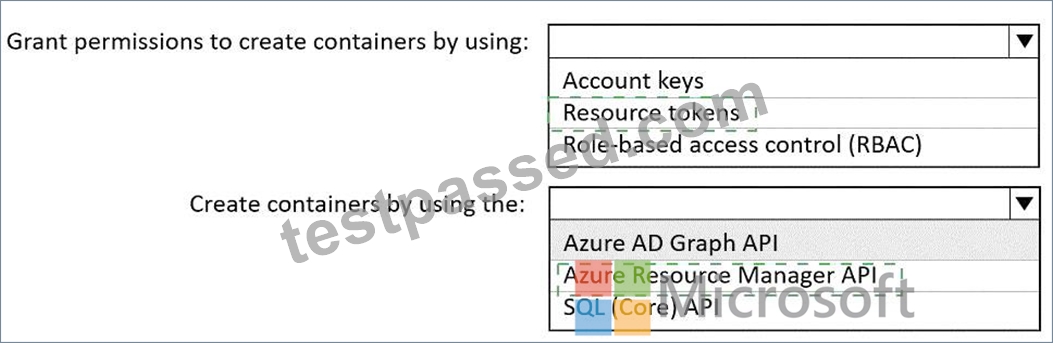
Explanation
Box 1: Resource tokens
Resource tokens provide access to the application resources within a database. Resource tokens:
Provide access to specific containers, partition keys, documents, attachments, stored procedures, triggers, and UDFs.
Box 2: Azure Resource Manager API
You can use Azure Resource Manager to help deploy and manage your Azure Cosmos DB accounts, databases, and containers.
Reference:
https://docs.microsoft.com/en-us/azure/cosmos-db/secure-access-to-data
https://docs.microsoft.com/en-us/rest/api/resources/
NEW QUESTION # 68
You have an Azure Cosmos DB Core (SQL) account that has a single write region in West Europe.
You run the following Azure CLI script.
For each of the following statements, select Yes if the statement is true. Otherwise, select No.
NOTE: Each correct selection is worth one point.
Answer:
Explanation:
Reference:
https://docs.microsoft.com/en-us/azure/cosmos-db/sql/how-to-multi-master
https://docs.microsoft.com/en-us/azure/cosmos-db/optimize-cost-regions
NEW QUESTION # 69
You have a database named telemetry in an Azure Cosmos DB Core (SQL) API account that stores IoT data.
The database contains two containers named readings and devices.
Documents in readings have the following structure.
id
deviceid
timestamp
ownerid
measures (array)
- type
- value
- metricid
Documents in devices have the following structure.
id
deviceid
owner
- ownerid
- emailaddress
- name
brand
model
For each of the following statements, select Yes if the statement is true. Otherwise, select No.
NOTE: Each correct selection is worth one point.
Answer:
Explanation:
Explanation:
Box 1: Yes
Need to join readings and devices.
Box 2: No
Only readings is required. All required fields are in readings.
Box 3: No
Only devices is required. All required fields are in devices.
NEW QUESTION # 70
You provision Azure resources by using the following Azure Resource Manager (ARM) template.
For each of the following statements, select Yes if the statement is true. Otherwise, select No.
NOTE: Each correct selection is worth one point.
Answer:
Explanation:
Explanation
Box 1: No
An alert is triggered when the DB key is regenerated, not when it is used.
Note: The az cosmosdb keys regenerate command regenerates an access key for a Azure Cosmos DB database account.
Box 2: No
Only an SMS action will be taken.
Emailreceivers is empty so no email action is taken.
Box 3: Yes
Yes, an alert is triggered when the DB key is regenerated.
Reference: https://docs.microsoft.com/en-us/cli/azure/cosmosdb/keys
NEW QUESTION # 71
......
Trend for DP-420 pdf dumps before actual exam: https://www.testpassed.com/DP-420-still-valid-exam.html
Real Exam Questions and Answers - Microsoft DP-420 Dump is Ready: https://drive.google.com/open?id=1yAgYz2m1XiokBjGIBfTmC1gdcnrTQGex