


Exam QSDA2022 Realistic Dumps Verified Questions Free [Apr 14, 2023]
Valid QSDA2022 Dumps for Helping Passing Qlik Exam!
The Qlik QSDA2022 (Qlik Sense Data Architect Certification Exam - 2022) is a certification exam designed for data professionals who work with Qlik Sense data architectures. This exam is intended to test individuals on their understanding of data modeling, data preparation, data visualization, and data management using Qlik Sense. Passing this exam certifies that the individual has a thorough understanding of Qlik Sense and can effectively use it to manage and analyze data.
The QSDA2022 certification exam is an excellent opportunity for individuals who want to showcase their expertise in data architecture using Qlik Sense. The exam tests an individual's proficiency in various areas and provides them with a recognized certification. The certification is ideal for individuals who have experience working with data and want to stand out in a competitive job market.
NEW QUESTION # 35
A data architect needs to upload data from ten different sources, but only if there are any changes after the last reload When data is updated, a new file is placed into a folder mapped to E A439926003 The data connection points to this folder.
The data architect plans a script which will:
1. Verify that the file exists
2. If the file exists, upload it Otherwise, skip to the next piece of code The script will repeat this subroutine for each source. When the script ends, all uploaded files will be removed with a batch procedure.
Which option should the data architectuse to meet these requirements?
- A. FilePath, FOR EACH, Peek, Drop
- B. FileExists, FOR EACH, IF
- C. FileSize, IF, THEN, END IF
- D. FilePath, IF, THEN. Drop
Answer: C
NEW QUESTION # 36 
Refer io the exhibit.
A data architect needs to modify the script to ONLY load rows from Table_B when Field_1 and Field_2 are the same as in Table_A. (For example, only the row containing A, 1, 456 should be loaded from Table_B.) Which script should the data architect use?
A)
B)
C)
D)
- A. Option C
- B. Option B
- C. Option D
- D. Option A
Answer: B
NEW QUESTION # 37
Refer to the exhibit.
A data architect must classify each product into a price group. The price groups must be the same width by default and allow users to dynamically change the width of the bucket duringanalysis.
Which feature should the data architect use to meet these requirements?
- A. IntervalMatch and use variables
- B. Class function in the script and use variables
- C. Nested IFs in a calculated dimension
- D. Class function in a calculated dimension
Answer: D
NEW QUESTION # 38
A data architect of an organization that has implemented Qlik Sense on Windows needs to load large amounts of data from a database that is continuously updated New records are added, and existing records get updated and deleted. Each record has a LastModified field.
All existing records are exported into aQVD file. The data architect wants to load the records into Qlik Sense efficiently.
Which steps should the data architect take to meet these requirements?
- A. 1. Use a partial LOAD to load new and updated data from the database.
2.Load the existing data from the QVD without the updated rows that have just been loaded from the database and concatenate with the new and updated records
3. Use the PEEK function to remove the deleted rows - B. 1. Load the existing data from the QVD
2. Load new andupdated data from the database Concatenate with the table loaded from the QVD.
3. Create a separate table for the deleted rows and use a WHERE NOT EXISTS to remove these records - C. 1 Load the existing data from the QVD
2. Load the new and updated data from the database without the rows that have just been loaded from the QVD and concatenate with data from the QVD
3. Load all records from the key field from the database and use an INNER JOIN on the previous table - D. 1 Load the new and updated data fromthe database.
2. Load the existing data from the QVD without the updated rows that have just been loaded from the database and concatenate with the new and updated records.
3. Load all records from the key field from the database and use an INNER JOIN onthe previous table.
Answer: D
NEW QUESTION # 39
A data architect needs to arrange data to create an app with a map where multiple location points consolidate into hexagonal areas based on postal codes The areas will be color coded based on the number of vendors in thelocation.
Which GeoAnalytics operation should the data architect use?
- A. Simplify
- B. Intersect
- C. Binning
- D. AddressLookup
Answer: C
Explanation:
Explanation
Binning is a GeoAnalytics operation that can be used to arrange data into hexagonal areas based on postal codes. The areascan then be color coded based on the number of vendors in the location.Source: Qlik Binning is a GeoAnalytics operation that allows data points to be grouped into hexagonal areas based on a geographic field, such as postal codes. The data architect can use binning to group the location points by postal code and then color code the resulting hexagonal areas based on the number of vendors in each location.
This operation is useful for visualizing spatial data and identifying patterns or trends in the data.
NEW QUESTION # 40
A data architect needs to load Table_A from an Excel file and sort the data by Field_2.
Which script should the data architect use?
A)
B)
C)
D)
- A. Option C
- B. Option D
- C. Option A
- D. Option B
Answer: B
NEW QUESTION # 41
A data architect needs to build an Order Fulfillment app. The business requires front-end performance is optimized.
The OrderDate and ShipmentDate are located in different tables.
The user needs to identify thedata type and must be able to:
* Show trends for orders and shipments
* Use a single filter for both date fields
* Analyze data over fiscal periods
Which steps should the data architect take to build the data model?
- A. 1. Load the Shipments and Orders table via the data manager
2. Create a single filter using fields from the Orders table - B. 1. Create a master calendar table as a data island
2. Create a single filter using fields from the master calendar - C. 1. Create a master calendar andjoin into the Shipments and Orders table
2. Create a single filter using fields from the Shipments table - D. 1. Create a link table with master calendar fields
2. Create a single filter using fields from the master calendar
Answer: D
NEW QUESTION # 42
A data architect needs to create an app that combines employee data from the Sales system and the Human Resources (HR) system.
These systems identify employees differently Employees in the HR system are identified with an alpha-numeric key Employees in the Sales system are identified using an integer key.
The Human Resources manager creates a table that maps these keys to another, called Associations.
The resultant data model must meet the following requirements:
* Associations must be valid
* The model must be optimized for performance
* The option must support multiple tables added
Which solution should the data architect use to meet these requirements?
- A. MAP EmloyeeKey USING Associations;
- B. APPLYMAP ( 'Associations , EmployeeKey ) as Employeekey;
- C. RENAME FIELDS USING Associations;
- D. MAPSUBSTRING ( 'Associations' ,EMployeekey) As Employeekey;
Answer: A
Explanation:
Explanation
The MAP function maps the EmployeeKey in the Sales system to the EmployeeKey in the HR system using the Associations table. This allows the data architect to join the data from the Sales system and the HR system using the same key, ensuring that the associations are valid.
Using the MAP function also optimizes the performance of the data model as it eliminates the need for multiple joins between the data from the Sales and HR systems.
This solution also supports multiple tables added, as the MAP function can be applied to any table that needs to be joined with the HR system data.
NEW QUESTION # 43
A company decides to migrate all apps from QlikView to Qlik Sense. After converting an apps: there are several unconverted objects What should the data architect do?
- A. Save the unconverted objects as extensions and import them into Qlik Sense
- B. Re-create the unconverted objects
- C. Save the unconverted objects as master items
- D. Remove the set analysis statements from the unconverted objects
Answer: B
Explanation:
Explanation
After migrating an app from QlikView to Qlik Sense, there may be some unconverted objects. In this case, the data architect should re-create the unconverted objects in order to ensure that the app works properly in Qlik Sense. The other options will not work, as saving the unconverted objects as extensions or master items will not ensure that the app works properly, and removing set analysis statements will not help either.
qlik-sense-certification-exam-study-guide-en.pdf
https://www.qlik.com/us/-/media/files/training/global-us/qlik-sense-certification-exam-study-guide-en.pdf?la=en Talk to Experts Tuesday - Migrating from QlikView to Qlik Sense FAQ
https://community.qlik.com/t5/Support-Knowledge-Base/Talk-to-Experts-Tuesday-Migrating-from-QlikView-to Certifications & Qualifications | Qlik
https://www.qlik.com/us/services/training/certifications-and-qualifications
NEW QUESTION # 44 
Refer to the exhibits.
The first table shows the source table (Original table).
This data represents the stocks stored every month for each product:
* The relevant fields are productid, qty, and date.
* The date field represents the calendar months using
* The qty field shows the product stock fluctuation from the current month versus the previous month. If there is no fluctuation between months, there are no new entries in the table.
The second table shows a Pivot table visualization the data analyst needs to create in the app displaying per each product the monthly trend of available stock.
For performance reasons, the data analyst requests the data architect to calculate the running stock quantity of each product for every month in the script.
Which approach should the data architect use?
- A. 1. Generate a Calendar table with all dates between the minimum and maximum date values in an Original table
2. RIGHT JOIN the Calendar table back to the Original table to populate the missing qty values
3. Use PEEK() and RANGECOUNTO functions to create the running quantity totals for each product for every month - B. 1. Generate a Cartesian JOIN between productid and date in a Combined table
2. LEFT JOIN the Combined table with theOriginal table to populate the missing qty values
3. Use PREVIOUSO and SUM() functions to create the running quantity totals for each product for every month - C. 1 Generate a Calendar table with all dates between the minimum and maximum date values in an Original table
2. LEFT JOIN the Calendar table back to the Original table to populate the missing qty values - D. 1 Generate a Cartesian JOIN between productid and date in a Combined table
2 RIGHT JOIN the Combined table with the Original table to populate the missing qty values
3. Use PREVIOUS() and RANGESUMQ functions to create the running quantity totals for each product for every month
Answer: C
NEW QUESTION # 45
Refer to the exhibit.
The data architect needs to create a KPI that displays the average amount of orders per customer. This aggregated field should be added to the existing orders table Which script should the data architect use?
A)
B)
C)
D)
- A. Option C
- B. Option D
- C. Option A
- D. Option B
Answer: A
NEW QUESTION # 46
A data architect needs to create an app to analyze 30-day re-admissions at a hospital.
* The medical record system does NOT calculate re-admission data
* The business rule to follow: if a patient is admitted to a hospital within 30 days after being discharged from a previous hospital stay, that event should be captured in the app with a flag called "30-day Re-admission"
* Data being used from the patient record includes hospital account ID, patient ID, admission dater and discharge date Which action should the data architect perform first to meet these requirements?
- A. Order patient records by patient ID and admission date
- B. Sequence patient records by patient ID using the Peek function
- C. Sequence patient records by hospital account ID and patient ID using the Peek function
- D. Calculate the days since previous discharge using admission date and discharge date
Answer: A
NEW QUESTION # 47
Refer to the exhibit.
A data architect is working on a Qlik Sense app the business has created to analyze the company orders and shipments. To understand the table structure, the business has given the following summary:
* Every order creates a unique orderlD and an order date in the Orders table
* An order can contain one or more order lines one for each product ID in the order details table
* Products in the order are shipped (shipment date) as soon as tliey are ready and can be shipped separately
* The dates need to be analyzed separately by Year Month, and Quarter
The data architect realizes the data model has issues that must be fixed.
Which steps should the data architect perform?
- A. 1. Create a key with OrderlD and ProductID in the OrderDetails tab e and in the Orders table
2. Delete the ShipmentID in the Shipments table
3. Delete the ProductID and OrderlD in the OrderDetails
4. Left join Orders andOrderDetails
5. Use Derive statement with the MasterCalendar table and apply the derive fields to OrderDate and ShipmentDate - B. 1. Create a key with OrderlD and ProductID in the OrderDetails table and in the Orders table
2. Delete the ShipmentID in the Shipments table
3. Delete the ProductID and OrderlD in theOrderDetails table
4. Concatenate Orders and OrderDetails
5. Create a link table using the MasterCalendar table and create a concatenated field between OrderDate and ShipmentDate - C. 1. Create a key with OrderlD and ProductID in the OrderDeta Is table and in the Shipments table
2. Delete the ShipmentID in the Orders table
3. Delete the ProductID and OrderlD in the Shipmi
4. Left join Orders and OrderDetails
5. Use Derive statement with the MasterCalendar table and apply the derive fields to OrderDateand ShipmentDate - D. 1. Create a key with OrderlD and ProductID in the OrderDetails table and in the Shipments table
2. Delete the ShipmentID in the Orders table
3 Delete the ProductID and OrderlD in the Shipments table
4. Concatenate Orders and OrderDetails
Answer: D
NEW QUESTION # 48 
The Section Access security table for an app is shown. User ABC\PPP opens a Qlik Sense app with a table using the field called LEVEL on one of the table columns.
What is the result?
- A. The table is removed from the user interface.
- B. The user gets an "incomplete visualization" error
- C. The table is displayed without the LEVELcolumn.
- D. The user gets a "Field not found" error.
Answer: B
NEW QUESTION # 49
A data architect needs to develop multiple apps for various departments.
More departments are requesting apps over time The company uses specific requirementsfor the number interpretation variables (e.g., ThousandSep, DecimalSep) found at the beginning of a LOAD script.
The data architect wants to reduce duplicate scripts but does not want to copy and paste the number interpretation variables each time new appis created. The data architect prefers to use the least amount of script in Qlik Sense.
How should the data architect meet these requirements?
- A. Create an Excel file with the number interpretation variables and use a FOR Next loop to load the variables into Qlik Sense
- B. Save the script for the number interpretation variables in a text file and use the CALL function to insert the variables.
- C. Save the script for the number interpretation variables in a text file and INLUDE function to insert the variables
- D. Create an Excel file with the number interpretation variables and apply the variables to the app using a mapping table
Answer: C
Explanation:
Explanation
This method involves saving the script for the number interpretation variables in a separate text file, and then using theINCLUDE function to insert the variables into each new app script that is created. This reduces the need to copy and paste the number interpretation variables each time a new app is created and allows the data architect to use the least amount of script in Qlik Sense.
The INCLUDE function is a script statement that allows you to insert the contents of one script file into another script file. This can be used to insert common scripts, such as the number interpretation variables, into multiple app scripts.
NEW QUESTION # 50
A data architect needs to upload different data sources. To properly handle null values, the data architect decides to set all of these values to "Missing Value".
Which syntax should the data architect use?
- A. NullAsValue*; Set NullValues = 'Missing Value';
- B. NullasNull *;
Set NullValue = 'Missing Value'; - C. NullasNull *;
Set NullValues = 'Missing Value'; - D. NullAsValue*;
Set NullValue = 'Missing Value';
Answer: A
Explanation:
Explanation
This syntax will set all null values to "Missing Value" in the data sources. The other options are not valid syntax and will not achieve the desired result.
NEW QUESTION # 51
A data architect needs to revise an existing app.
The number of data rows has grown rapidly recently. While the app is in production, users are becoming increasingly unhappy about the response times when they make selections Which two methods should be used toimprove performance? (Select two.)
- A. Use flags in the data model to simplify set analysis
- B. Denormalize the schema
- C. Create master items for all complex expressions
- D. Make sure any Ul variables are preceded by '='
- E. Use dynamic script generation with variables
Answer: A,E
NEW QUESTION # 52
ITALY IT001 HR
GERMANY DE002 HR
SPAIN SP03 FINANCE
FRANCE FRO04 SALES
Refer to the exhibit
A company stores the employee data within a key composed of Country UserlD, and Department. These fields are separated by a blank space. The UserlD field iscomposed of two characters that indicate the country followed by a unique code of two or three digits. A data architect wants to retrieve only that unique code.
- A. LEFT(SUBFIELD(Key, ' ', 2), 2)
- B. LTRIM (SUBFIELD (Key, ' ', 2), 2)
- C. RIGHT(SUBFIELD (Key,' ', 2), 3)
- D. MID ( SUBFIELD (Key , ' ', 2), 3)
Answer: A
Explanation:
Explanation
This expression will extract the unique code from the key by using the SUBFIELD function to separate the key into its components, and then using the LEFT function to extract the first two characters of the second component.Source: Qlik
NEW QUESTION # 53
Refer to the exhibit.
An existing app on Qlik Sense Enterprise is duplicated and transferred to a data architect to add some additional data When trying to manually reload the original script, the data architect receives an error What should be done to make sure the script runs correctly?
- A. Add the line lib connect to 'QVD(abc_qservice/orderData.qvd) '; before the LOAD for the Order Data table
- B. Add the line lib connect to ' SQL (abc_qs9rvi.es) ' ;before the LOAD for the Order Detail table
- C. Make the data architect the owner of the app in the QMC
- D. Give the data architect the Read rights on the data connections in the QMC
Answer: D
NEW QUESTION # 54 
A Human Resources Director needs an app to analyze organizational structure. The Directory is particularly interested in the longest levels of line management.
Two table loads are required. Both use the same basic structure.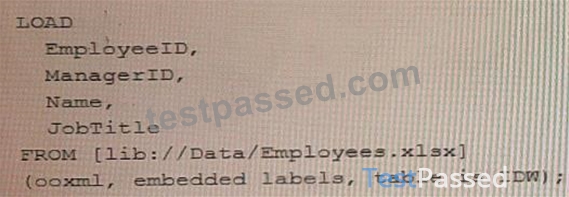
Which two table load prefixes are needed?
- A. * HierarchyBelongs.To(EmployeeID, ManagerlD, Name ManagerlD, Manager, Depth)
- B. *HierarchyLevel(EmployeelD, ManagerlD Name Level, '/', Structure)
*HierarchyBelongsTo(EmployeelD, ManagerlD, Name ManagerlD,Manager, Depth) - C. * HierarchyBelongsTo(ManagerlD, Manager, ManagerlD, ManagerlD, Manager Level)
* Hierarchy(EmployeelD, ManagerlD, Name. Manager Name, Structure '/' Depth) - D. * Hierarchy(EmployeelD. ManagerlD Name, Manager Name, Structure V,Depth)
* HierarchyLevelEmployeelD, ManagerlD, Name, Manager, Name, Structure, Depth '/')
Answer: A
NEW QUESTION # 55 
Refer to the exhibit.
A data architect is loading two tables: Orders and Product. The Product table includes attributes and values for each ProductID such as Colour, Price, Category, and Description.
The business analyst can filter by the value of these attributes. For performance reasons, the Data Model will use two tables.
Which solution should the data architect apply in the Data Load Editor to build the ProductDetails table?
For performance reasons, the Data Model will use two tables a Load Editor to build the ProductDetails table?
- A. Use a For loop to apply a Generic load to the Product table and concatenate the generic tables together
- B. Use a For loop to concatenate all of the Products table and apply a Generic Load to the final concatenate table
- C. Use a Generic Loadin the Product table and a For loop to left join each Generic table
Answer: C
NEW QUESTION # 56
A data architect plans to build an app that contains geographically diverse data that must be specific to user run-time selections. The source contains transactional data. The app must have minimal impact on already limited server resources.
Which approach should the data architect use?
- A. Loop and Reduce
- B. QVDs
- C. ODAG
- D. In-memory
Answer: B
Explanation:
Explanation
Using QVDs is the best approach for this scenario, as it allows the data to be stored in a highly compressed format, which will have minimal impact on server resources. Additionally, QVDs can be loaded quickly, which allows for faster access to the data based on user run-time selections. The other options, Loop and Reduce, In-memory, and ODAG, are not valid strategies for this scenario.
NEW QUESTION # 57
Refer to the exhibit.
A customer needs to load forecast data from an Excel file.
Which preceding load statement should the data architect use to load the data?
- A.

- B.

- C.

- D.

Answer: D
NEW QUESTION # 58
......
The Qlik QSDA2022 certification exam is designed for professionals who want to demonstrate their expertise in Qlik Sense data architecture. This certification exam validates a candidate's ability to design, deploy, and manage data models, create and maintain data connections, and perform data transformations using Qlik Sense. The QSDA2022 certification is suitable for data architects, data analysts, business intelligence developers, and IT professionals who work with Qlik Sense.
QSDA2022 Exam Dumps For Certification Exam Preparation: https://www.testpassed.com/QSDA2022-still-valid-exam.html
Download Free Qlik QSDA2022 Exam Questions & Answer : https://drive.google.com/open?id=1GLPf679juIgR5xee_plIiKwbqFKfzgYT