


FlashArray-Storage-Professional Free Certification Exam Easy to Download PDF Format 2026
Get 100% Success with Latest FlashArray Storage FlashArray-Storage-Professional Exam Dumps
Pure Storage FlashArray-Storage-Professional Exam Syllabus Topics:
| Topic | Details |
|---|---|
| Topic 1 |
|
| Topic 2 |
|
| Topic 3 |
|
| Topic 4 |
|
| Topic 5 |
|
NEW QUESTION # 31
RFC2307 enables cross-protocol support for which two protocols?
- A. NFS, S3
- B. NFS, SMB
- C. S3, SMB
Answer: B
Explanation:
Understanding RFC2307: RFC2307 is an extension to the LDAP (Lightweight Directory Access Protocol) schema that allows for the storage of Unix-style information (POSIX attributes) within a directory service, most commonly Microsoft Active Directory. These attributes include things like uidNumber (User ID), gidNumber (Group ID), and login shells.
The Cross-Protocol Challenge: In a Unified Storage environment where the same data needs to be accessed by both Windows clients (using the SMB protocol) and Linux/Unix clients (using the NFS protocol), the storage array must be able to map a Windows Security Identifier (SID) to a Unix UID/GID.
How Pure Uses It: When an administrator enables RFC2307 support in Purity//FA File Services, the FlashArray can query Active Directory to retrieve these POSIX attributes. This creates a 1:1 mapping between the Windows user and the Unix identity.
The Benefit: This mapping ensures that a user can create a file via SMB and another user (or the same user on a different system) can access or modify that same file via NFS while maintaining consistent permission enforcement and ownership records. Without this (or a similar mapping service like NIS or local files), cross-protocol access often results in permission "Mapping" errors or files being owned by "nobody."
NEW QUESTION # 32
An on-premises mediator has been deployed. When a pod is stretched and replicating, it is observed that the pod is utilizing the Pure1 Cloud Mediator and not the on-premises mediator.
Why is the on-premises mediator NOT being used by this new pod?
- A. The on-premises mediator is NOT available for the ActiveCluster FlashArrays.
- B. No A record exists for an on-premises mediator.
- C. The pod needs to be configured to use the on-premises mediator.
Answer: C
Explanation:
ActiveCluster Mediator Logic: In an ActiveCluster setup, the Mediator is a lightweight component (an "arbiter") that resides at a third site (failure domain). Its job is to break the tie in a "split-brain" scenario (when arrays lose connectivity with each other) to determine which array stays online.
Default Behavior: By default, every FlashArray is configured to use the Pure1 Cloud Mediator. This is a managed service provided by Pure Storage that requires no local infrastructure other than internet access from the array controllers.
On-Premises Mediator Deployment: Organizations that cannot use the Cloud Mediator (due to "dark site" security requirements or lack of reliable internet) can deploy the Pure Storage On-Premises Mediator as a small OVF/VM template.
Configuration at the Pod Level: Simply deploying the On-Premises Mediator VM and connecting the arrays to it at the array level is not enough for existing or new pods to switch automatically. In Purity, the mediator preference is a per-pod attribute.
When a pod is created or stretched, it inherits the default (Cloud).
To use the local mediator, the administrator must explicitly configure the pod to point to the On-Premises Mediator's IP or DNS name. This is done via the CLI using purepod setattr --mediator <address> <pod-name> or through the Pod settings in the GUI.
Why Option C is incorrect: While an A record is necessary for DNS resolution, the prompt implies the mediator is already "deployed" and available. The most common reason it isn't being used is simply that the pod hasn't been told to look there instead of the default Cloud option.
NEW QUESTION # 33
What is the recommended Maximum Transmission Unit (MTU) size for the replication ports on a FlashArray?
- A. 0
- B. 1
- C. 2
Answer: B
Explanation:
Pure Storage strongly recommends an MTU size of 9000 (Jumbo Frames) for replication networks-such as those used for Asynchronous Replication, ActiveCluster, and ActiveDR-as well as for iSCSI and NVMe/TCP data networks.
A 9000-byte MTU significantly reduces protocol overhead and CPU processing load on the storage controllers by allowing a much larger payload of data to be transmitted inside a single network packet. During heavy replication, this drastically increases throughput and maximizes bandwidth efficiency.
Here is why the other options are incorrect:
1500 (B): While 1500 bytes is the standard default MTU for Ethernet and is exactly what Pure Storage recommends for the management ports (vir0), it is not the recommended optimization for high-throughput replication traffic. (Note: If your network cannot support 9000 end-to-end, 1500 must be used to prevent packet fragmentation, but 9000 remains the best-practice recommendation).
4200 (A): This is an arbitrary number and is not a standard network MTU size used in Pure Storage environments.
NEW QUESTION # 34
A FlashArray administrator is configuring new hosts. There is an option in the personality settings for the target OS.
When is the best time to configure the personality for a host in Purity?
- A. Host personalities can be configured at anytime except for the ESXi operating system.
- B. When a host is initially created and before volumes are connected to the host.
- C. After the host has been created and volumes are connected to the host.
Answer: B
Explanation:
Definition of Host Personality: In Purity//FA, a Host Personality is a setting applied to a host object that modifies how the FlashArray communicates with that specific initiator. It ensures the array sends the correct SCSI responses that the target Operating System (OS) expects. Common personalities include ESXi, AIX, HP-UX, and Hitachi-VSP.
The Importance of Timing: The best practice is to set the personality during the host creation phase, before any volumes are attached or I/O has commenced. This ensures that from the very first "Inquiry" command sent by the host, the FlashArray responds with the appropriate settings (such as specific VAAI primitives for ESXi or specific ALUA behaviors for other Unix variants).
Risks of Changing Later: While Purity allows you to change a host personality later, doing so while volumes are connected and I/O is active can be disruptive. For many operating systems, a change in personality requires the host to be rebooted or the storage paths to be "rescanned" to recognize the change in device capabilities.
Default Behavior: If no personality is selected, the FlashArray uses a "Generic" personality suitable for standard Windows and Linux distributions. However, for specialized hypervisors like ESXi, failing to set the personality correctly from the start can lead to performance issues or lack of support for hardware acceleration features.
Why Option C is incorrect: Changing the personality after volumes are connected is reactive rather than proactive. It increases the risk of the host misinterpreting the storage device's capabilities, potentially leading to mount failures or path instability.
NEW QUESTION # 35
A storage administrator has presented VMFS datastores from a FlashArray with 10TB of raw capacity.
Why would the administrator see system space when logging in to the FlashArray GUI?
- A. More than 2TB of volume snapshots were destroyed.
- B. Virtual machines have not yet issued an unmap command.
- C. There is more than 2TB of reclaimable space on the FlashArray.
Answer: C
Explanation:
On a Pure Storage FlashArray, "System Space" is a specific GUI-reported metric. Purity has a predefined, hidden internal space budget-typically around 20% of the raw mapped capacity (which would be 2TB on a 10TB array)-reserved for internal array operations. This budget covers RAID/parity overhead, metadata, and reclaimable space (data from deleted volumes, snapshots, or overwritten blocks that are waiting for the backend garbage collection process to fully erase them from the flash chips).
Normally, this internal overhead stays below the 20% budget, and "System Space" displays as 0.00 in the GUI. However, if an administrator deletes a massive amount of data at once, causing the reclaimable space to exceed that 2TB budget, the overflow is prominently displayed in the GUI as "System Space." Here is why the other options are incorrect:
Virtual machines have not yet issued an unmap command (A): If a VMware VM deletes a file but the OS hasn't issued an UNMAP/TRIM command, the FlashArray is completely unaware that the data was deleted. Therefore, the array continues to report that capacity as standard Volume Space, not System Space.
More than 2TB of volume snapshots were destroyed (C): While destroying snapshots leads to reclaimable space, "reclaimable space" (Option B) is the specific, correct Purity architectural term and metric that the system uses to calculate the internal budget threshold.
NEW QUESTION # 36
What is unified storage for Pure?
- A. FlashArray runs both Block and File level protocols.
- B. FlashArray runs both NFS and SMB protocols.
- C. FlashArray runs both iSCSI and Fibre Channel (FC) protocols.
Answer: A
Explanation:
Definition of Unified Storage: In the storage industry, "Unified Storage" refers to a platform that can natively serve both Block-level storage (accessed via protocols like Fibre Channel, iSCSI, or NVMe-oF) and File-level storage (accessed via protocols like NFS or SMB) from a single pool of capacity and under a single management interface.
Pure Storage Implementation (FA File): Pure Storage achieved unified storage on the FlashArray through the introduction of Purity//FA File Services. Unlike traditional unified storage that often required a "gateway" or separate hardware "heads," Pure's implementation runs natively on the FlashArray controllers.
Shared Resources: On a unified FlashArray, the global storage pool is shared between volumes (Block) and file systems (File). All of Pure's core data services-such as deduplication, compression, and SafeMode snapshots-apply globally across both block and file data.
Protocol Diversity: While Option A mentions NFS and SMB, those are strictly File protocols. Option C mentions iSCSI and FC, which are strictly Block protocols. Only Option B correctly identifies the combination of Block and File, which defines the "Unified" architecture of the FlashArray.
NEW QUESTION # 37
How would a FlashArray administrator view external latency for write requests for a specific volume?
- A. Analysis; Performance; Volumes; Select the appropriate volume; Select "Write" and Deselect "Read" and "Mirrored Write"
- B. Storage; Volumes; Select the appropriate volume; Details
- C. Health; Network; Select the appropriate protocol; Select the appropriate port
Answer: A
Explanation:
The Analysis Tab: In the Pure Storage FlashArray GUI, the Analysis tab is the primary location for deep-dive performance troubleshooting and historical data visualization. While the Storage tab provides a real-time "at-a-glance" view of a volume, the Analysis tab allows for granular filtering of specific metrics.
Granular Metric Filtering: When troubleshooting latency, it is critical to distinguish between Read and Write operations, as they interact with the Purity operating environment differently (e.g., writes hitting NVRAM vs. reads hitting the Flash modules).
External vs. Internal Latency: Pure Storage differentiates between "Array Latency" (internal processing) and "External Latency" (the time seen by the host). By navigating to Analysis > Performance, an administrator can drill down into the Volumes sub-tab.
Selecting the Volume and Operations: Once a specific volume is selected, the chart typically defaults to a combined view. To isolate "external latency for write requests," the administrator must use the legend/filters to select "Write" while deselecting "Read" and "Mirrored Write" (which refers to synchronous replication traffic in ActiveCluster environments). This provides a clean graph of the round-trip write latency specifically for that volume's host I/O.
Why other options are incorrect: Option B refers to physical port health and hardware status, not volume-level performance. Option C provides basic volume metadata and real-time total latency, but lacks the granular historical filtering (selecting/deselecting specific I/O types) required for detailed performance analysis.
NEW QUESTION # 38
A storage administrator is troubleshooting a FlashArray that is critically low on space. They have successfully deleted and eradicated a large volume, but used space keeps increasing.
What is a possible cause?
- A. FlashArray workload is too high, and the reclamation process is not keeping up.
- B. Space decrease won't be seen for 1 day, as the volume is kept for 24 hours as a safeguard.
- C. A host is still connected to the volume so space was not released.
Answer: A
Explanation:
Logical vs. Physical Reclamation: When an administrator "Eradicates" a volume, the FlashArray immediately removes the logical reference to that data. However, the physical blocks are not "wiped" instantly. Instead, those blocks are marked as "eligible for reclamation" by Purity's background Garbage Collection (GC) process.
Workload Prioritization: Purity is designed to prioritize Host I/O (production performance) over background system tasks. If the array is under an extremely high workload (high Load Meter percentage), Purity will automatically throttle the Garbage Collection process to ensure the application latency remains as low as possible.
The "Reclamation Lag": If the incoming write rate from the hosts (new data being written) exceeds the speed at which the throttled GC process can reclaim space from the eradicated volume, the "Used Space" metric will continue to trend upward. This is a common scenario when arrays are pushed to their performance or capacity limits simultaneously.
Why Option A is incorrect: The 24-hour safeguard applies to Destroyed volumes (the "Pending Eradication" bucket). Once an administrator manually clicks Eradicate, that safeguard is bypassed, and the space should logically be freed. If the space is still not reflecting as "Free," it is a back-end processing delay, not a timer delay.
Why Option C is incorrect: In the Purity Operating Environment, the array does not require the host to "unmount" or "disconnect" before it can reclaim space. Once the volume is destroyed and eradicated on the array side, those blocks are gone from the array's perspective, regardless of the host's state (though the host will likely experience I/O errors).
NEW QUESTION # 39
Refer to the exhibit: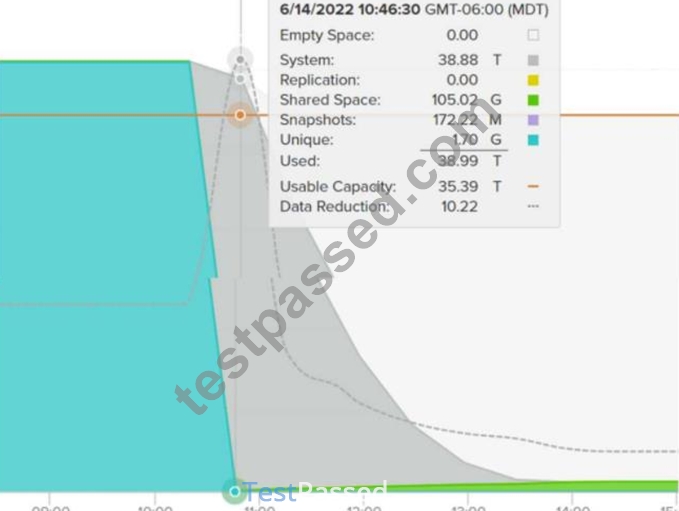
What is the most likely cause of system space in this capacity graph?
- A. SafeMode was enabled on the system.
- B. Space reclamation stopped working properly.
- C. Large volume destroyed and eradicated.
Answer: C
Explanation:
Analyzing the Graph: The provided capacity graph shows a sharp, vertical drop in Unique and Shared space (the teal/green sections) at approximately 10:45. Simultaneously, there is a massive spike in System space (the grey shaded area).
The "System" Space Spike: In Purity, when a volume is deleted and eradicated, the data isn't physically wiped from the flash modules instantly. Instead, the logical references are removed, and the blocks are moved into a "Pending Reclamation" state. In older versions of Purity reporting (or specific views), this pending work is often categorized under System space until the background Garbage Collection (GC) process can physically reclaim it.
The Decay Curve: Notice the grey "System" area gradually tapers down over the following hours (from 11:00 to 14:00). This is the visual representation of the array's Garbage Collection engine working in the background to physically free up those blocks.
Why Option C is incorrect: If SafeMode were enabled, the space would not move into "System" space in this manner; it would remain locked in the Snapshots or Destroyed bucket for the duration of the retention period, preventing the graph from dropping at all.
Why Option A is incorrect: If space reclamation stopped working, the grey "System" area would stay flat and would not decay over time. The fact that it is trending downward proves that reclamation is actively processing the deleted volume.
NEW QUESTION # 40
If an NFS client can mount the FA File export shares with the IP address, but not the fully qualified domain name, what is most likely causing the issue?
- A. Issue with the DNS
- B. Issue with the OpenLDAP
- C. Issue with the Active Directory (AD) controller
Answer: A
Explanation:
When an NFS client successfully mounts an export using the target's IP address, it proves that the fundamental network connectivity (routing, firewalls) and the storage protocol layer (NFS export policies, host access permissions) are functioning correctly.
However, if the exact same mount attempt fails when using the Fully Qualified Domain Name (FQDN) of the FlashArray file service, the issue lies entirely with name resolution. The Domain Name System (DNS) is responsible for translating human-readable FQDNs into the IP addresses required for network communication. If the client cannot reach the DNS server, or if the DNS server lacks the correct A or AAAA records for the FlashArray's file Virtual IP (VIP) addresses, the client won't be able to resolve the name to the IP, causing the mount command to fail.
Here is why the other options are incorrect:
Issue with the Active Directory (AD) controller (A): Active Directory is primarily used for directory services, user authentication, and authorization (such as mapping permissions for SMB or NFSv4). While AD environments usually include DNS, an "AD controller issue" in the context of storage protocols usually points to permission denials, not host name resolution failures. Furthermore, since the mount works via IP, basic access is already validated.
Issue with the OpenLDAP (C): Similar to AD, OpenLDAP provides directory services for user mappings (UID/GID) and authentication. It does not perform FQDN-to-IP resolution.
NEW QUESTION # 41
An administrator setup replicated snapshots for a protection group last week. They left the local snapshot schedule disabled.
How many snapshots are stored locally on the source array?
- A. 0
- B. All of the replicated snapshots are also stored locally.
- C. 1
Answer: B
Explanation:
Replication Fundamentals: On a Pure Storage FlashArray, replication is a snapshot-based process. To replicate a Protection Group (pgroup) to a target array, the system must first create a point-in-time snapshot of the volumes within that group on the source array.
The "Immutable" Rule: Even if the Local Snapshot Schedule is disabled, the act of replicating requires the existence of a local snapshot to serve as the "base" or "source" for the data transfer. Purity does not stream data directly from the active volume to the wire; it creates a snapshot and then replicates the unique blocks contained in that snapshot.
Accounting for Local Copies: When a Protection Group is configured for replication, every snapshot generated by the Replication Schedule is stored locally on the source array. These snapshots will remain on the source array until they are aged out according to the Local Retention policy (even if the local schedule itself is off, the retention policy still applies to those replicated snapshots).
Visibility: If you navigate to the Protection Group in the Purity GUI, you will see these snapshots listed under the "Snapshots" tab. They are functionally identical to local snapshots, meaning they can be used for local clones or restores without needing to pull data back from the target array.
Why Option A and C are incorrect: * Option A: If 0 snapshots were stored, there would be nothing to replicate.
Option C: While Purity uses the most recent snapshot as a reference for delta-tracking, it keeps the entire history of snapshots defined by your retention policy, not just a single one.
NEW QUESTION # 42
Which FA File Directory Services statement is correct?
- A. FA File uses management interfaces as default for directory service communication.
- B. FA File uses file service interfaces as default for directory service communication.
- C. FA File uses all network interfaces for DNS and directory service communication.
Answer: B
Explanation:
Interface Separation: Pure Storage FlashArrays distinguish between Management traffic (used for the GUI, CLI, and Pure1 connectivity) and Data traffic (used for host connectivity). Within the data path, File Service Interfaces are the logical interfaces assigned to handle NFS and SMB traffic.
Directory Service Communication: For FA File to function, it must communicate with external identity providers (like Microsoft Active Directory or OpenLDAP) to authenticate users and resolve permissions.
The Default Path: By design, Purity prioritizes the File Service Interfaces for these lookups. This is because the directory servers (Domain Controllers) are typically located on the same production/data network as the clients accessing the files. Using the File Service Interface ensures that authentication traffic follows the same network path and security rules as the data traffic itself.
Why Option B is incorrect: While the array management plane can use the management interfaces for its own administrative LDAP/SAML logins, the File Services component defaults to the data-path (File) interfaces to avoid "crossing the streams" between management and production data networks.
Why Option C is incorrect: Purity is very specific about its routing tables. It does not blindly use "all" interfaces for DNS/Directory services. If a File Service interface is configured and active, it becomes the primary egress point for file-related metadata and authentication requests.
NEW QUESTION # 43
A storage administrator is tasked with providing real-time data and alerts to the Network Operations Center (NOC) dashboard.
What source should the information come from to provide real-time data?
- A. Pure Performance Monitoring
- B. FlashArray
- C. Pure1
Answer: B
Explanation:
To provide true real-time data and alerts directly to a Network Operations Center (NOC) dashboard, the information must be sourced directly from the FlashArray. The FlashArray's Purity operating environment natively supports real-time data streaming and alerting integrations via protocols like Syslog, SNMP traps, and the local REST API. Polling the array directly or configuring it to push alerts guarantees that the NOC receives instantaneous, up-to-the-second notifications regarding array health, hardware faults, and performance metrics.
Here is why the other options are incorrect:
Pure1 (B): While Pure1 is Pure Storage's powerful, cloud-based monitoring and predictive analytics platform, it relies on phone-home telemetry data. This telemetry is batched and transmitted from the array to the Pure1 cloud on a short polling interval (typically a few minutes). Because of this transmission and processing interval, Pure1 provides near-real-time (lagging by a few minutes) and historical data. It is excellent for global fleet management and predictive support, but not for instantaneous, zero-latency NOC alerting.
Pure Performance Monitoring (A): This is a distractor. There is no standalone product or specific protocol in the Pure Storage ecosystem officially named "Pure Performance Monitoring." Performance monitoring is simply a feature accessed via the FlashArray GUI/CLI or the Pure1 platform.
NEW QUESTION # 44
An administrator is setting up FA File using the FlashArray GUI. The company is an NFS only shop and needs to configure their remote user authentication.
Which of the following GUI locations should the administrator use to configure access?
- A. Settings > Access > File System
- B. Settings > Access > Directory Services
- C. Settings > Access > Create Active Directory Account
Answer: B
Explanation:
For FlashArray File Services (FA File), user authentication and mapping depend on the storage protocol being used. In an NFS-only environment, remote user authentication (resolving UNIX UIDs and GIDs to actual usernames and managing access) is typically handled via LDAP or NIS.
To configure this integration in the Purity GUI, the storage administrator must navigate to Settings > Access > Directory Services. This specific section allows the FlashArray to connect to a centralized directory server (such as OpenLDAP or even Active Directory providing LDAP services) to pull the necessary UNIX user and group attributes required for NFS file permissions to function properly.
Here is why the other options are incorrect:
Settings > Access > Create Active Directory Account (A): This specific menu path is used strictly for configuring native Active Directory (AD) computer accounts and joining the domain to support the SMB (Server Message Block) protocol. Since the scenario explicitly states the company is an "NFS only shop," configuring an SMB AD account is not the correct step.
Settings > Access > File System (C): While you manage file-level exports and policies within the Purity file interface, the global configuration for remote user authentication and directory server integration lives under the dedicated Directory Services pane.
NEW QUESTION # 45
How is SAN Time measured?
- A. Average time, measured in milliseconds, that an IO request spends waiting to synchronize to the peer array.
- B. Average time, measured in milliseconds, that an I/O request spends in the array waiting to be served.
- C. Average time, measured in milliseconds, required to transfer data between the initiator and the array.
Answer: C
Explanation:
Understanding Total Latency: In a FlashArray environment, total latency as seen by the host application is the sum of several components. Pure Storage breaks this down into Array Time and SAN Time to help administrators pinpoint where performance bottlenecks exist.
SAN Time Definition: SAN Time represents the latency introduced by the network infrastructure between the host (initiator) and the FlashArray (target). This includes the time spent traveling across Fibre Channel or Ethernet switches, cables, and host bus adapters (HBAs). It is calculated by taking the total round-trip time measured by the host and subtracting the time the FlashArray spent processing the I/O.
Metric Breakdown: * Array Time: The time the FlashArray takes to process the I/O once it hits the front-end ports (Option C describes internal array time).
SAN Time: The transit time for the request to reach the array and the response to return to the host (Option A).
Wait Time: In ActiveCluster environments, there is also "Mirror Latency," which is the time spent synchronizing data to a peer array (Option B).
Troubleshooting Value: If a user reports high latency but the FlashArray GUI shows very low Array Time, the administrator can look at the SAN Time metric. A high SAN Time indicates an issue with the fabric, such as a failing SFP, a congested switch port, or oversubscribed ISLs (Inter-Switch Links).
NEW QUESTION # 46
In Pure Protect //DRaaS, the administrator modified the business policy used for backups, reducing the "DR Retention" from 7 days to 3 days. The DR target environment currently has 7 days of backups.
What will occur?
- A. Earlier backups will be retained until they expire according to the pre-modification policy, with new backups following the updated policy.
- B. The change will error out, requiring manual expiration of backups older than 3 days.
- C. Earlier backups will be erased to match the modified policy.
Answer: C
Explanation:
Policy-Driven Automation: Pure Protect //DRaaS (Disaster Recovery as a Service) is built on a declarative policy engine. When you define a business policy (Protection Group or similar policy-based management), the system's primary goal is to bring the environment into compliance with the "Desired State" defined by that policy.
Retention Enforcement: When the retention period is reduced (e.g., from 7 days down to 3 days), the Purity/Pure Protect engine identifies that any existing snapshots or backups older than the new 3-day threshold are now "out of policy." Immediate Reclamation: Unlike some legacy backup systems that only apply new retention settings to future backups, Pure Storage's policy-driven architecture typically triggers an immediate cleanup of the now-obsolete data to reclaim space on the target. This ensures the environment matches the modified policy requirements immediately upon the policy update.
SafeMode Considerations: If SafeMode is enabled on the target, these "erased" backups will actually move into the "Destroyed" (but not yet eradicated) bucket for the duration of the SafeMode timer, providing a safety net against accidental policy changes or malicious deletions. However, from the perspective of the active DR policy, they are removed.
NEW QUESTION # 47
What is the proper configuration method to connect a volume to multiple hosts?
- A. Connect the volume to a host group.
- B. Connect a volume group to the host.
- C. Connect the volume to each individual host.
Answer: A
Explanation:
In Pure Storage Purity OS, the absolute best practice and proper configuration method for sharing a single volume across multiple hosts-such as a VMware ESXi cluster or a Microsoft Windows Server Failover Cluster (WSFC)-is to connect the volume to a Host Group.
When you create a Host Group, you add the individual Host objects (which contain the WWPNs, IQNs, or NQNs) into that group. When a volume is then connected to the Host Group, Purity automatically ensures that the volume is presented to every host in that group using the exact same LUN ID. Consistent LUN IDs across all nodes in a cluster are a strict requirement for clustered file systems like VMFS and Cluster Shared Volumes (CSV) to function correctly and prevent data corruption.
Here is why the other options are incorrect:
Connect the volume to each individual host (C): This is known as creating "private connections." If you manually connect a shared volume to multiple hosts individually, Purity might assign a different LUN ID to the volume for each host. Inconsistent LUN IDs will cause clustered operating systems to fail to recognize the disk as a shared resource. Private connections should only be used for boot LUNs or standalone standalone servers.
Connect a volume group to the host (B): In Purity, a "Volume Group" is a logical container used for applying consistent snapshot policies, replication schedules, or ActiveCluster configurations to a set of related volumes (like a database and its log files). Volume groups are not used for host presentation or access control.
NEW QUESTION # 48
An administrator is attempting to add a volume to a volume group but it does not show up in the list of volumes available to move in, even though it does show up in the volumes pane.
Why is the volume missing?
- A. It is already part of another volume group.
- B. It is already part of a Protection Group.
- C. It is protected by SafeMode.
Answer: A
Explanation:
In the Pure Storage Purity operating environment, a volume can only be a member of one Volume Group at a time.
When an administrator navigates to a Volume Group in the GUI and clicks to add members, the system filters the inventory and only displays volumes that are currently "unassigned" (not belonging to any Volume Group). If a volume is already residing inside another Volume Group, Purity intentionally hides it from this available list to prevent conflicting overlapping memberships. To resolve this, the administrator must first navigate to the volume's current Volume Group, remove the volume from that group, and then it will become available to add to the new one.
Here is why the other options are incorrect:
It is already part of a Protection Group (B): Protection Groups (pgroups) manage snapshot and replication schedules. A volume can absolutely be a standalone member of a Protection Group while simultaneously being added to a Volume Group. Being in a pgroup does not hide it from the vgroup selection list.
It is protected by SafeMode (C): SafeMode is a ransomware protection feature that prevents the manual eradication of destroyed volumes and snapshots before their retention timer expires. It does not dictate or restrict logical organizational containers like Volume Groups.
NEW QUESTION # 49
......
Get Ready to Pass the FlashArray-Storage-Professional exam Right Now Using Our FlashArray Storage Exam Package: https://www.testpassed.com/FlashArray-Storage-Professional-still-valid-exam.html