


2021 Valid AI-900 test answers & Microsoft Exam PDF
Free Microsoft AI-900 Exam Questions & Answer from Training Expert TestPassed
Explain Computer Vision Workloads Features on Azure (15-20%)
Here, the following skills will be measured:
- Identify Azure services & tools for Computer Vision Projects – This section requires that the learners identify different capabilities of Computer Vision service, Face service, Customer Vision service, and Form Recognizer service.
- Identify the basic types of Computer Vision Solution – The candidates need to understand and be able to identify a range of features. They include image classification solutions, semantic segmentation solutions, object detection solutions, and optical attributes recognition solutions. It also covers the attributes of facial recognition, facial analysis, and facial detection solutions.
NEW QUESTION 80
You have a database that contains a list of employees and their photos.
You are tagging new photos of the employees.
For each of the following statements select Yes if the statement is true. Otherwise, select No.
NOTE: Each correct selection is worth one point.
Answer:
Explanation:
Explanation
Reference:
https://docs.microsoft.com/en-us/azure/cognitive-services/face/overview
https://docs.microsoft.com/en-us/azure/cognitive-services/face/concepts/face-detection
NEW QUESTION 81
To complete the sentence, select the appropriate option in the answer area.
Answer:
Explanation:
Reference:
https://docs.microsoft.com/en-us/azure/machine-learning/concept-designer#deploy
NEW QUESTION 82
Which type of machine learning should you use to predict the number of gift cards that will be sold next month?
- A. regression
- B. clustering
- C. classification
Answer: A
Explanation:
Section: Describe fundamental principles of machine learning on Azure
Explanation:
In the most basic sense, regression refers to prediction of a numeric target.
Linear regression attempts to establish a linear relationship between one or more independent variables and a numeric outcome, or dependent variable.
You use this module to define a linear regression method, and then train a model using a labeled dataset. The trained model can then be used to make predictions.
Reference:
https://docs.microsoft.com/en-us/azure/machine-learning/studio-module-reference/linear-regression
NEW QUESTION 83
For each of the following statements, select Yes if the statement is true. Otherwise, select No.
NOTE: Each correct selection is worth one point.
Answer:
Explanation:
Explanation:
Box 1: Yes
Azure bot service can be integrated with the powerful AI capabilities with Azure Cognitive Services.
Box 2: Yes
Azure bot service engages with customers in a conversational manner.
Box 3: No
The QnA Maker service creates knowledge base, not Question: 55
Note: You can use the QnA Maker service and a knowledge base to add Question:-and-answer support to your bot. When you create your knowledge base, you seed it with Questions and answers.
Reference:
https://docs.microsoft.com/en-us/azure/bot-service/bot-builder-tutorial-add-qna
NEW QUESTION 84
You need to predict the sea level in meters for the next 10 years.
Which type of machine learning should you use?
- A. regression
- B. clustering
- C. classification
Answer: A
Explanation:
Explanation
In the most basic sense, regression refers to prediction of a numeric target.
Linear regression attempts to establish a linear relationship between one or more independent variables and a numeric outcome, or dependent variable.
You use this module to define a linear regression method, and then train a model using a labeled dataset. The trained model can then be used to make predictions.
Reference:
https://docs.microsoft.com/en-us/azure/machine-learning/studio-module-reference/linear-regression Regression is a form of machine learning that is used to predict a numeric label based on an item's features.
https://docs.microsoft.com/en-us/learn/modules/create-regression-model-azure-machine-learning-designer/introd
NEW QUESTION 85
For each of the following statements, select Yes if the statement is true. Otherwise, select No.
NOTE: Each correct selection is worth one point.
Answer:
Explanation:
Explanation
Box 1: Yes
Content Moderator is part of Microsoft Cognitive Services allowing businesses to use machine assisted moderation of text, images, and videos that augment human review.
The text moderation capability now includes a new machine-learning based text classification feature which uses a trained model to identify possible abusive, derogatory or discriminatory language such as slang, abbreviated words, offensive, and intentionally misspelled words for review.
Box 2: No
Azure's Computer Vision service gives you access to advanced algorithms that process images and return information based on the visual features you're interested in. For example, Computer Vision can determine whether an image contains adult content, find specific brands or objects, or find human faces.
Box 3: Yes
Natural language processing (NLP) is used for tasks such as sentiment analysis, topic detection, language detection, key phrase extraction, and document categorization.
Sentiment Analysis is the process of determining whether a piece of writing is positive, negative or neutral.
Reference:
https://azure.microsoft.com/es-es/blog/machine-assisted-text-classification-on-content-moderator-public-preview
https://docs.microsoft.com/en-us/azure/architecture/data-guide/technology-choices/natural-language-processing
NEW QUESTION 86
You use Azure Machine Learning designer to publish an inference pipeline.
Which two parameters should you use to consume the pipeline? Each correct answer presents part of the solution.
NOTE: Each correct selection is worth one point.
- A. the model name
- B. the REST endpoint
- C. the authentication key
- D. the training endpoint
Answer: A,B
Explanation:
Explanation
A: The trained model is stored as a Dataset module in the module palette. You can find it under My Datasets.
Azure Machine Learning designer lets you visually connect datasets and modules on an interactive canvas to create machine learning models.
D: You can consume a published pipeline in the Published pipelines page. Select a published pipeline and find the REST endpoint of it.
Reference:
https://docs.microsoft.com/en-us/azure/machine-learning/how-to-run-batch-predictions-designer
https://docs.microsoft.com/en-us/azure/machine-learning/concept-designer
NEW QUESTION 87
You are developing a model to predict events by using classification.
You have a confusion matrix for the model scored on test data as shown in the following exhibit.
Use the drop-down menus to select the answer choice that completes each statement based on the information presented in the graphic.
NOTE: Each correct selection is worth one point.
Answer:
Explanation:
Explanation
Box 1: 11
TP = True Positive.
The class labels in the training set can take on only two possible values, which we usually refer to as positive or negative. The positive and negative instances that a classifier predicts correctly are called true positives (TP) and true negatives (TN), respectively. Similarly, the incorrectly classified instances are called false positives (FP) and false negatives (FN).
Box 2: 1,033
FN = False Negative
Reference:
https://docs.microsoft.com/en-us/azure/machine-learning/studio/evaluate-model-performance Finding TP is easy. It basically means the value where Predicted and True value is 1 and that is 11 in this case.
False Negative means where true value was 1 but predicted value was 0 and that is 1033 in this case The confusion matrix shows cases where both the predicted and actual values were 1 (known as true positives) at the top left, and cases where both the predicted and the actual values were 0 (true negatives) at the bottom right. The other cells show cases where the predicted and actual values differ (false positives and false negatives).
https://docs.microsoft.com/en-us/learn/modules/create-classification-model-azure-machine-learning-designer/eva
NEW QUESTION 88
You have a dataset that contains information about taxi journeys that occurred during a given period.
You need to train a model to predict the fare of a taxi journey. What should you use as a feature?
- A. the fare of individual taxi journeys
- B. the number of taxi journeys in the dataset
- C. the trip ID of individual taxi journeys
- D. the trip distance of individual taxi journeys
Answer: D
Explanation:
The label is the column you want to predict. The identified Featuresare the inputs you give the model to predict the Label.
Example:
The provided data set contains the following columns:
passenger_count: The number of passengers on the trip is a feature.
trip_time_in_secs: The amount of time the trip took. You want to predict the fare of the trip before the trip is completed. At that moment, you don't know how long the trip would take. Thus, the trip time is not a feature and you'll exclude this column from the model.
trip_distance: The distance of the trip is a feature.
payment_type: The payment method (cash or credit card) is a feature. fare_amount: The total taxi fare paid is the label.
Reference:
https://docs.microsoft.com/en-us/dotnet/machine-learning/tutorials/predict-prices
NEW QUESTION 89
You need to provide content for a business chatbot that will help answer simple user queries.
What are three ways to create question and answer text by using QnA Maker? Each correct answer presents a complete solution.
NOTE: Each correct selection is worth one point.
- A. Use automated machine learning to train a model based on a file that contains the questions.
- B. Manually enter the questions and answers.
- C. Generate the questions and answers from an existing webpage.
- D. Connect the bot to the Cortana channel and ask questions by using Cortana.
- E. Import chit-chat content from a predefined data source.
Answer: B,C,E
Explanation:
Section: Describe features of conversational AI workloads on Azure
Explanation:
Automatic extraction
Extract question-answer pairs from semi-structured content, including FAQ pages, support websites, excel files, SharePoint documents, product manuals and policies.
Reference:
https://docs.microsoft.com/en-us/azure/cognitive-services/qnamaker/concepts/content-types
NEW QUESTION 90
You plan to apply Text Analytics API features to a technical support ticketing system.
Match the Text Analytics API features to the appropriate natural language processing scenarios.
To answer, drag the appropriate feature from the column on the left to its scenario on the right. Each feature may be used once, more than once, or not at all.
NOTE: Each correct selection is worth one point.
Answer:
Explanation:
Explanation:
Box1: Sentiment analysis
Sentiment Analysis is the process of determining whether a piece of writing is positive, negative or neutral.
Box 2: Broad entity extraction
Broad entity extraction: Identify important concepts in text, including key Key phrase extraction/ Broad entity extraction: Identify important concepts in text, including key phrases and named entities such as people, places, and organizations.
Box 3: Entity Recognition
Named Entity Recognition: Identify and categorize entities in your text as people, places, organizations, date/time, quantities, percentages, currencies, and more. Well-known entities are also recognized and linked to more information on the web.
Reference:
https://docs.microsoft.com/en-us/azure/architecture/data-guide/technology-choices/natural-language-processing
https://azure.microsoft.com/en-us/services/cognitive-services/text-analytics
NEW QUESTION 91
You send an image to a Computer Vision API and receive back the annotated image shown in the exhibit.
Which type of computer vision was used?
- A. optical character recognition (OCR)
- B. object detection
- C. image classification
- D. semantic segmentation
Answer: B
Explanation:
Explanation
Object detection is similar to tagging, but the API returns the bounding box coordinates (in pixels) for each object found. For example, if an image contains a dog, cat and person, the Detect operation will list those objects together with their coordinates in the image. You can use this functionality to process the relationships between the objects in an image. It also lets you determine whether there are multiple instances of the same tag in an image.
The Detect API applies tags based on the objects or living things identified in the image. There is currently no formal relationship between the tagging taxonomy and the object detection taxonomy. At a conceptual level, the Detect API only finds objects and living things, while the Tag API can also include contextual terms like
"indoor", which can't be localized with bounding boxes.
Reference:
https://docs.microsoft.com/en-us/azure/cognitive-services/computer-vision/concept-object-detection
NEW QUESTION 92
To complete the sentence, select the appropriate option in the answer area.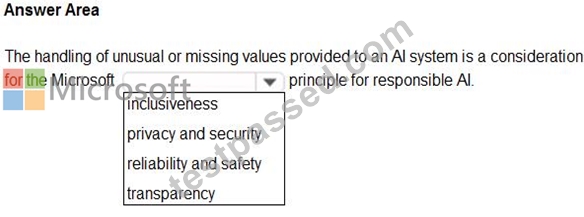
Answer:
Explanation:
NEW QUESTION 93
To complete the sentence, select the appropriate option in the answer area.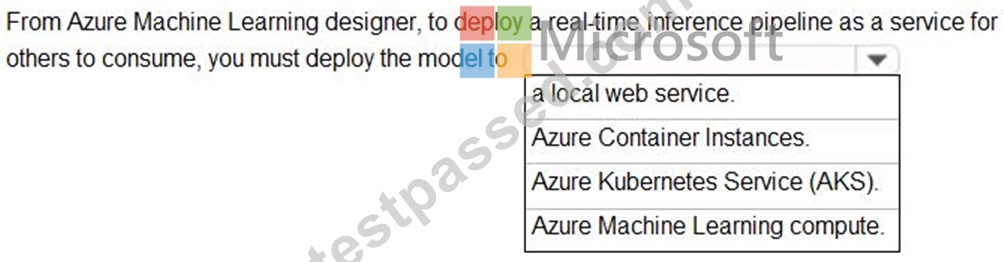
Answer:
Explanation:
Explanation:
To perform real-time inferencing, you must deploy a pipeline as a real-time endpoint. Real-time endpoints must be deployed to an Azure Kubernetes Service cluster.
Reference:
https://docs.microsoft.com/en-us/azure/machine-learning/concept-designer#deploy
NEW QUESTION 94
For each of the following statements, select Yes if the statement is true. Otherwise, select No.
NOTE: Each correct selection is worth one point.
Answer:
Explanation:
Reference:
https://azure.microsoft.com/es-es/blog/machine-assisted-text-classification-on-content-moderator-public-preview/
https://docs.microsoft.com/en-us/azure/architecture/data-guide/technology-choices/natural-language-processing
NEW QUESTION 95
For each of the following statements, select Yes if the statement is true. Otherwise, select No.
NOTE: Each correct selection is worth one point.
Answer:
Explanation:
Explanation:
Box 1: Yes
Content Moderator is part of Microsoft Cognitive Services allowing businesses to use machine assisted moderation of text, images, and videos that augment human review.
The text moderation capability now includes a new machine-learning based text classification feature which uses a trained model to identify possible abusive, derogatory or discriminatory language such as slang, abbreviated words, offensive, and intentionally misspelled words for review.
Box 2: No
Azure's Computer Vision service gives you access to advanced algorithms that process images and return information based on the visual features you're interested in. For example, Computer Vision can determine whether an image contains adult content, find specific brands or objects, or find human faces.
Box 3: Yes
Natural language processing (NLP) is used for tasks such as sentiment analysis, topic detection, language detection, key phrase extraction, and document categorization.
Sentiment Analysis is the process of determining whether a piece of writing is positive, negative or neutral.
Reference:
https://azure.microsoft.com/es-es/blog/machine-assisted-text-classification-on-content-moderator-public-preview/
https://docs.microsoft.com/en-us/azure/architecture/data-guide/technology-choices/natural-language-processing
NEW QUESTION 96
To complete the sentence, select the appropriate option in the answer area.
Answer:
Explanation:
Explanation:
In the most basic sense, regression refers to prediction of a numeric target.
Linear regression attempts to establish a linear relationship between one or more independent variables and a numeric outcome, or dependent variable.
You use this module to define a linear regression method, and then train a model using a labeled dataset. The trained model can then be used to make predictions.
Incorrect Answers:
Classification is a machine learning method that uses data to determine the category, type, or class of an item or row of data.
Clustering, in machine learning, is a method of grouping data points into similar clusters. It is also called segmentation.
Over the years, many clustering algorithms have been developed. Almost all clustering algorithms use the features of individual items to find similar items. For example, you might apply clustering to find similar people by demographics. You might use clustering with text analysis to group sentences with similar topics or sentiment.
Reference:
https://docs.microsoft.com/en-us/azure/machine-learning/algorithm-module-reference/linear-regression
https://docs.microsoft.com/en-us/azure/machine-learning/studio-module-reference/machine-learning-initialize- model-clustering
NEW QUESTION 97
You have the following dataset.
You plan to use the dataset to train a model that will predict the house price categories of houses.
What are Household Income and House Price Category? To answer, select the appropriate option in the answer area.
NOTE: Each correct selection is worth one point.
Answer:
Explanation:
Reference:
https://docs.microsoft.com/en-us/azure/machine-learning/studio/interpret-model-results
NEW QUESTION 98
Which AI service should you use to create a bot from a frequently asked questions (FAQ) document?
- A. QnA Maker
- B. Text Analytics
- C. Speech
- D. Language Understanding (LUIS)
Answer: A
Explanation:
Section: Describe features of conversational AI workloads on Azure
NEW QUESTION 99
To complete the sentence, select the appropriate option in the answer area.
Answer:
Explanation:
Reference:
https://docs.microsoft.com/en-us/azure/cloud-adoption-framework/innovate/best-practices/trusted-ai
NEW QUESTION 100
Your company is exploring the use of voice recognition technologies in its smart home devices. The company wants to identify any barriers that might unintentionally leave out specific user groups.
This an example of which Microsoft guiding principle for responsible AI?
- A. accountability
- B. inclusiveness
- C. privacy and security
- D. fairness
Answer: B
Explanation:
Section: Describe Artificial Intelligence workloads and considerations
Explanation/Reference:
https://docs.microsoft.com/en-us/learn/modules/responsible-ai-principles/4-guiding-principles
NEW QUESTION 101
......
Preparation Process
Microsoft offers a wide range of resources to help you prepare for your certification exam. The first step in the preparation process is to go through the topics in detail. This will enable you to understand the specific areas that are covered in the test. With this understanding, you can start to get the materials that will provide more knowledge on the objectives. Thus, Microsoft comes with two training options to help the candidates develop the required skills. These are free online training and instructor-led training.
- Instructor-Led Training: The Microsoft Azure AI Fundamentals course is designed to help you gain the required skills to pass the exam and obtain the certification. It introduces the learners to the fundamental concepts of AI and the services available in Microsoft Azure that are useful in creating AI solutions. This training is delivered by the certified partners and its details can be found on the Microsoft website. It is important to mention that this course is designed to be combined with other online materials that are available on the Microsoft Learning platform.
- Free Online Training: The individuals can explore five free training tutorials that are available on the official exam webpage. They have a series of modules that focus on the specific domains of the test. These training tutorials are recommended for those candidates who are comfortable with the self-paced study. The topics of these manuals include the following options:
- Get Started with AI on Azure;
- Create No-Code Predictive Models with Azure ML;
- Explore NLP;
- Explore Computer Vision on Microsoft Azure;
- Explore Conversational Artificial Intelligence.
The students can find the details of these learning paths on the official website.
- Practice Test: As a future examinee, you also have access to the official practice test to evaluate your understanding of the exam topics before taking the actual test. The link to this training tool can be found on the Microsoft website.
The Microsoft AI-900 exam, usually known as the Microsoft Azure AI Fundamentals, is well suited to baseline-level IT specialists with knowledge of artificial intelligence (AI) & Machine Learning (ML), and the relevant Microsoft Azure concepts. This is the only test that you should pass to qualify for the Microsoft Certified: Azure AI Fundamentals certification.
Top Microsoft AI-900 Courses Online: https://www.testpassed.com/AI-900-still-valid-exam.html
AI-900 Practice Dumps - Verified By TestPassed Updated 140 Questions: https://drive.google.com/open?id=1XTPRLEggQgbb34SpHAPKhbN_FU7IJASw