


PASS NCP-CI-AWS exam with Nutanix Real Exam Questions - 100% Valid!
Actual NCP-CI-AWS Exam Recently Updated Questions with Free Demo
Nutanix NCP-CI-AWS Exam Syllabus Topics:
| Topic | Details |
|---|---|
| Topic 1 |
|
| Topic 2 |
|
| Topic 3 |
|
| Topic 4 |
|
NEW QUESTION # 23
An administrator wants to route the outbound and inbound traffic from the NC2 cluster through a proxy server. Which two statements are correct about using a proxy server? (Choose two.)
- A. The proxy server must be configured only while creating a cluster because the proxy server settings cannot be configured after the cluster is deployed.
- B. The proxy configuration can be changed while tasks for adding or removing nodes are in progress.
- C. NC2 clusters using Flow Virtual Networking do not support a proxy server.
- D. A proxy server is only supported with AOS 6.7.1.6 or higher versions and only with user-created VPCs.
Answer: C,D
NEW QUESTION # 24
In which two ways should an NC2 on AWS cluster be hibernated manually? (Choose two.)
- A. Log into Prism, Central, navigate to Planning, find hibernate and resume.
- B. Log into Prism Element navigate to Settings and select Hibernate/Resume.
- C. Select the cluster under NC2 console and Select Hibernate/Resume on the cluster sur page.
- D. Log into NC2 console, find the cluster name and select Hibernate/Resume from the ellipses.
Answer: C,D
Explanation:
To manually hibernate an NC2 on AWS cluster, the administrator can use the following methods:
Select the cluster under NC2 console and Select Hibernate/Resume on the cluster sur page: Navigate to the specific cluster in the NC2 console and use the provided Hibernate/Resume option.
Log into NC2 console, find the cluster name and select Hibernate/Resume from the ellipses: Access the NC2 console, locate the cluster name, and select the Hibernate/Resume option from the ellipses (three dots) menu.
These options allow for the manual control of the cluster's hibernation state directly within the NC2 console interface.
Reference:
Nutanix Cloud Clusters on AWS Administration
Nutanix Support & Insights
NEW QUESTION # 25
An administrator is tasked with deploying a VM in an NC2 cluster on AWS that needs to by accessed by resources within the on-premises datacenter.
The cluster has the following characteristics:
* 8 nodes
* Resides in the us-east-1a Availability Zone
* Contains 13 Subnets
* Has access to a Direct Connect connection
* Subnet that the User VM (UVM) is being deployed to:UserVM_subnet
There are multiple VMs within the cluster and the UserVM_subnet has access to the on-premises resources.
The administrator deploys the machine, but communication is not possible.
What is the most likely resolution for this situation?
- A. The AWS UVM Security Group requires the new application's ports adding to inbound traffic.
- B. The AWS Internal Management Security Group requires the new application's ports adding to outbound traffic.
- C. The AWS IGW requires the new application's ports adding to inbound traffic.
- D. The AWS User Management Security Group requires the new application's ports adding to and traffic
Answer: A
Explanation:
For a VM deployed in an NC2 cluster on AWS to be accessed by resources within the on-premises datacenter, the security group associated with the User VM (UVM) subnet must allow inbound traffic on the specific ports required by the application.
If the security group rules do not permit inbound traffic on these ports, the communication will fail, even if other network configurations are correct.
The administrator should ensure that the UVM Security Group includes rules to allow inbound traffic for the application's required ports, facilitating proper communication between the VM and on-premises resources.
Reference:
Refer to the AWS documentation on security group configurations and Nutanix NC2 documentation for details on configuring network access and security group rules.
NEW QUESTION # 26
An administrator has been asked to create a cluster to support new workloads.
What are the maximum number of nodes supported in AWS?
- A. 24 nodes
- B. 28 nodes
- C. 18 nodes
- D. 14 nodes
Answer: A
Explanation:
The maximum number of nodes supported in an NC2 cluster on AWS is 24 nodes. This limit ensures optimal performance and manageability within the AWS infrastructure while leveraging the benefits of the Nutanix architecture.
Reference:
Nutanix Clusters on AWS Deployment Guide
Nutanix Support & Insights
NEW QUESTION # 27
An administrator is planning an NC2 deployment and wants to connect to AWS Services privately from the corporate VPC without going through the public internet.
Which connectivity solution should the administrator use?
- A. Gateway Endpoint
- B. Point-to-Site VPN
- C. Site-to-Site VPN
- D. VTEP Gateways
Answer: A
Explanation:
Gateway Endpoint:
A Gateway Endpoint in AWS allows you to connect to supported AWS services privately without going through the public internet. This setup provides secure and efficient connectivity directly from the corporate VPC to the required AWS services.
Gateway Endpoints support services such as Amazon S3 and DynamoDB and are ideal for scenarios where private connectivity to these services is needed.
Reference:
Refer to the AWS documentation on VPC endpoints, specifically Gateway Endpoints, and the Nutanix documentation on configuring private connectivity for NC2 deployments.
NEW QUESTION # 28
Exhibit.
What does the exhibit indicate?
- A. Ongoing replication
- B. Replication in paused state
- C. No ongoing replication
- D. Replication in error state
Answer: C
Explanation:
The exhibit indicates a replication operation with specific details about the protection domain, remote site, and snapshot. Key points to note are:
Bytes Completed: 0 bytes completed.
Complete Percent: 0.0%
Paused: false
Aborted: false
Given these details:
No ongoing replication: The operation has started, but there is no progress in terms of bytes completed or percentage completed. Since the status shows 0 bytes and 0 percent completed, it indicates that no data has been replicated yet.
Reference:
Nutanix Protection Domain and Replication Documentation
Nutanix Best Practices for Monitoring Replication
NEW QUESTION # 29
An administrator has been tasked with performing a test migrating from an NC2 environment to a Nutanix on-premises environment.
Where should the administrator perform this task?
- A. Nutanix Cloud Services Portal
- B. NC2 Prism Element
- C. On-premises Prism Central
- D. NC2 Prism Central
Answer: D
Explanation:
When performing a migration from an NC2 environment to a Nutanix on-premises environment, the task should be performed using the NC2 Prism Central. This is because NC2 Prism Central provides a centralized management interface that allows administrators to manage and migrate workloads between cloud and on-premises environments seamlessly.
Reference:
Nutanix Cloud Clusters (NC2) Documentation
Nutanix Community Guide
NEW QUESTION # 30
What role is needed to create a cluster?
- A. Customer Administrator
- B. Customer Security Administrator
- C. Cluster Super Admin
- D. Cluster Administrator
Answer: C
Explanation:
To create a cluster in Nutanix Cloud Integration with AWS, the role needed is Cluster Super Admin.
The Cluster Super Admin role provides the highest level of privileges required to perform critical operations such as creating, managing, and deleting clusters.
This role is essential for overseeing the cluster setup and configuration processes, ensuring the user has full control over the cluster lifecycle.
Reference:
Refer to the Nutanix documentation on roles and permissions for NC2 on AWS for further details on the capabilities and required permissions for cluster creation.
NEW QUESTION # 31
An administrator is planning a new NC2 on AWS deployment. The workload VMs to be deployed on the new cluster have low storage and memory, but high CPU frequency (>3.0 GHz) requirements.
The administrate! has also been tasked with ensuring that the cluster nodes have the lowest number of CPU cores to reduce application licensing requirements.
Which node type will satisfy this new deployment?
- A. zld.metal
- B. m5d.metal
- C. i4i.metal
- D. i3.metal
Answer: D
Explanation:
For a new NC2 on AWS deployment where workload VMs have low storage and memory requirements but high CPU frequency (>3.0 GHz) requirements, and the goal is to minimize the number of CPU cores to reduce application licensing costs, the i3.metal instance type is the most suitable.
i3.metal:
High CPU Frequency: i3.metal instances offer high-frequency Intel Xeon processors (up to 3.1 GHz) which meet the high CPU frequency requirement.
Low Storage and Memory: These instances come with a balanced amount of storage and memory, suitable for workloads with low requirements in these areas.
Minimized CPU Cores: i3.metal instances have fewer CPU cores compared to other high-frequency instances like i4i.metal, making them ideal for minimizing application licensing costs.
Other Instance Types:
z1d.metal: While also offering high CPU frequency, these instances typically come with a higher core count and more memory, which may not be optimal for minimizing licensing costs.
i4i.metal: Designed for I/O intensive applications with higher core counts.
m5d.metal: Balanced instance type but with more cores and not as high CPU frequency as required.
Reference:
AWS EC2 Instance Types Documentation
Nutanix Cloud Clusters on AWS Administration Guide
Nutanix Best Practices for Instance Selection
NEW QUESTION # 32
An administrator has been tasked with deploying a new production NC2 cluster on AWS and is studying the deployment..
AWS supports EC2 bare-metal instances in regions with at least how many partitions?
- A. 0
- B. 1
- C. 2
- D. 3
Answer: B
Explanation:
AWS supports EC2 bare-metal instances in regions with at least 3 partitions. Partitions in AWS provide high availability and fault tolerance by distributing instances across different hardware to minimize the impact of hardware failures.
Reference:
AWS EC2 Bare Metal Instances Documentation
AWS Regions and Availability Zones
NEW QUESTION # 33
An administrator is deploying an NC2 cluster on AWS in the us-west-2 region. A VPC, management subnet, and a VM subnet are already created in the target region.
The management subnet has a local route and a route to the internet. The subnet has a route and a route to the NAT gateway. During the deployment, the management subnet appears in the drop-down list in the Create Cluster wizard, but cannot be selected.
What is the cause of this problem?
- A. The subnet has an IPv4 CIDR block but does not have an IPv6 CIDR block.
- B. The subnet has a direct route to an Internet gateway.
- C. The subnet does not have route to a Site-to-Site VPN connection through a virtual private gateway.
- D. The subnet has both an IPv4 CIDR block and an IPv6 CIDR block.
Answer: D
Explanation:
The Nutanix Create Cluster wizard may not support selecting subnets that have both IPv4 and IPv6 CIDR blocks due to compatibility or configuration constraints.
When a subnet with both CIDR blocks is present, it can cause issues in the selection process during cluster creation, as the system might not be able to properly handle or recognize the dual-stack configuration.
Ensuring that the management subnet has only an IPv4 CIDR block, without an IPv6 CIDR block, could resolve this issue and allow for successful selection in the cluster creation wizard.
Reference:
Refer to the Nutanix and AWS documentation on subnet configuration and requirements for NC2 cluster deployments, specifically addressing IPv4 and IPv6 compatibility and constraints.
NEW QUESTION # 34
What is the purpose of an organization in the NC2 console?
- A. To segregate clusters based on specific requirements
- B. To map the on-premises Prism Central environment
- C. To Link with a Public Cloud account
- D. To link with NC2 subscription plans
Answer: A
Explanation:
In the NC2 console, an organization is used to segregate clusters based on specific requirements. This segregation allows administrators to manage clusters more effectively by grouping them according to business units, projects, or other criteria. This organizational structure helps in maintaining clear boundaries and applying specific policies or permissions to different clusters within the same NC2 environment.
Reference:
Nutanix Cloud Clusters on AWS Administration
Nutanix Certified Professional - Cloud Integration - AWS
NEW QUESTION # 35
A company wants to use Nutanix NC2 to burst VDI resources to the AWS cloud. The VDI workloads requires GPU accelation.
Which solution meets the company's requirements?
- A. m6g.metal nodes
- B. g4dn.metal nodes
- C. AN36 nodes
- D. AN36P nodes
Answer: B
Explanation:
For VDI workloads that require GPU acceleration, the g4dn.metal nodes are the appropriate choice. These instances are equipped with NVIDIA T4 GPUs, which are well-suited for graphics-intensive applications such as VDI workloads that need GPU acceleration. Other node types like AN36P, m6g.metal, or AN36 do not provide the necessary GPU capabilities.
Reference:
Nutanix Support & Insights - GPU support in AWS
NEW QUESTION # 36
An administrator needs to recover a cluster protected using the Cluster Protect feature. The Prism Central instance was not on the failed cluster.
Which steps, in order, should the administrator perform to recover the cluster?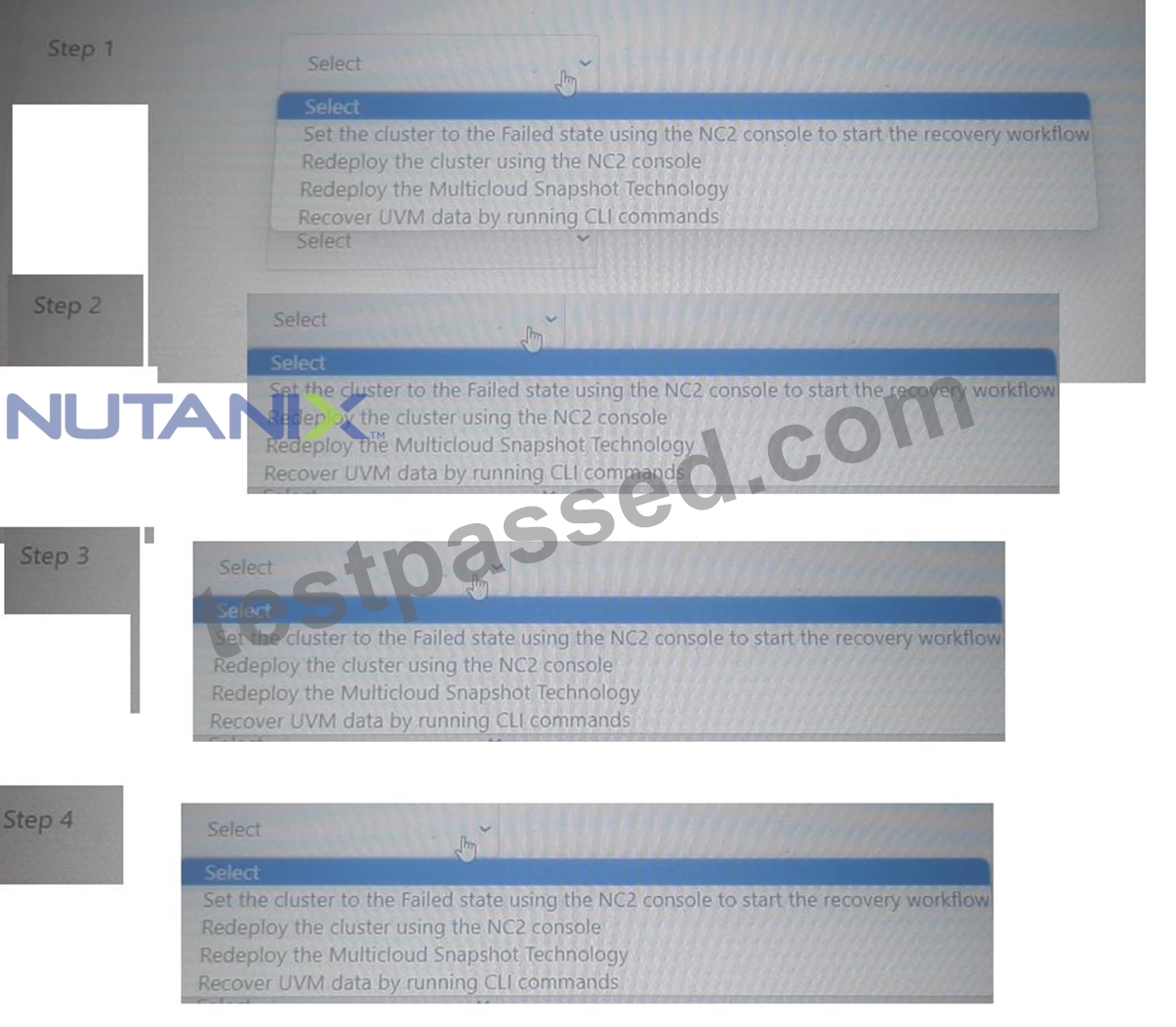
Answer:
Explanation: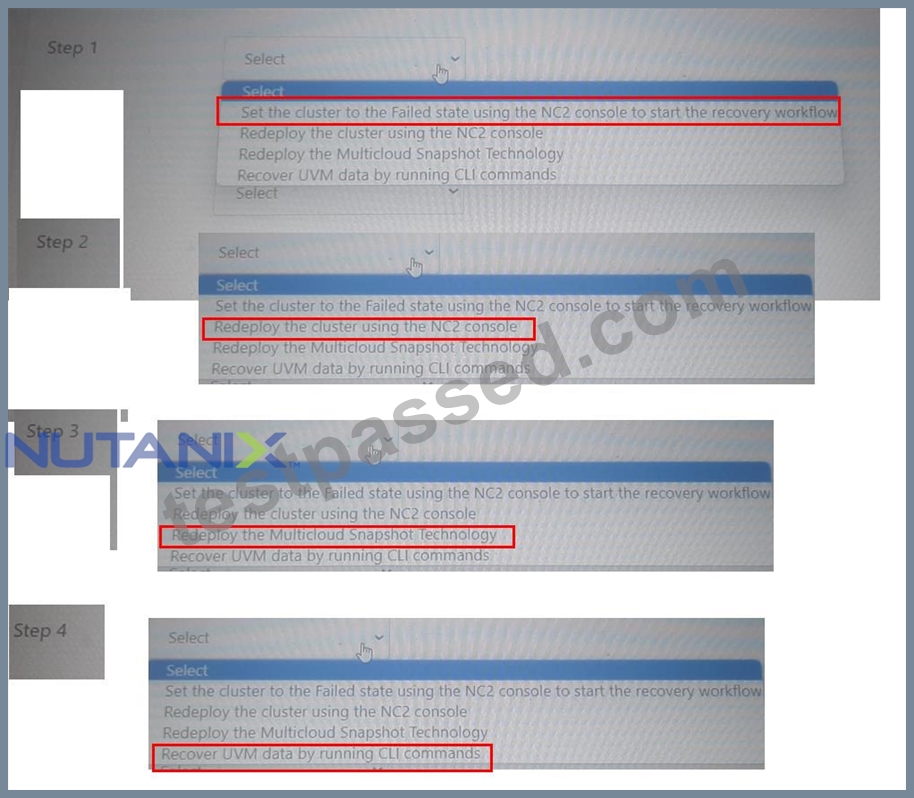
Reference:
Nutanix Documentation on Cluster Protect and Recovery Processes
Nutanix Support & Insights
Nutanix Cloud Clusters on AWS Administration
NEW QUESTION # 37
An administrator has been tasked with ensuring NC2 VMs are able to access AWS resources. The NC2 VM traffic must not traverse the internet.
in which two ways would the administrator achieve this? (Choose two.)
- A. By using a Gateway Endpoint
- B. By using an Interface Endpoint
- C. By using a NAT Gateway.
- D. By using a VPC Peer.
Answer: B,D
Explanation:
To ensure that NC2 VMs can access AWS resources without traversing the internet, the administrator can use AWS VPC Peering and Interface Endpoints. Both methods ensure that traffic stays within the AWS network, maintaining security and efficiency.
Interface Endpoint:
Interface Endpoints allow you to privately connect your VPC to supported AWS services. They use AWS PrivateLink to route traffic directly to services within the AWS network, bypassing the public internet.
Steps:
Create an interface endpoint for the required service in the AWS VPC console.
Ensure the security groups and route tables are configured to allow traffic to the interface endpoint.
VPC Peering:
VPC Peering allows the routing of traffic between VPCs using private IP addresses, without the need for internet gateways, NAT devices, or VPN connections.
Steps:
Create a VPC peering connection between the VPCs.
Update the route tables to direct traffic between the peered VPCs.
Ensure security group rules allow the necessary traffic between VPCs.
Reference:
AWS VPC Peering Documentation
AWS Interface Endpoint Documentation
Nutanix Cloud Clusters on AWS Administration Guide
NEW QUESTION # 38
An organization wants to control network traffic at the individual User VM (UVM) subnet level.
Which action will help achieve this goal?
- A. Modify the user management security group.
- B. Modify the internal management security group.
- C. Modify the default UVM security group.
- D. Create a custom security group.
Answer: D
Explanation:
To control network traffic at the individual User VM (UVM) subnet level, creating a custom security group is the appropriate action. This approach allows for fine-grained control over inbound and outbound traffic rules that can be applied to specific subnets or individual instances within those subnets.
Custom Security Group:
Custom security groups enable administrators to define specific traffic rules tailored to the needs of individual subnets or VMs. This includes specifying allowed IP ranges, ports, and protocols.
By applying these custom security groups to the UVMs, the organization can control access and enhance security according to their policies and requirements.
Steps to Create a Custom Security Group:
Navigate to the AWS Management Console and go to the VPC service.
Select "Security Groups" under the "Security" section.
Click on "Create Security Group" and define the name, description, and VPC.
Add inbound and outbound rules according to the desired traffic control policies.
Attach the custom security group to the UVMs or subnets in question.
Reference:
Nutanix Cloud Clusters on AWS Administration Guide
AWS Security Group Documentation
Nutanix Best Practices for Security Groups
NEW QUESTION # 39
......
NCP-CI-AWS Free Sample Questions to Practice One Year Update: https://www.testpassed.com/NCP-CI-AWS-still-valid-exam.html
Free Nutanix NCP-CI-AWS Exam Questions: https://drive.google.com/open?id=1SqBrokJRfqzorzSOHh6tF8eEsq1kKlPs