


HP HPE7-A01 Real 2026 Braindumps Mock Exam Dumps
HPE7-A01 Exam Questions | Real HPE7-A01 Practice Dumps
HP HPE7-A01 exam, also known as the Aruba Certified Campus Access Professional exam, is a highly respected certification exam that is designed to test the skills and knowledge of IT professionals who work with Aruba’s networking solutions. HPE7-A01 exam is a key requirement for IT professionals who are looking to boost their career prospects, as it validates their expertise in working with Aruba’s products and technologies.
Preparing for the HP HPE7-A01 exam requires a combination of practical experience and study. Candidates should have hands-on experience with Aruba products and solutions, as well as a solid understanding of networking concepts. They can also prepare for the exam by taking Aruba training courses and studying resources such as the Aruba Certified Mobility Professional (ACMP) study guide.
NEW QUESTION # 72
By default, Best Effort is higher priority than which priority traffic type?
- A. Internet Control
- B. All queues
- C. Network Control
- D. Background
Answer: D
Explanation:
This is because Best Effort traffic is all other kinds of non-detrimental traffic that are not sensitive to Quality of Service metrics (jitter, packet loss, latency). A typical example would be peer-to-peer and email applications. Background traffic is a type of traffic that is used for system maintenance or backup purposes and does not affect the performance or availability of the network. Therefore, Best Effort traffic has a higher priority than Background traffic in terms of network resources allocation and management.
NEW QUESTION # 73
you need to have different routing-table requirements With Aruba CX 6300 VSF configuration.
Assuming the correct layer-2 VLAN already exists, how would you create a new SVI for a separate routing table?
- A. Create a new SVI and use attach command.
- B. Create a new routing table, and attach VLANS to it
- C. create a new VLAN, and attach the VRF to it.
- D. Create a new VLAN. and attach the routing table to it
Answer: A
Explanation:
The correct answer is C. Create a new SVI and use attach command.
To create a new SVI for a separate routing table, you need to use the attach command to associate the SVI with a VRF (Virtual Routing and Forwarding) instance. A VRF is a logical entity that allows multiple routing tables to coexist on the same switch. Each VRF has its own set of interfaces, routing protocols, and routes that are isolated from other VRFs.
According to the AOS-CX Virtual Switching Framework (VSF) Guide1, one of the steps to configure VRF-aware VSF is:
* Configure the VRFs on each member switch and assign the SVIs to the respective VRFs using the attach command. For example:
switch(config)# vrf red
switch(config-vrf)# exit
switch(config)# interface vlan 10
switch(config-if-vlan)# ip address 10.1.1.1/24
switch(config-if-vlan)# attach vrf red
The above commands create a VRF named red and assign VLAN 10 SVI to it. The SVI has an IP address of
10.1.1.1/24.
The other options are incorrect because:
* A. You cannot attach a VRF to a VLAN directly. You need to create an SVI for the VLAN and then attach the VRF to the SVI.
* B. You cannot create a new routing table manually. You need to create a VRF and then use routing protocols or static routes to populate the routing table for the VRF.
* D. You cannot attach a routing table to a VLAN directly. You need to create an SVI for the VLAN and then attach a VRF that has a routing table associated with it.
NEW QUESTION # 74
Select the Aruba stacking technology matching each option (Options may be used more than once or not at all.)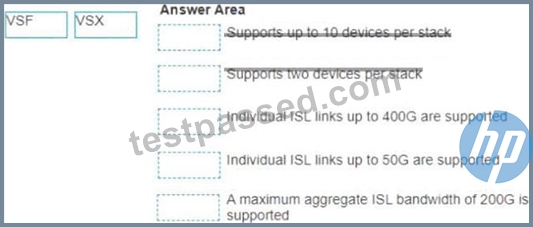
Answer:
Explanation: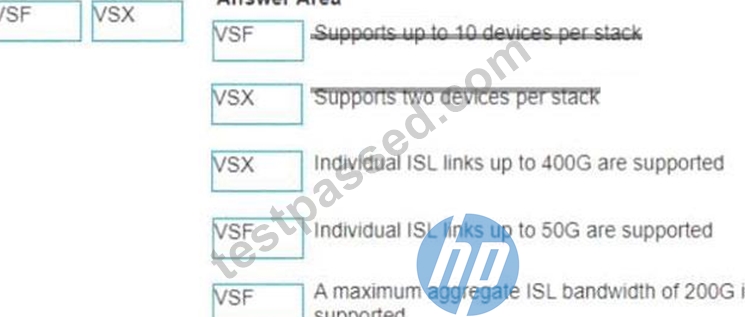
Explanation:
a) Support up to 10 devices per stack -> VSF
b) Support two devices per stack -> VSX
c) Individual ISL links up to 400G are supported -> VSX
d) individual ISL links up to 50G are supported -> VSF
e) A maximum aggregate ISL bandwidth of 200G is supported -> VSF
References: 1 https://www.arubanetworks.com/techdocs/AOS-CX/10.04/HTML/5200-6728/GUID-
2E425DAE-EC54-4313-9D
NEW QUESTION # 75
What is a primary benefit of BSS coloring?
- A. BSS color tags improve security by identifying rogue APs and removing them from the network.
- B. BSS color tags improve performance by allowing clients on the same channel to share airtime.
- C. BSS color tags are applied to client devices and can reduce the threshold for interference
- D. BSS color tags are applied to Wi-Fi channels and can reduce the threshold for interference
Answer: D
Explanation:
Explanation
BSS coloring is a mechanism that helps identify the BSS Basic Service Set. A BSS is a set of interconnected stations that can communicate with each other. BSS can be an independent BSS or infrastructure BSS. An independent BSS is an ad hoc network that does not include APs, whereas the infrastructure BSS consists of an AP and all its associated clients. on the same channel and differentiate them from other BSS on the same channel12. Each BSS is assigned a color code, which is a 6-bit value that is carried in the PHY header of the Wi-Fi frames12. By using BSS coloring, the APs and clients can reduce the threshold for interference detection and avoid unnecessary backoff or retransmissions when they detect frames from other BSS with different colors12. This can improve the spectral efficiency and throughput of the network12. The other options are incorrect because they do not describe the primary benefit of BSS coloring.
NEW QUESTION # 76
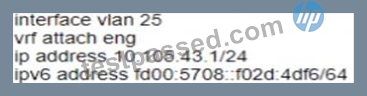
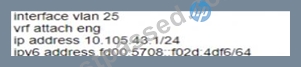
You are configuring an SVI on an Aruba CX switch that needs to have the following characteristics:
* VLANID = 25
. IPv4 address 10 105 43 1 with mask 255 255 255.0
* IPv6 address fd00:5708::f02d:4df6 with a 64 bit prefix length
* member of VRF eng
* VRF eng and VLAN 25 have not yet been created
Which command lists will satisfy the requirements with the least number of commands?
- A.
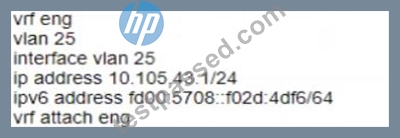
- B.
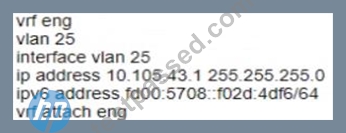
- C.
- D.
Answer: D
Explanation:
The other options either use more commands or do not create the VRF or the VLAN.
Option C uses the following commands:
vrf eng: This command creates a VRF named eng and enters the VRF configuration mode1.
vlan 25: This command creates a VLAN with ID 25 and enters the VLAN configuration mode2.
interface vlan 25: This command creates an SVI on VLAN 25 and enters the interface configuration mode3.
ip address 10.105.43.1/24 ipv6 address fd00:5780::102d:4df6/64 vrf attach eng: This command assigns an IPv4 address of 10.105.43.1 with a subnet mask of 255.255.255.0 and an IPv6 address of fd00:5780::102d:4df6 with a prefix length of 64 to the SVI, and attaches it to the VRF eng.
NEW QUESTION # 77
A company recently upgraded its campus switching infrastructure with Aruba 6300 CX switches. They have implemented 802.1X authentication on edge ports where laptop and loT devices typically connect An administrator has noticed that for PoE devices the pons are delivering the maximum wattage instead of what the device actually needs Upon connecting the loT devices, the devices request their specific required wattage through information exchange
- A. implement a classifier policy with the correct power definitions.
- B. Enable AAA authentication to exempt LLDP and/or CDP information
- C. Create device profiles with the correct power definitions.
- D. Globally enable the QoS trust setting for LLDP and/or CDP
- E. Concerned about this waste of electricity, what should the administrator implement to solve this problem?
Answer: C
Explanation:
According to the Aruba Documentation Portal1, the Aruba 6300 CX switches support various features to control the PoE devices on specific ports, such as device profiles and classifier policies. These features can help reduce the power consumption and improve the performance of the PoE devices.
1:
https://www.arubanetworks.com/techdocs/AOS-CX/10.10/HTML/monitoring_6300-6400/Content/Chp_LEDs/fr
https://www.arubanetworks.com/products/switches/6300-series/ 3:
https://docs.samsungknox.com/admin/knox-manage/configure/profile/configure-profile-policies/configure-profil
NEW QUESTION # 78
You are troubleshooting an issue with a pair of Aruba CX 8360 switches configured with VSX Each switch has multiple VRFs. You need to find the IP address of a particular client device with a known MAC address.
You run the "show arp" command on the primary switch in the pair but do not find a matching entry for the client MAC address.
The client device is connected to an Aruba CX 6100 switch by VSX LAG. Which action can be used to find the IP address successfully?
- A.

- B.

- C.

- D.

Answer: D
Explanation:
The show arp command displays the ARP table for a specific VRF or all VRFs on the switch. The ARP table contains the IP address to MAC address mappings for hosts that are directly connected to the switch or reachable through a gateway. If the client device is connected to another switch by VSX LAG, the ARP entry for the client device will not be present on the primary switch unless it has communicated with it recently.
Therefore, to find the IP address of the client device, the administrator should run the show arp command on the secondary switch in the VSX pair, specifying the VRF name that contains the client device's subnet.
NEW QUESTION # 79
Your Director of Security asks you to assign AOS-CX switch management roles to new employees based on their specific job requirements. After the configuration was complete, it was noted that a user assigned with the administrators role did not have the appropriate level of access on the switch. The user was not limited to viewing nonsensitive configuration information and a level of 1 was not assigned to their role.
Which default management role should have been assigned for the user?
- A. operators
- B. sysadmin
- C. helpdesk
- D. config
Answer: A
Explanation:
The operators user role is a predefined role that allows users to view nonsensitive configuration information on the switch, such as interfaces, VLANs, routing protocols, statistics, and more. The operators user role has a privilege level of 1, which is the lowest level of access on the switch.
The administrators user role is a predefined role that has full access to all switch configuration information and all REST API methods. This role is more than what the Director of Security requires.
NEW QUESTION # 80
Two AOS-CX switches are configured with VSX at the the Access-Aggregation layer where servers attach to them An SVI interface is configured for VLAN 10 and serves as the default gateway for VLAN 10.
The ISL link between the switches fails, but the keepalive interface functions. Active gateway has been configured on the VSX switches.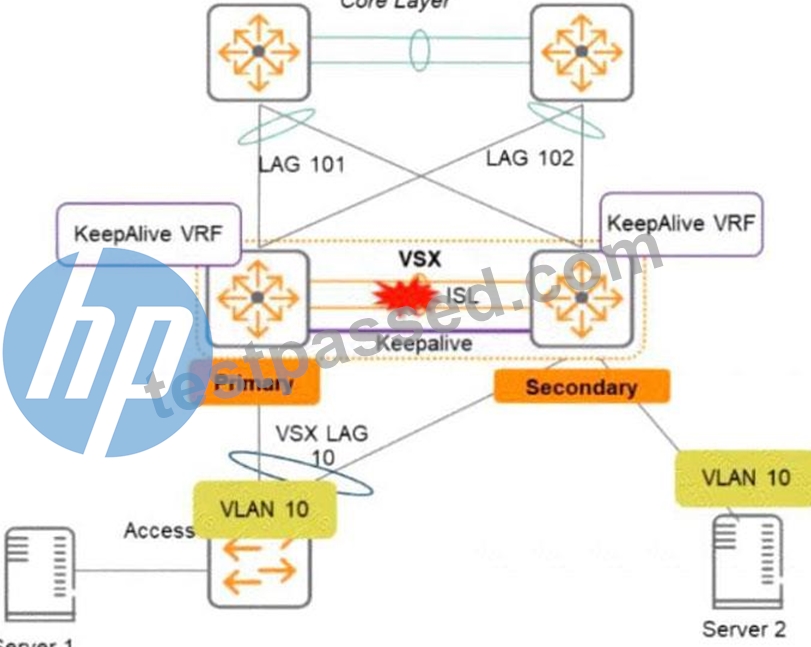
What is correct about access from the servers to the Core? (Select two.)
- A. Server 2 can access the core layer via the keepalive link
- B. Server 1 can access the core layer on only one uplink
- C. Server 1 can access the core layer via the keepalrve link
- D. Server 1 and Server 2 can communicate with each other via the core layer
- E. Server 1 can access the core layer via both uplinks
- F. Server 2 cannot access the core layer.
Answer: D,E
Explanation:
These are the correct statements about access from the servers to the Core when the ISL link between the switches fails, but the keepalive interface functions. Server 1 can access the core layer via both uplinks because it is connected to VSX-A, which is still active for VLAN 10. Server 2 can also access the core layer via its uplink to VSX-B, which is still active for VLAN 10 because of Active Gateway feature.
Server 1 and Server 2 can communicate with each other via the core layer because they are in the same VLAN and subnet, and their traffic can be routed through the core switches. The other statements are incorrect because they either describe scenarios that are not possible or not relevant to the question.
References: https://www.arubanetworks.com/techdocs/AOS-CX/10.04/HTML/5200-6728/bk01-
NEW QUESTION # 81
Match each PoE power class to Its corresponding 802.3 standard. (Options may he used more than once or not at all)
Answer:
Explanation:
* Class 3 (15.4W): 802.3af
* Class 4 (30W): 802.3at
* Class 6 (60W): 802.3bt
* Class 8 (90W): 802.3bt
NEW QUESTION # 82
AppRF 2.0 allows you to:
- A. monitor applications and radio frequencies
- B. customize application signatures
- C. classify web content based on reputation
- D. configure ACL and bandwidth control for applications
Answer: C
NEW QUESTION # 83
You are setting up a customer's 15 headless loT devices that do not support 802.1X..
What should you use?
- A. Multiple Pre-Shared Keys (MPSK) with WPA3-AES
- B. Multiple Pre-Shared Keys (MPSK) Local
- C. Clearpass with WPA3-AES
- D. Clearpass with WPA3-PSK
Answer: B
Explanation:
MPSK Local is a feature that can be used to set up 15 headless IoT devices that do not support 802.1X authentication. MPSK Local allows the switch to automatically generate and assign unique pre-shared keys for devices based on their MAC addresses, without requiring any configuration on the devices or an external authentication server. The other options are incorrect because they either require 802.1X authentication, which is not supported by the IoT devices, or WPA3 encryption, which is not supported by Aruba CX switches.
References:
https://www.arubanetworks.com/techdocs/AOS-CX/10.04/HTML/5200-6728/bk01-ch05.html
https://www.arubanetworks.com/techdocs/AOS-CX/10.04/HTML/5200-6728/bk01-ch06.html
NEW QUESTION # 84
Your customer currently has Iwo (2) 5406 modular switches with MSTP configured as their core switches. You are proposing a new solution. What would you explain regarding the Aruba CX VSX switch pair when the Primary VSX node is replaced and the system MAC is replaced?
- A. Configure vMAC on the Primary VSX node under VSX to retain MAC after hardware replacement.
- B. During the initial VSX configuration, the system-mac is assigned with a fixed MAC based on VSX ID.
- C. VSX will select the MAC address from a node that is the lower ID.
- D. VSX will select the MAC address from a node that is a higher ID.
Answer: B
Explanation:
The system-mac command is used to configure a fixed MAC address for the VSX system. This MAC address is used as the source MAC address for all routed traffic from the VSX node. The system-mac command is highly recommended for preventing traffic disruptions when the primary VSX switch restores after the secondary VSX switch, such as during a primary switch hardware replacement or a power outage. During the initial VSX configuration, the system-mac is assigned with a fixed MAC based on VSX ID. The system-mac command can be used to change this default MAC address if needed.
NEW QUESTION # 85
With Aruba CX 6300. how do you configure ip address 10 10 10 1 for the interface in default state for interface 1/1/1?
- A. int 1/1/1. ip address 10.10.10.1/24
- B. int 1/1/1. no switching, ip address 10 10 10.1/24
- C. int 1/1/1. routing, ip address 10.10.10 1/24
- D. int 1/1/1. switching, ip address 10 10 10 1/24
Answer: B
Explanation:
To configure an IP address for an interface in default state for interface 1/1/1 on Aruba CX 6300 switch, you need to disable switching on the interface first with the command no switching. Then you can assign an IP address with the command ip address. The other options are incorrect because they either do not disable switching or use invalid keywords suchas switching or routing. References:
https://www.arubanetworks.com/techdocs/AOS-CX_10_08/UG/bk01-ch01.htmlhttps://www.arubanetworks.com
NEW QUESTION # 86
With the Aruba CX 6000 24G switch with uplinks of 1/1/25 and what does the switch do when a client port detects a loop and the do-not-disabie parameter is used?
- A. Port status led blinks in amber with 100hz.
- B. An event log message is created.
- C. Port status will be validated once status is cleared
- D. The network analytics engine is triggered.
Answer: B
Explanation:
The do-not-disable parameter is used to prevent the switch from disabling the port when a loop is detected by the loop-protect feature. Instead, the switch will generate an event log message that indicates the port number and the VLAN ID where the loop was detected. The switch will also send a trap to the SNMP manager, if configured.
NEW QUESTION # 87
The administrator notices that wired guest users that have exceeded their bandwidth limit are not being disconnected Access Tracker in ClearPass indicates a disconnect CoA message is being sent to the AOS-CX switch.
An administrator has performed the following configuration
What is the most likely cause of this issue?
- A. Change of Authorization has not been globally enabled on the switch
- B. The SSL certificate for CPPM has not been added as a trust point on the switch
- C. There is a time difference between the switch and the ClearPass Policy Manager
- D. There is a mismatch between the RADIUS secret on the switch and CPPM.
Answer: C
Explanation:
Change of Authorization (CoA) is a feature that allows ClearPass Policy Manager (CPPM) to send messages to network devices such as switches to change the authorization state of a user session. CoA requires that both CPPM and the network device support this feature and have it enabled. For AOS-CX switches, CoA must be globally enabled using the command radius-server coa enable. If CoA is not enabled on the switch, the disconnect CoA message from CPPM will be ignored and the user session will not be terminated. Reference: https://www.arubanetworks.com/techdocs/ClearPass/6.7/PolicyManager/index.htm#CPPM_UserGuide/Admin/ChangeOfAuthorization.htm https://techhub.hpe.com/eginfolib/Aruba/OS-CX_10.04/5200-6692/GUID-9B8F6E8F-9C7A-4F0D-AE7B-9D8E6C5B6A7F.html
NEW QUESTION # 88
......
To pass the HPE7-A01 certification exam, candidates must demonstrate a thorough understanding of Aruba wireless technologies, including access points, controllers, and mobility controllers. They must also have a strong grasp of wireless security protocols, such as 802.1x, WPA2, and Advanced Encryption Standard (AES). Additionally, they must be familiar with network design principles, network management, and troubleshooting methodologies.
Verified HPE7-A01 Exam Dumps Q&As - Provide HPE7-A01 with Correct Answers: https://www.testpassed.com/HPE7-A01-still-valid-exam.html
Pass Your HPE7-A01 Dumps Free Latest HP Practice Tests: https://drive.google.com/open?id=1oSBLOrgT2p1Q87c9MOTlgH8lCAcx8YDX