


[Feb-2026] Dumps Practice Exam Questions Study Guide for the 350-801 Exam
350-801 Dumps with Practice Exam Questions Answers
Describing the Test Domains
- Cisco IOS XE Gateway and Media Resources
This domain is built around the configuration of specific voice gateway components. These include codec preference list, dial peers, and DTMF. It also addresses the configuration and troubleshooting of ISDN PRI/BRI, skills needed to verify and set up the MGCP, and select the right media resources that are most suitable for certain scenarios.
- Collaboration Applications
This domain will mostly focus on the setting up the SIP integration options to call control, configuration of MWI and Unity Connection Mailbox, and description of call handlers. It also covers the deployment of Cisco jabber on-premises as well as Cisco Unified IM&P protocols and high avilability.
- Design and infrastructure
Here, the instructors will want to know if you can describe the key components of design when it comes to Cisco Collaboration architecture. They include high availability, bandwidth, sizing, licensing, security, QoS, disaster recovery, and dial plan. Also, the candidates should show their knowledge of the crucial elements that Cisco Collaboration technologies like SNMP and DNS, the purpose of of edge devices within the Cisco Collaboration architecture, and skills in troubleshooting DNS, NTP, and LDAP integration.
- Protocols, Codecs, and Endpoints
This is the last domain that candidates need to master when preparing for the Cisco 350-801 exam. It checks one's abilities in troubleshooting a wide range of SIP conversation elements including SDP and DTMF as well as collaboration endpoints, deploying SIP endpoints, and setting up codec negotiations. Also, it requires onw to know how to choose a proper collaboration codec for specific scenario.
- Call Control
This module of the exam outline emphasizes four major skills including those associated with the Mobile and Remote Access (MRA), Cisco Unified Communications Manager digit analysis process, and the implementation of toll fraud prevention. In addition, one should be skilled in the configuration of globalized call routing within a Cisco Unified CM.
NEW QUESTION # 62
What are two valid features of Cisco Unified Survivable Remote Site Telephony? (Choose two.)
- A. Allows users to make calls with the same dial-plan as if connected to Cisco UCM cluster.
- B. Enables failover between two or more Cisco UCM servers in a cluster if one server is placed at a remote site.
- C. To get SIP trunk failover capability for Cisco UCM.
- D. On a router registers all phones to that remote site router if link to the central Cisco UCM cluster is lost.
- E. Using a Cisco router, it provides failover between these routers to ensure remote site operations.
Answer: A,D
NEW QUESTION # 63
You are adding regions in Cisco Unified Communications Manager. Which codec(s) are selected when a call is placed if you set up the max audio bit rate to use 8 kbps?
- A. G.729
- B. G.722
- C. G.711ulaw and G.711alaw
- D. G.729 and G.711ualw
Answer: A
NEW QUESTION # 64
A Cisco TelePresence SX80 suddenly has issues displaying main video to a display over HDMI. Which command can you use from the SX80 admin CLI to check the video output status to the monitor?
- A. xConfiguration Video Output
- B. xCommand Video Status
- C. xStatus Video Output
- D. xStatus HDMI Output
Answer: A
NEW QUESTION # 65
An administrator must configure the local route group feature on cisco UCM.
Which step will enable this feature?
- A. For each route list configure a route group to use as a Local Route Group.
- B. For each route pattern, select the Local Route Group as the destination.
- C. For each device pool, configure a route group to use as a Local Route Group for that device pool
- D. For each route group, check the box for the Local Route Group feature.
Answer: C
Explanation:
https://www.cisco.com/c/en/us/td/docs/voice_ip_comm/cucm/admin/10_0_1/ccmfeat/CUCM_BK_ F3AC1C0F_00_cucm-features-services-guide-100/CUCM_BK_F3AC1C0F_00_cucm-features- services-guide-100_chapter_0100110.html
NEW QUESTION # 66
What is the major difference between the two possible Cisco IM and presence high-availability modes?
- A. Balanced mode provides user load failover in the event of an outage. Active/standby mode provides an always on standby node in the event of an outage, and is also provides load balancing.
- B. Balanced mode does not provide user load balancing, but it provides user failover in the event of an outage. Active/standby mode provides an always on standby node in the event of an outage, but is does not provide load balancing.
- C. Balanced mode provides user load balancing and user failover in the event of an outage. Active/standby mode provides an always on standby node in the event of an outage, but it does not provide load balancing.
- D. Balanced mode provides user load balancing and user failover only for manually generated failovers.
Active/standby made provides an unconfigured standby node in the event of an outage, but it does not provide load balancing.
Answer: C
NEW QUESTION # 67
An engineer configures NTP on a Cisco Unified Border Element router to synchronize time with a public NTP server. Which command synchronizes a Cisco UCM server to the CUBE router?
- A. ntp server source
- B. ntp master 0
- C. ntp server allow all
- D. ntp master 2
Answer: D
Explanation:
The ntp mastercommand configures the Cisco Unified Border Element (CUBE) router to act as an NTP server for other devices, such as a Cisco UCM server. The numeric value (e.g., 2) specifies the stratum level of the CUBE router as an NTP server. Stratum levels indicate the distance of the NTP server from a reference clock (e.g., stratum 1 is directly connected to a reference clock).
Why use ntp master 2?
By configuring the CUBE as an NTP server (stratum 2 in this case), it allows the Cisco UCM to synchronize time with the CUBE. This setup is common when the CUBE is synchronized with a public NTP server. Setting the stratum level to 2 indicates that the CUBE is synchronized to an external NTP server, providing accurate time to connected devices like Cisco UCM.
Accurate time synchronization is critical in VoIP and collaboration environments for features such as call detail records (CDRs), troubleshooting logs, and secure communication (e.g., TLS).
NEW QUESTION # 68
Which Layer 3 PHB marking is used for VoIP applications?
- A. 0
- B. CS1
- C. AF21
- D. EF
Answer: D
NEW QUESTION # 69
Refer to the exhibit.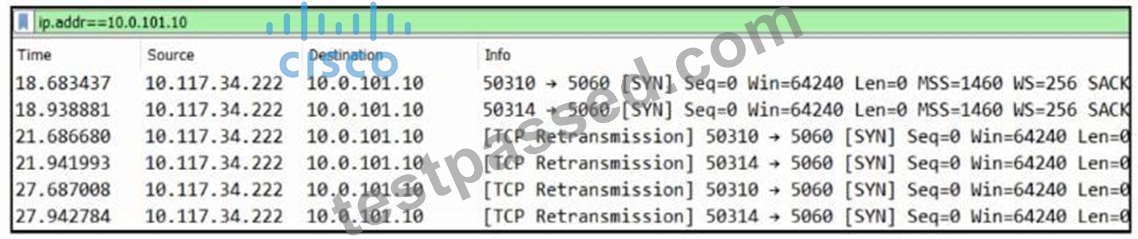
An administrator is attempting to register a SIP phone to a Cisco UCM but the registration is failing. The IP address of the SIP Phone is 10.117.34 222 and the IP 1 address of the Cisco UCM is 10.0.101.10. Pings from the SIP phone to the Cisco UCM are successful. What is the cause of this issue and how should it be resolved?
- A. The certificates on the SIP phone are not trusted by the Cisco UCM. The SIP phone must generate new certificates.
- B. An network device is blocking TCP port 5060 from the SIP phone to the Cisco UCM. This device must be reconfigured to allow traffic from the IP phone.
- C. DNS lookup for the Cisco UCM FQDN is failing. The SIP phone must be reconfigured with the proper DNS server.
- D. An NTP mismatch is preventing connection of the TCP session between the SIP phone and the Cisco UCM. The SIP phone and Cisco UCM must be set with identical NTP sources.
Answer: B
NEW QUESTION # 70
An administrator is configuring a new Cisco UCM with PSTN capabilities. Due to bandwidth constraints, audio compression is used on the codec. DTMF must work as expected because the customer is calling many call centers where the users must select options in the call.
Where is DTMF out-of-band in a CCM 12.5 with SIP-based gateway configured?
- A. in the DTMF setting under SIP profile on the Cisco Unified Border Element
- B. in DTMF settings in the audio codec preference list under regions in the Cisco UCM
- C. in regions on the Cisco UCM where you set the appropriate codec to use
- D. in the dial peer on the Cisco IOS router
Answer: D
Explanation:
https://www.cisco.com/c/en/us/support/docs/unified-communications/unified-border- element/200412-DTMF-Relay-and-Interworking-on-CUBE.html
NEW QUESTION # 71
Which configuration tells a switch port to send Cisco Discovery protocol packets that configure an attached Cisco IP phone to trust tagged traffic that is received from a device that is connected to the access port on the Cisco IP phone?
Router# configure terminal
- A. Router(config)# interface gigabitethernet 5/1
Router(config-if)# platform qos extend trust - B. Router(config)# interface gigabitethernet 5/1
Router(config-if)# platform qos trust extend cos 5
Router# configure terminal - C. Router(config)# interface gigabitethernet 5/1
Router(config-if)# platform qos trust extend
Router# configure terminal - D. Router(config)# interface gigabitethernet 5/1
Router(config-if)# platform qos trust extend cos 3
Router# configure terminal
Answer: C
NEW QUESTION # 72
Refer to the exhibit. IP phone A makes a call to IP phone B and RTP voice stream is successfully established between the endpoints.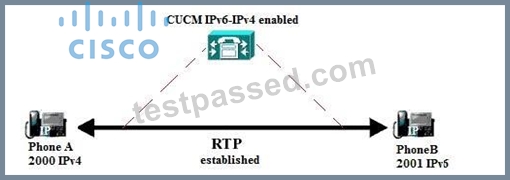
What option describes how to accomplish this call on phones with incompatible IP addressing versions?
- A. Enable alternative network address types
- B. Assign a media resource group with available MTPs
- C. Set IP addressing mode preference for signalling to IPv4
- D. Set common device configuration to IPv4 and IPv6
Answer: B
NEW QUESTION # 73
When a user dials a number with a phone that is registered to the Cisco Unified Communications Manager, what is the default timeout before the number is sent?
- A. 3 seconds
- B. 10 seconds
- C. 15 seconds
- D. 5 seconds
Answer: C
NEW QUESTION # 74
A user reports that when receiving an inbound call on their IP Phone from the PSTN they are unable to transfer this call to another PSTN number What is the reason for this failure?
- A. The gateway is configured with the wrong device pool
- B. The service parameter related to Offnet to Offnet Call Transfer is set to TRUE
- C. The IP phone is configured with the wrong region
- D. The incoming calling search space of the SIP trunk does not include the partition of the line in the IP phone
Answer: B
NEW QUESTION # 75
What is the purpose of a Workspace in Cisco Webex Control Hub?
- A. to add or manage devices in an organization
- B. to generate detailed reports about room usage
- C. to add services to shared devices in a common area
- D. to assign devices to users
Answer: C
NEW QUESTION # 76
Refer to the exhibit. A collaboration engineer adds an analog gateway to a Cisco UCM cluster.
The engineer chooses MGCP over SCCP as the gateway protocol.
Which two actions ensure that the gateway registers? (Choose two.)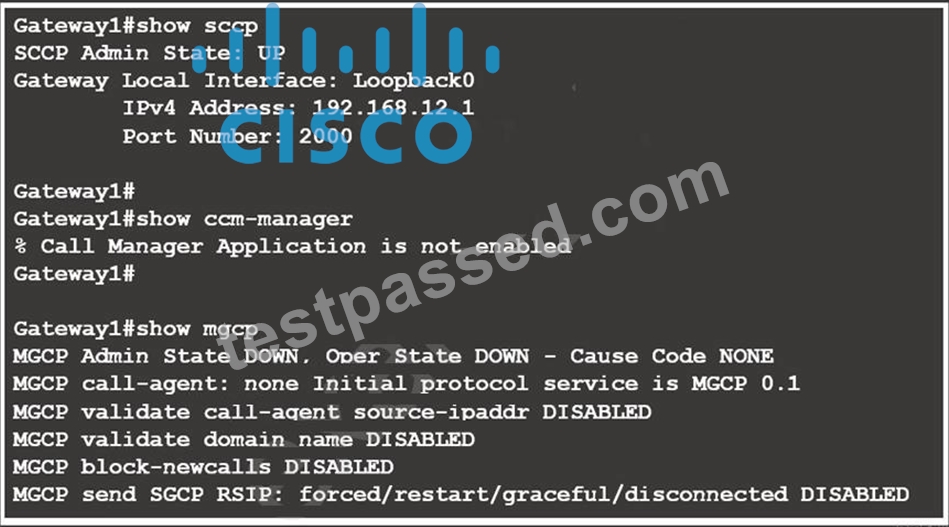
- A. Enter "mgcp" on the gateway in configuration mode.
- B. Delete and re-add the gateway configuration in Cisco UCM.
- C. Enter "ccm-manager config" on the gateway in configuration mode.
- D. Enter "ccm-manager mgcp" on the gateway in configuration mode.
- E. Enter "no sccp" on the gateway in configuration mode.
Answer: A,D
Explanation:
https://community.cisco.com/t5/unified-communications/cisco-router-2901-mgcp-x-callmanager-9-
1-1/td-p/2419551
NEW QUESTION # 77
An end user at a remote site is trying to initiate an Ad Hoc conference call to an end user at the main site. The conference bridge is configured to support G.711. The remote user's phone only supports G.729. The remote end user receives an error message on the phone: "Cannot Complete Conference Call." What is the cause of the issue?
- A. The transcoder resource is missing.
- B. The remote phone does not have the conference feature assigned.
- C. A Media Termination Point is missing.
- D. A software conference bridge is not assigned.
Answer: A
NEW QUESTION # 78
What are two characteristics of priority queueing? (Choose two.)
- A. It places traffic Into one of four queues.
- B. It guarantees bandwidth for user-defined traffic classes.
- C. It allocates an equal share of bandwidth to each flow.
- D. It applies strict priority to user-defined traffic classes.
- E. It ensures that critical traffic queues are serviced first.
Answer: A,E
NEW QUESTION # 79
As a voice engineer, which two recommendations do you make to your company to optimize Cisco Unified Communications Manager configuration to reduce the number of toll fraud incidents? (Choose two.)
- A. Inbound CSS on any gateway typically should have access to internal destinations and PSTN destinations.
- B. Classify all route patterns as on-net or off-net and prohibit off-net call transfers in Cisco Unified CM Service parameters.
- C. Classify all route pattern as off-net and prohibit off-net to off-net call transfers in Cisco Unified CM service parameters.
- D. Classify all route patterns as on-net and prohibit on-net to on-net call transfers in Cisco Unified CM service parameters.
- E. Inbounds CSS on any gateway typically should have access to internal destinations only and not PSTN destinations.
Answer: C,E
NEW QUESTION # 80
Where is the default for Maximum Session Bit Rate for a region configured?
- A. Enterprise Phone Configuration
- B. Enterprise Parameters Configuration
- C. Region Configuration
- D. Service Parameter Configuration
Answer: D
Explanation:
Section: Infrastructure and Design
Explanation/Reference: https://www.cisco.com/c/en/us/td/docs/voice_ip_comm/cucm/admin/9_1_1/ccmcfg/ CUCM_BK_A34970C5_00_admin-guide-91/CUCM_BK_A34970C5_00_admin-guide-91_chapter_0111.html
NEW QUESTION # 81
Which characterstic of distributed class- based weighted fair queueing addresses jitter prevention?
- A. It provides additional granularity by allowing a user to define custom class
- B. It provides additional granularity by allowing a user to create classes
- C. It uses a priority queue for voice traffic to avoid jitter.
- D. It minimizes jitter by implementing a priority queue for voice traffic
Answer: D
NEW QUESTION # 82
Which two types of devices are included in the conditionally trusted endpoints category of Cisco UCM? (Choose two.)
- A. unsecure PCs
- B. analog gateways
- C. Cisco IP phones
- D. handheld mobile devices
- E. Cisco TelePresence endpoints
Answer: C,E
NEW QUESTION # 83 
Refer to the exhibit. An administrator is attempting to register a SIP phone to a Cisco UCM but the registration is failing. The IP address of the SIP Phone is 10.117.34.222 and the IP address of the Cisco UCM is 10.0.101.10. Pings from the SIP phone to the Cisco UCM are successful. What is the cause of this issue and how should it be resolved?
- A. The certificates on the SIP phone are not trusted by the Cisco UCM. The SIP phone must generate new certificates.
- B. An network device is blocking TCP port 5060 from the SIP phone to the Cisco UCM. This device must be reconfigured to allow traffic from the IP phone.
- C. DNS lookup for the Cisco UCM FQDN is failing. The SIP phone must be reconfigured with the proper DNS server.
- D. An NTP mismatch is preventing the connection of the TCP session between the SIP phone and the Cisco UCM. The SIP phone and Cisco UCM must be set with identical NTP sources.
Answer: B
NEW QUESTION # 84
How does traffic policing respond to violations?
- A. AH traffic is treated equally.
- B. Excess traffic is queued.
- C. Excess traffic is retransmitted.
- D. Excess traffic is dropped.
Answer: D
Explanation:
https://www.cisco.com/c/en/us/support/docs/quality-of-service-qos/qos-policing/19645- policevsshape.html
NEW QUESTION # 85
......
Free CCNP Collaboration 350-801 Exam Question: https://www.testpassed.com/350-801-still-valid-exam.html
350-801 by CCNP Collaboration Actual Free Exam Practice Test: https://drive.google.com/open?id=1SELptv_360MaGuCBw_FPgPXHQ5lBz3be