


Authentic IAPP CIPT Exam Dumps PDF - 2026 Updated
Get Prepared for Your CIPT Exam With Actual 258 Questions
How to book CIPT Exams
The registration for the CIPT Exam follows the steps given below.
- Step2: Search for the CIPT Exam and purchase the exam by making payment using credit/debit card.
- Step3: Through Pearson VUE's scheduling platform, you will be able to choose a test center, time and date.
- Step1: Visit the IAPP store Website
Note:-Candidates must schedule AND complete their exams within one year of purchases. If you do not,your exam fee will be forfeited.
The CIPT certification exam is an essential step for individuals working in the field of privacy technology. It is a comprehensive test that covers various privacy and data protection laws, regulations, and best practices. Passing the exam demonstrates an individual's expertise and knowledge in the field and opens up opportunities for career advancement.
IAPP CIPT certification is a valuable credential for individuals who specialize in information privacy technology. It provides individuals with the necessary skills to manage privacy risks and implement effective privacy policies within their organizations. Certified Information Privacy Technologist (CIPT) certification is recognized globally and is highly valued by employers. If you work in the field of information technology and handle sensitive data, the CIPT certification is definitely worth considering.
NEW QUESTION # 66
What is the primary purpose of using a key risk indicator (KRI) within a privacy program?
- A. Replace the need to conduct performance impact assessments (PIAs) by implementing automated alerts.
- B. Predict regulatory risk with privacy based on the volume of Data Subject Access Requests (DSARs) submitted.
- C. Determine the confidentiality status of in-scope data via system alerting mechanisms.
- D. Signal early warning signs of potential privacy failures or weaknesses.
Answer: D
Explanation:
CIPT describes Key Risk Indicators (KRIs) as metrics used in privacy and risk governance frameworks to:
# Identify early warning signs of emerging privacy risks
# Provide visibility into potential control breakdowns
# Enable proactive mitigation before incidents occur
KRIs are forward-looking indicators that help detect:
* Process weaknesses
* Potential compliance gaps
* Risk trends
* Red flags in operations
* Indicators of privacy program stress or workload pressure
This aligns with CIPT themes from:
* Privacy Program Management
* Continuous Monitoring
* Governance, Accountability & Risk
* Integration of KRIs/KPIs with enterprise risk management
* NIST and ISO risk frameworks
Why other options are incorrect:
* A: KRIs can include DSAR volume, but predicting regulatory risk is not their primary purpose.
* B: Determining confidentiality status is a security monitoring function, not a KRI role.
* D: KRIs never replace PIAs; PIAs remain mandatory risk assessments.
NEW QUESTION # 67
What term describes two re-identifiable data sets that both come from the same unidentified individual?
- A. Imprecise data.
- B. Pseudonymous data.
- C. Aggregated data.
- D. Anonymous data.
Answer: C
NEW QUESTION # 68
Which of the following statements best describes the relationship between privacy and security?
- A. Privacy restricts access to personal information; security regulates how information should be used.
- B. Security systems can be used to enforce compliance with privacy policies.
- C. Privacy protects data from being viewed during collection and security governs how collected data should be shared.
- D. Privacy and security are independent; organizations must decide which should by emphasized.
Answer: A
NEW QUESTION # 69
SCENARIO
Looking back at your first two years as the Director of Personal Information Protection and Compliance for the Berry Country Regional Medical Center in Thorn Bay, Ontario, Canada, you see a parade of accomplishments, from developing state-of-the-art simulation based training for employees on privacy protection to establishing an interactive medical records system that is accessible by patients as well as by the medical personnel. Now, however, a question you have put off looms large: how do we manage all the data-not only records produced recently, but those still on hand from years ago? A data flow diagram generated last year shows multiple servers, databases, and work stations, many of which hold files that have not yet been incorporated into the new records system. While most of this data is encrypted, its persistence may pose security and compliance concerns. The situation is further complicated by several long-term studies being conducted by the medical staff using patient information. Having recently reviewed the major Canadian privacy regulations, you want to make certain that the medical center is observing them.
You also recall a recent visit to the Records Storage Section, often termed "The Dungeon" in the basement of the old hospital next to the modern facility, where you noticed a multitude of paper records. Some of these were in crates marked by years, medical condition or alphabetically by patient name, while others were in undifferentiated bundles on shelves and on the floor. The back shelves of the section housed data tapes and old hard drives that were often unlabeled but appeared to be years old. On your way out of the dungeon, you noticed just ahead of you a small man in a lab coat who you did not recognize. He carried a batch of folders under his arm, apparently records he had removed from storage.
Which cryptographic standard would be most appropriate for protecting patient credit card information in the records system?
- A. Symmetric Encryption
- B. Hashing
- C. Obfuscation
- D. Asymmetric Encryption
Answer: D
NEW QUESTION # 70
An organization is considering launching enhancements to improve security and authentication mechanisms in their products. To better identify the user and reduce friction from the authentication process, they plan to track physical attributes of an individual. A privacy technologist assessing privacy implications would be most interested in which of the following?
- A. That the individual is aware tracking is occurring.
- B. The purpose of the data tracking.
- C. The authentication mechanism proposed.
- D. The encryption of individual physical attributes.
Answer: B
Explanation:
a privacy technologist assessing privacy implications would be most interested in the purpose of the data tracking.
NEW QUESTION # 71
it Is Important for a privacy technologist to understand dark patterns In order to reduce the risk of which of the following?
- A. Discrimination from profiling.
- B. Breaches of an individual's data.
- C. Illicit collection of personal data.
- D. Manipulation of a user's choice.
Answer: D
Explanation:
it is important for a privacy technologist to understand dark patterns in order to reduce the risk of manipulation of a user's choice. Dark patterns are user interface design choices that are intended to manipulate users into taking actions they might not otherwise take.
NEW QUESTION # 72
A valid argument against data minimization is that it?
- A. Can limit business opportunities.
- B. Increases the chance that someone can be identified from data.
- C. Can have an adverse effect on data quality.
- D. Decreases the speed of data transfers.
Answer: A
NEW QUESTION # 73
A key principle of an effective privacy policy is that it should be?
- A. Designed primarily by the organization's lawyers.
- B. Written in enough detail to cover the majority of likely scenarios.
- C. Made general enough to maximize flexibility in its application.
- D. Presented with external parties as the intended audience.
Answer: B
Explanation:
A key principle of an effective privacy policy is that it should be written in enough detail to cover the majority of likely scenarios. This ensures that the policy provides clear guidance on how personal data is to be handled, making it easier for employees to understand and follow, and for customers to know how their data is being used. According to the IAPP, privacy policies need to be sufficiently detailed to address the range of situations that the organization may encounter, which helps in maintaining compliance with privacy laws and regulations.
NEW QUESTION # 74
An organization's customers have suffered a number of data breaches through successful social engineering attacks.
One potential solution to remediate and prevent future occurrences would be to implement which of the following?
- A. Multi-factor authentication.
- B. Attribute-based access control.
- C. Differential identifiability.
- D. Greater password complexity.
Answer: A
Explanation:
Multi-factor authentication. Social engineering attacks often involve tricking individuals into revealing their login credentials. Implementing multi-factor authentication can help prevent unauthorized access even if an attacker obtains a user's password.
NEW QUESTION # 75
SCENARIO - Please use the following to answer the next question:
Kyle is a new security compliance manager who will be responsible for coordinating and executing controls to ensure compliance with the company s information security policy and industry standards. Kyle is also-new to the company, where collaboration is a core value. On his first day of new-hire orientation, Kyle s schedule included participating in meetings and observing work in the IT and compliance departments.
Kyle spent the morning in the IT department, where the CIO welcomed him and explained that her department was responsible for IT governance. The CIO and Kyle engaged in a conversation about the importance of identifying meaningful IT governance metrics. Following their conversation, the CIO introduced Kyle to Ted and Barney. Ted is implementing a plan to encrypt data at the transportation level of the organization s wireless network. Kyle would need to get up to speed on the project and suggest ways to monitor effectiveness once the implementation was complete. Barney explained that his short-term goals are to establish rules governing where data can be placed and to minimize the use of offline data storage.
Kyle spent the afternoon with Jill, a compliance specialist, and learned that she was exploring an initiative for a compliance program to follow self-regulatory privacy principles. Thanks to a recent internship, Kyle had some experience in this area and knew where Jill could find some support. Jill also shared results of the company s privacy risk assessment, noting that the secondary use of personal information was considered a high risk.
By the end of the day, Kyle was very excited about his new job and his new company. In fact, he learned about an open position for someone with strong qualifications and experience with access privileges, project standards board approval processes, and application-level obligations, and couldn't wait to recommend his friend Ben who would be perfect for the job.
Which data practice is Barney most likely focused on improving?
- A. Deletion.
- B. Inventory.
- C. Retention.
- D. Sharing.
Answer: D
NEW QUESTION # 76
A valid argument against data minimization is that it?
- A. Can limit business opportunities.
- B. Increases the chance that someone can be identified from data.
- C. Can have an adverse effect on data quality.
- D. Decreases the speed of data transfers.
Answer: A
Explanation:
A valid argument against data minimization is that it can limit business opportunities23. Data minimization refers to limiting the collection, storage, and processing of personal information to only what is strictly necessary for business operations3. While this practice can help protect privacy and security, it can also restrict the potential uses and benefits of data for innovation, research, marketing, analytics etc.23. The other options are not valid arguments against data minimization, but rather arguments in favor of it23.
https://www.manageengine.com/data-security/what-is/data-minimization.html
NEW QUESTION # 77
A laundry company is collecting, with user consent, the geolocation of its customers to analyze movement patterns and determine potential locations for joint services with marketing partners. What type of concern is raised by this practice?
- A. Behavioral.
- B. Ethical.
- C. Technical.
- D. Legal.
Answer: B
Explanation:
Even with user consent, analyzing geolocation patterns for marketing partnerships raises ethical concerns, especially around:
* User expectations
* Proportionality
* Fairness
* Secondary use creep
* Power imbalance
* Potential inferences about behavior, lifestyle, or socioeconomic factors CIPT emphasizes ethical review when:
* Consent exists but data use may exceed what users reasonably expect
* Sensitive behavioral profiles are created
* Data is used to influence user choices indirectly
This scenario aligns strongly with CIPT's "Ethical Use of Personal Data" section and behavioral analytics concerns.
Why the others are incorrect:
* A - Legal: Consent was obtained, so no direct legal violation is described.
* C - Technical: There is no technical flaw.
* D - Behavioral: The company analyzes behavior, but the concern raised is ethical.
# Correct answer: B
NEW QUESTION # 78
What is the best way to protect privacy on a geographic information system?
- A. Using a wireless encryption protocol.
- B. Using a firewall.
- C. Limiting the data provided to the system.
- D. Scrambling location information.
Answer: C
Explanation:
Explanation/Reference: https://www.researchgate.net/
publication/2873114_Protecting_Personal_Privacy_in_Using_Geographic_Information_Systems
NEW QUESTION # 79
An organization uses artificially created data from a raw data set that has the same statistical characteristics to enable researchers to use relevant data points without exposing personal data. This is an example of what?
- A. Artificial Intelligence (AI).
- B. Privacy by Design (PbD).
- C. Machine Learning (ML).
- D. Privacy Enhancing Technologies (PET).
Answer: D
Explanation:
The scenario describes the use of synthetic data - artificially generated data created to maintain statistical similarity to real data without exposing actual personal information. Synthetic data is explicitly categorized under Privacy Enhancing Technologies (PETs) in CIPT materials.
PETs are technologies designed to:
* Reduce or eliminate the handling of identifiable personal data
* Protect individuals during processing
* Support analytics, testing, and research while preserving privacy
Synthetic data is highlighted as a PET because it:
* Allows safe data use for research/testing
* Minimizes privacy risk
* Avoids exposure of real personal data
* Supports data minimization and privacy-by-design principles
Why the other options are incorrect:
* A (ML) # ML may use synthetic data but synthetic data itself is not ML.
* B (PbD) # PETs support PbD, but the technology itself is specifically a PET.
* C (AI) # AI is a broad concept; synthetic data generation does not equal AI.
# Correct: D
NEW QUESTION # 80
What is true of providers of wireless technology?
- A. They are typically exempt from data security regulations.
- B. They have the legal right in most countries to control and use any data on their systems.
- C. They routinely backup data that crosses their system.
- D. They can see all unencrypted data that crosses the system.
Answer: D
NEW QUESTION # 81
SCENARIO - Please use the following to answer the next question:
Kyle is a new security compliance manager who will be responsible for coordinating and executing controls to ensure compliance with the company s information security policy and industry standards. Kyle is also-new to the company, where collaboration is a core value. On his first day of new-hire orientation, Kyle s schedule included participating in meetings and observing work in the IT and compliance departments.
Kyle spent the morning in the IT department, where the CIO welcomed him and explained that her department was responsible for IT governance. The CIO and Kyle engaged in a conversation about the importance of identifying meaningful IT governance metrics. Following their conversation, the CIO introduced Kyle to Ted and Barney. Ted is implementing a plan to encrypt data at the transportation level of the organization s wireless network. Kyle would need to get up to speed on the project and suggest ways to monitor effectiveness once the implementation was complete. Barney explained that his short-term goals are to establish rules governing where data can be placed and to minimize the use of offline data storage.
Kyle spent the afternoon with Jill, a compliance specialist, and learned that she was exploring an initiative for a compliance program to follow self-regulatory privacy principles. Thanks to a recent internship, Kyle had some experience in this area and knew where Jill could find some support. Jill also shared results of the company s privacy risk assessment, noting that the secondary use of personal information was considered a high risk.
By the end of the day, Kyle was very excited about his new job and his new company. In fact, he learned about an open position for someone with strong qualifications and experience with access privileges, project standards board approval processes, and application-level obligations, and couldn t wait to recommend his friend Ren who would be nerfert for the job Teds implementation is most likely a response to what incident?
- A. Encryption keys were previously unavailable to the organization s cloud storage host.
- B. Cyber criminals accessed proprietary data by running automated authentication attacks on the organization s network.
- C. Signatureless advanced malware was detected at multiple points on the organization s networks.
- D. Confidential information discussed during a strategic teleconference was intercepted by the organization stop competitor.
Answer: A
NEW QUESTION # 82
Value Sensitive Design (VSD) focuses on which of the following?
- A. Principles and standards.
- B. Quality and benefit.
- C. Ethics and morality.
- D. Privacy and human rights.
Answer: C
Explanation:
* Option A (Quality and benefit): While quality and benefit are important, they do not capture the core focus of VSD, which is more concerned with ethical considerations rather than purely functional or performance-based attributes.
* Option B (Ethics and morality): VSD primarily focuses on incorporating ethical and moral values into technology design. This involves considering the impacts on human values such as privacy, autonomy, and fairness.
* Option C (Principles and standards): While principles and standards are relevant, they do not specifically encapsulate the ethical dimension that VSD emphasizes.
* Option D (Privacy and human rights): While privacy and human rights are important aspects of VSD, the approach is broader, encompassing various ethical and moral values beyond just privacy and human rights.
References:
Value Sensitive Design literature by Batya Friedman and Peter Kahn.
Studies on integrating ethical considerations into design processes (e.g., "Value Sensitive Design: Theory and Methods" by Friedman, Kahn, and Borning).
Conclusion: Value Sensitive Design (VSD) focuses on ethics and morality (Option B), ensuring that technology development incorporates ethical considerations and respects human values.
NEW QUESTION # 83
SCENARIO
Clean-Q is a company that offers house-hold and office cleaning services. The company receives requests from consumers via their website and telephone, to book cleaning services. Based on the type and size of service, Clean-Q then contracts individuals that are registered on its resource database - currently managed in-house by Clean-Q IT Support. Because of Clean-Q's business model, resources are contracted as needed instead of permanently employed.
The table below indicates some of the personal information Clean-Q requires as part of its business operations: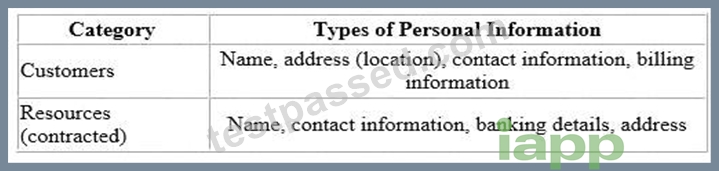
Clean-Q has an internal employee base of about 30 people. A recent privacy compliance exercise has been conducted to align employee data management and human resource functions with applicable data protection regulation. Therefore, the Clean-Q permanent employee base is not included as part of this scenario.
With an increase in construction work and housing developments, Clean-Q has had an influx of requests for cleaning services. The demand has overwhelmed Clean-Q's traditional supply and demand system that has caused some overlapping bookings.
Ina business strategy session held by senior management recently, Clear-Q invited vendors to present potential solutions to their current operational issues. These vendors included Application developers and Cloud-Q's solution providers, presenting their proposed solutions and platforms.
The Managing Director opted to initiate the process to integrate Clean-Q's operations with a cloud solution (LeadOps) that will provide the following solution one single online platform: A web interface that Clean-Q accesses for the purposes of resource and customer management. This would entail uploading resource and customer information.
* A customer facing web interface that enables customers to register, manage and submit cleaning service requests online.
* A resource facing web interface that enables resources to apply and manage their assigned jobs.
* An online payment facility for customers to pay for services.
What is a key consideration for assessing external service providers like LeadOps, which will conduct personal information processing operations on Clean-Q's behalf?
- A. Recognizing the value of LeadOps' website holding a verified security certificate.
- B. Establishing a relationship with the Managing Director of LeadOps.
- C. Obtaining knowledge of LeadOps' information handling practices and information security environment.
- D. Understanding LeadOps' costing model.
Answer: C
NEW QUESTION # 84
After committing to a Privacy by Design program, which activity should take place first?
- A. Create a privacy standard that applies to all projects and services.
- B. Perform privacy reviews on new projects.
- C. Implement easy to use privacy settings for users.
- D. Establish a retention policy for all data being collected.
Answer: A
Explanation:
When implementing a Privacy by Design (PbD) program, the first crucial step is to establish a comprehensive privacy standard that will serve as the foundation for all subsequent privacy-related activities and initiatives.
This standard ensures that privacy considerations are systematically integrated into all projects and services from the outset. The privacy standard sets the guidelines and frameworks within which privacy measures will be designed, developed, and maintained.
Reference:
IAPP Certification Textbooks: "Privacy by Design" emphasizes the need for proactive and preventive measures in privacy management, starting with setting clear standards and guidelines.
NEW QUESTION # 85
SCENARIO
Carol was a U.S.-based glassmaker who sold her work at art festivals. She kept things simple by only accepting cash and personal checks.
As business grew, Carol couldn't keep up with demand, and traveling to festivals became burdensome. Carol opened a small boutique and hired Sam to run it while she worked in the studio. Sam was a natural salesperson, and business doubled. Carol told Sam, "I don't know what you are doing, but keep doing it!" But months later, the gift shop was in chaos. Carol realized that Sam needed help so she hired Jane, who had business expertise and could handle the back-office tasks. Sam would continue to focus on sales. Carol gave Jane a few weeks to get acquainted with the artisan craft business, and then scheduled a meeting for the three of them to discuss Jane's first impressions.
At the meeting, Carol could not wait to hear Jane's thoughts, but she was unprepared for what Jane had to say.
"Carol, I know that he doesn't realize it, but some of Sam's efforts to increase sales have put you in a vulnerable position. You are not protecting customers' personal information like you should." Sam said, "I am protecting our information. I keep it in the safe with our bank deposit. It's only a list of customers' names, addresses and phone numbers that I get from their checks before I deposit them. I contact them when you finish a piece that I think they would like. That's the only information I have! The only other thing I do is post photos and information about your work on the photo sharing site that I use with family and friends. I provide my email address and people send me their information if they want to see more of your work. Posting online really helps sales, Carol. In fact, the only complaint I hear is about having to come into the shop to make a purchase." Carol replied, "Jane, that doesn't sound so bad. Could you just fix things and help us to post even more online?"
'I can," said Jane. "But it's not quite that simple. I need to set up a new program to make sure that we follow the best practices in data management. And I am concerned for our customers. They should be able to manage how we use their personal information. We also should develop a social media strategy." Sam and Jane worked hard during the following year. One of the decisions they made was to contract with an outside vendor to manage online sales. At the end of the year, Carol shared some exciting news. "Sam and Jane, you have done such a great job that one of the biggest names in the glass business wants to buy us out!
And Jane, they want to talk to you about merging all of our customer and vendor information with theirs beforehand." What type of principles would be the best guide for Jane's ideas regarding a new data management program?
- A. Vendor management principles.
- B. Incident preparedness principles.
- C. Collection limitation principles.
- D. Fair Information Practice Principles
Answer: D
NEW QUESTION # 86
SCENARIO - Please use the following to answer the next question:
Clean-Q is a company that offers house-hold and office cleaning services. The company receives requests from consumers via their website and telephor, to book cleaning services. Based on the type and size of service, Clean-Q then contracts individuals that are registered on its resource database - currently managed in-house by Clean-Q IT Support. Because of Clean-Q:s business.
model, resources are contracted as needed instead of permanently employed.
The table below indicates some of the personal information Clean-Q requires as part of its business operations:
Clean-Q has an internal employee base of about 30 people. A recent privacy compliance exercise has been conducted to align employee data management and human resource functions with applicable data protection regulation.
Therefore, the Clean-Q permanent employee base is not included as part of this scenario.
With an increase in construction work and housing developments, Clean-Q has had an influx of requests for cleaning services. The demand has overwhelmed Clean-Q:s traditional supply and demand system that has caused some overlapping bookings.
In a business statrategy session held by senior management recently, Clearning invited vendors to present potential solutions to their current operational issues. These vendors includes included Application development and Cloud solution providers, presenting their proposed solution and platforms.
The Managing Direct opted to initiate the process to integrate Clean-Q's operations with a cloud solution (LeadOps) that will provide the following solution one single online platform. A web interface that Clean-Q accesses for the purposes of resource and customer management. This would entail uploading resource and customer information.
A customer facing web interface that enables customers to register, manage and submit cleaning service requests online.
A resource facing web interface that enables resources to apply and manage their assigned jobs.
An online payment facility for customer to pay for services.
What is a key consideration for assessing external service providers like LeadOps, which will conduct personal information processing operations on Clean-Q:s behalf?
- A. Establishing a relationship with the Managing Director of LeadOps.
- B. Obtaining knowledge of LeadOps information handling practices and information security environment.
- C. Understanding LeadOps costing model.
- D. Recognizing the value of LeadOps website holding a verified security certificate.
Answer: A
NEW QUESTION # 87
SCENARIO
Clean-Q is a company that offers house-hold and office cleaning services. The company receives requests from consumers via their website and telephone, to book cleaning services. Based on the type and size of service, Clean-Q then contracts individuals that are registered on its resource database - currently managed in- house by Clean-Q IT Support. Because of Clean-Q's business model, resources are contracted as needed instead of permanently employed.
The table below indicates some of the personal information Clean-Q requires as part of its business operations: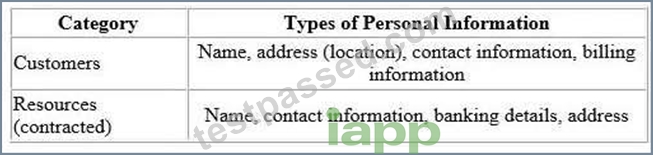
Clean-Q has an internal employee base of about 30 people. A recent privacy compliance exercise has been conducted to align employee data management and human resource functions with applicable data protection regulation. Therefore, the Clean-Q permanent employee base is not included as part of this scenario.
With an increase in construction work and housing developments, Clean-Q has had an influx of requests for cleaning services. The demand has overwhelmed Clean-Q's traditional supply and demand system that has caused some overlapping bookings.
Ina business strategy session held by senior management recently, Clear-Q invited vendors to present potential solutions to their current operational issues. These vendors included Application developers and Cloud-Q's solution providers, presenting their proposed solutions and platforms.
The Managing Director opted to initiate the process to integrate Clean-Q's operations with a cloud solution (LeadOps) that will provide the following solution one single online platform: A web interface that Clean-Q accesses for the purposes of resource and customer management. This would entail uploading resource and customer information.
* A customer facing web interface that enables customers to register, manage and submit cleaning service requests online.
* A resource facing web interface that enables resources to apply and manage their assigned jobs.
* An online payment facility for customers to pay for services.
Considering that LeadOps will host/process personal information on behalf of Clean-Q remotely, what is an appropriate next step for Clean-Q senior management to assess LeadOps' appropriateness?
- A. Nothing at this stage as the Managing Director has made a decision.
- B. Obtain a legal opinion from an external law firm on contracts management.
- C. Determine if any Clean-Q competitors currently use LeadOps as a solution.
- D. Involve the Information Security team to understand in more detail the types of services and solutions LeadOps is proposing.
Answer: D
NEW QUESTION # 88
......
Accurate & Verified New CIPT Answers As Experienced in the Actual Test!: https://www.testpassed.com/CIPT-still-valid-exam.html
Valid CIPT Test Answers Full-length Practice Certification Exams: https://drive.google.com/open?id=1367B5Zh3wDUuQ4ienvNjE-RSr_2XUgxq