


Arch-302 Training & Certification Get Latest Salesforce Architect Updated on May 15, 2026
Certification Training for Arch-302 Exam Dumps Test Engine
NEW QUESTION # 48
A company is using Service Cloud, B2C Commerce, and Marketing Cloud to provide an end-to-end B2C solution. The company does not use MuleSoft or any other integration middleware and does not plan on using them in the near future. The company has about 10 million customers with a growth rate of 10% year over year, On average, each customer raises 10-50 support tickets each year, Each ticket may contain multiple comments, responses, and attachments. There is a need for the service agents to have visibility on customer tickets for up to 5 years.
What approach should a Solution Architect recommend in order to deliver the desired functionality given the company's expected growth over the next 5 years, while still adhering to the platform's governor limits?
- A. Capture and resolve tickets using the capabilities of Service Cloud, Use the Service Cloud console to display cases and related data raised by a customer in the past 5 years.
- B. Capture and resolve tickets using the capabilities of Service Cloud. Archive resolved cases and related data into Heroku and display them back in Service Cloud using Salesforce Connect.
- C. Capture and resolve tickets using the capabilities of Service Cloud. Archive cases and related data older than a year in Big Objects and delete records that are more than 5 years old.
- D. Capture and resolve tickets using the capabilities of 852C Commerce. Archive cases and related data older than a year in Big Objects and delete records that are more than 5 years old.
Answer: B
Explanation:
This approach allows the company to use Service Cloud for capturing and resolving tickets, which provides a better customer service experience than B2C Commerce. It also allows the company to archive resolved cases and related data into Heroku, which is a cloud platform that can store large amounts of data without hitting the platform's governor limits. Using Salesforce Connect, the company can display the archived data back in Service Cloud without storing it in Salesforce, thus saving storage space and costs. References: https://help.
salesforce.com/s/articleView?id=sf.data_source_connect.htm&type=5 https://www.heroku.com/home
NEW QUESTION # 49
An organization operating more than 20 beauty, personal care, and health brands wants to move from its on- premise CRM system to Service Cloud and Marketing Cloud. Because a customer's privacy and marketing preferences can vary based on the brand, the organization needs to track those preferences to run consent- based marketing campaigns.
Which consideration should a Solution Architect keep in mind with respect to consent preferences in Marketing Cloud with the consent data model?
- A. A separate contact is required for each brand where consent is independently managed; the total count of contacts in Marketing Cloud can be larger than the number of individual customers.
- B. When a subscriber unsubscribes without following the unsubscribe link provided in the message, the unsubscribe request is sent to Marketing Cloud directly and synchronized to the Salesforce Consent Data Model through Marketing Cloud Connect.
- C. Global consent governs all-or-nothing consent settings that should be managed on the Contact object to follow cross-cloud data strategy best practice using the contact ID as the primary key in Marketing Cloud.
- D. When multiple brands are operated in a single org, the native relationship between Business, Brand, and Contact object helps distinguish privacy and consent preferences that vary between different brands.
Answer: A
Explanation:
This answer is correct because the consent data model in Marketing Cloud allows for multiple contacts per individual customer, each with their own consent preferences for different brands. This enables consent-based marketing campaigns across multiple brands in a single org. References: https://help.salesforce.com/s
/articleView?id=sf.mc_cab_consents.htm&type=5
NEW QUESTION # 50
A company is implementing a multi-locale solution that includes B2C Commerce, Service Cloud, and Marketing Cloud. Order confirmation emails are triggered from either B2C Commerce or Service Cloud and sent from Marketing Cloud.
What are two possible reasons why the shipping method name and description can be missing when these emails are triggered for languages other than US English, while other translated content appears correctly?
Choose 2 answers
- A. The subscriber in Marketing Cloud does not have a preferred locale set.
- B. The locale is not set correctly in the body of the email template.
- C. The name and description for the shipping method are not set up correctly in B2C Commerce or Service Cloud for the requested locale.
- D. The ShippingMethods data extension is missing the label and description field for the corresponding locale.
Answer: C,D
Explanation:
The shipping method name and description can be missing when order confirmation emails are triggered for languages other than US English, while other translated content appears correctly, for the following possible reasons:
* The name and description for the shipping method are not set up correctly in B2C Commerce or Service Cloud for the requested locale. The shipping method name and description are stored as attributes in B2C Commerce or Service Cloud, and they need to be translated and localized for each supported locale. If the translation or localization is missing or incorrect, the order confirmation email may not display them properly.
* The ShippingMethods data extension is missing the label and description field for the corresponding locale. The ShippingMethods data extension is a table in Marketing Cloud that stores the shipping method information for each locale. It has fields for label and description that need to match the values in B2C Commerce or Service Cloud. If the fields are missing or mismatched for a certain locale, the order confirmation email may not display them properly.
Option B is incorrect because the subscriber in Marketing Cloud does not need to have a preferred locale set.
The locale can be determined by the order data or the storefront language. Option C is incorrect because the locale can be set correctly in the email template using AMPscript or SSJS variables. References:
* https://help.salesforce.com/s/articleView?id=sf.mc_co_transactional_messaging.htm&type=5
* https://help.salesforce.com/s/articleView?id=sf.mc_co_order_confirmation_email.htm&type=5
* https://help.salesforce.com/s/articleView?id=sf.mc_co_shipping_methods_data_extension.htm&type=5
NEW QUESTION # 51
An insurance company needs the ability to relate contacts to their workplace to track which services are paid by the employee benefits. Contacts receive emails to notify them of new policy offerings. Agents also need to relate adults in the same household who share access to financial resources and policy information to sign them up for the right policies. Adjusters need the ability to see and respond to claims from anyone in the household. Independent agents need daily access to customer data as well. Customers also need periodic access to claims and policy information for their household. The company also wants to track what data searches are performed by agents and adjusters on the platform to analyze their work.
Which products should a Solution Architect recommend in addition to Insurance for Financial Services and Experience Cloud to meet these needs?
- A. REST API Event Monitoring and Tableau CRM, Marketing Engagement Studio
- B. Shield and Event Monitoring Analytics App, Pardot
- C. Salesforce Field Service, Shield Encryption at rest. Digital Engagement
- D. Digital Engagement, Shield with Splunk, Social Engagement Studio
Answer: B
Explanation:
A: Shield and Event Monitoring Analytics App, Pardot can help meet these needs by providing enhanced security, compliance, auditing, analytics, and marketing capabilities for the insurance company. Shield can help protect sensitive data with encryption, monitor user activity with event logs, enforce data retention policies with archiving, and comply with industry regulations with field audit trails. Event Monitoring Analytics App can help analyze user behavior, performance, adoption, and usage with prebuilt dashboards and reports. Pardot can help create personalized email campaigns, track customer engagement, automate lead generation, and measure marketing ROI. References:
* https://www.salesforce.com/products/platform/products/salesforce-shield/
* https://www.salesforce.com/products/platform/products/event-monitoring-analytics-app/
* https://www.salesforce.com/products/marketing-cloud/best-marketing-automation-software/
NEW QUESTION # 52
A company uses Marketing Cloud, Experience Cloud, B2C Commerce, and Service Cloud. It is in the process of defining the authoritative system for key data entities involved in B2C Journeys. The company has about
200,000 customers, each averaging 30 orders per year
Which option should be considered the authoritative record for consent and compliance preferences, as well as primary person attributes such as name, address, birthday, phone, and email?
- A. Experience Cloud user
- B. B2C Commerce customer
- C. Service Cloud contact
- D. Marketing Cloud subscriber
Answer: C
Explanation:
Service Cloud contact should be considered the authoritative record for consent and compliance preferences, as well as primary person attributes such as name, address, birthday, phone, and email. Service Cloud contact is the core entity that represents a person across multiple Salesforce clouds and can store and manage the customer's consent and compliance preferences using features like Individual object, Data Protection and Privacy, and Consent Management. The other systems can use Service Cloud contact as the master record and sync or update the customer data accordingly.
NEW QUESTION # 53
A company has 2,000 customers and currently services them using a call center and spreadsheets. Because of the lack of systems there is no ability to track how successful agents are. In addition, their ordering system cannot be easily accessed by service agents costing valuable time and hurting customer satisfaction.
What are two reasons a connected B2C Solution can add value to the company?
Choose 2 answers
- A. Increases spend ROI as fewer service agents will be needed, which can allow for more sales agents
- B. Provides a better interface for agents using Service Cloud and B2C Commerce with Heroku
- C. Allows agents to more easily access customer data to better support customers when they call in
- D. Allows agents to use SSO to log into B2C Commerce and Service Cloud using the same credentials
Answer: C,D
Explanation:
B: Allowing agents to more easily access customer data to better support customers when they call in can add value to the company by improving customer satisfaction, loyalty, and retention. This can also enable agents to provide personalized recommendations, cross-sell or upsell opportunities, and proactive service based on the customer's profile, preferences, and purchase history. C. Allowing agents to use SSO to log into B2C Commerce and Service Cloud using the same credentials can add value to the company by simplifying the login process, enhancing security, and reducing administrative overhead. This can also provide a seamless user experience for agents across different systems and platforms. References:
* https://www.salesforce.com/products/service-cloud/overview/
* https://www.salesforce.com/products/commerce-cloud/overview/
* https://help.salesforce.com/s/articleView?id=sf.identity_sso.htm&type=5
NEW QUESTION # 54
An organization currently has separate teams supporting Service Cloud, Marketing Cloud, store operations with a point-of-sale solution, and eCommerce with Commerce Cloud. Each business unit has their own key performance indicators (KPIs) but the organization is struggling to understand the big picture and improve customer engagement with the brand.
In which two ways would Salesforce CDP help in this scenario?
Choose 2 answers
- A. It provides cross-channel analytics using pre-built, native dashboards and charts within the unified profile.
- B. It ingests customer data from each system and uses matching rules to find records representing the same person, uniting them under a Unified Individual.
- C. It can power experiences through other channels like Marketing Cloud Engagement by activating customer segments.
- D. It creates one Individual record that replaces the system-specific records in other products, creating a unified view of the customer.
Answer: B,C
Explanation:
These answers are correct because they are ways that Salesforce CDP can help the organization in this scenario. Salesforce CDP can ingest customer data from each system and use matching rules to find records representing the same person, uniting them under a Unified Individual. This creates a single view of the customer across all systems and channels. Salesforce CDP can also power experiences through other channels like Marketing Cloud Engagement by activating customer segments. This enables personalized and targeted marketing campaigns based on customer data and behavior. References: https://www.salesforce.com/products
/customer-data-platform/overview/
NEW QUESTION # 55
A global merchant plans to use B2C Commerce, Service Cloud, and Marketing Cloud to support the shopper experience. They also plan on using Marketing Cloud Connect to integrate Service and Marketing Clouds and the Service Cloud Connector for B2C Commerce. The customers will receive SMS messages through Mobile Connect. One of the key requirements is to enable consent and profile management across the clouds.
Which two recommendations should a Solution Architect make as part of the solution?
Choose 2 answers
- A. Service Cloud profile data can be configured to sync to the Marketing Cloud profile center
- B. Shopper consent in B2C storefronts will sync to Service Cloud when person accounts are used
- C. SMS opt-in will sync with Service Cloud when contact ID is the subscriber key in Marketing Cloud
- D. Profile changes in B2C Commerce will sync to Service Cloud when person accounts are used
Answer: C,D
Explanation:
A: SMS opt-in will sync with Service Cloud when contact ID is the subscriber key in Marketing Cloud. This can help enable consent and profile management across the clouds by allowing customers to opt-in or opt-out of SMS messages and reflecting their preferences in both Service Cloud and Marketing Cloud. This can also help comply with industry regulations and best practices for SMS marketing. C. Profile changes in B2C Commerce will sync to Service Cloud when person accounts are used. This can help enable consent and profile management across the clouds by allowing customers to update their profile information in B2C Commerce and syncing their changes to Service Cloud. This can also help maintain consistent and accurate customer data across different systems and platforms. References:
* https://help.salesforce.com/s/articleView?id=sf.mc_co_person_accounts.htm&type=5
* https://help.salesforce.com/s/articleView?id=sf.mc_co_implement_marketing_cloud_connect.htm&type=5
* https://help.salesforce.com/s/articleView?id=sf.b2c_commerce_integration.htm&type=5
NEW QUESTION # 56
A company uses Salesforce to store accounts and contacts. All users have switched to the Lightning Experience user interface. The Account Hierarchy feature is used extensively to relate companies to their subsidiaries. A Solution Architect finds that the data migration process is creating duplicate contacts with different primary accounts.
Which two options can the Solution Architect use to ensure that there is only a single contact for a particular person across all the subsidiaries of a company?
Choose 2 answers
- A. Customer 360 Data Manager
- B. Lightning Data Services
- C. Duplicate Matching Rules
- D. Third-party application or AppExchange tool
Answer: A,C
Explanation:
* Option A is correct because Customer 360 Data Manager can be used to ensure that there is only a single contact for a particular person across all the subsidiaries of a company. Customer 360 Data Manager is a tool that enables data integration and identity resolution across multiple Salesforce clouds and external systems. It can match and merge duplicate contacts based on various criteria and create a single source of truth for customer data.
* Option C is correct because Duplicate Matching Rules can be used to ensure that there is only a single contact for a particular person across all the subsidiaries of a company. Duplicate Matching Rules are rules that define how Salesforce identifies duplicate records based on standard or custom fields. They can prevent users from creating or updating duplicate contacts based on various criteria and actions.
* Option B is incorrect because Third-party application or AppExchange tool is not an option that the Solution Architect can use to ensure that there is only a single contact for a particular person across all the subsidiaries of a company. Third-party application or AppExchange tool is not a specific or native solution for this problem, but rather a general or external solution that may or may not work depending on the features and compatibility of the application or tool.
* Option D is incorrect because Lightning Data Services is not an option that the Solution Architect can use to ensure that there is only a single contact for a particular person across all the subsidiaries of a company. Lightning Data Services is a tool that enables developers to access, cache, and modify data in Lightning web components without using Apex code. It does not have any functionality to prevent or resolve duplicate contacts.
References:
* [Get Started with B2C Solution Architect Cert Prep - Trailhead]
* [Certification - B2C Solution Architect - Trailhead]
* B2C Solution Architect Certification Guide | Salesforce Ben
NEW QUESTION # 57
Universal Containers has been using Service Cloud and recently decided to implement Marketing Cloud.
There are many data quality issues in Service Cloud like duplicates and incomplete email addresses. They want to use Marketing Cloud to send personalized communications.
Which two recommendations should a Solution Architect make when suggesting a migration strategy from an existing Service Cloud implementation to a new Marketing Cloud one?
Choose 2 answers
- A. Fix the data quality issues in Service Cloud before migrating to Marketing Cloud.
- B. Use Customer Data Platform (CDP) to synchronize data between Service Cloud and Marketing Cloud.
- C. Map Contact, Lead, and Account objects within Marketing Cloud to enable personalization.
- D. Build a custom connector between Service Cloud and Marketing Cloud that will remove the duplicates.
Answer: A,C
Explanation:
A: Fixing the data quality issues in Service Cloud before migrating to Marketing Cloud can help avoid duplicate or incomplete contacts in Marketing Cloud, which can affect the contact count, billing, and personalization. Data quality issues can be fixed by using tools such as Data Loader, Duplicate Management, or ETL tools. C. Mapping Contact, Lead, and Account objects within Marketing Cloud can help enable personalization by using data from Service Cloud in email content or journeys. Mapping can be done by using Marketing Cloud Connect or Customer 360 Data Manager. References: https://help.salesforce.com/s/articleView?id=sf.mc_co_sync_leads_and_contacts.htm&type=5
https://help.salesforce.com/s/articleView?id=sf.mc_co_subscriber_key_migration.htm&type=5 https://help.salesforce.com/s/articleView?id=sf.mc_co_map_salesforce_objects.htm&type=5
NEW QUESTION # 58
Northern Trail Outfitters (NTO) wants to integrate its product information management (PIM) system with B2C Commerce so shopping experiences can be relevant, personalized, and seamless across channels. They need the ability to search for product deltas in the PIM system and reflect those changes in B2C Commerce on a scheduled basis. The Solution Architect recommends using MuleSoft Accelerator for B2C Commerce for this integration.
Which two benefits should the Solution Architect highlight about API-led connectivity while implementing the MuleSoft accelerator for B2C Commerce?
Choose 2 answers
- A. It offers a template-driven approach for development.
- B. It enforces a distributed approach and allows for the creation of Experience APIs, Data APIs, and System APIs.
- C. It lets the business quickly integrate different systems without involving IT.
- D. It enables self-service and an increase in productivity through reusable microservices and APIs.
Answer: B,D
Explanation:
API-led connectivity is a method of connecting data to applications through reusable and purposeful APIs.
MuleSoft Accelerator for Salesforce B2C Commerce Cloud is a solution that uses API-led connectivity to integrate B2C Commerce with other systems such as PIM, ERP, or Service Cloud. The benefits of API-led connectivity while implementing the MuleSoft accelerator for B2C Commerce are:
* It enables self-service and an increase in productivity through reusable microservices and APIs. API-led connectivity allows developers to create modular and reusable microservices and APIs that can be easily discovered, accessed, and composed by other developers or business users. This reduces duplication of effort, increases agility, and accelerates time to market.
* It enforces a distributed approach and allows for the creation of Experience APIs, Data APIs, and System APIs. API-led connectivity follows a distributed approach that decouples data sources from data consumers, enabling greater scalability, flexibility, and security. It also allows for the creation of three layers of APIs: Experience APIs that tailor data to specific channels or devices, Data APIs that orchestrate data from multiple sources, and System APIs that connect to core systems of record.
Option B is incorrect because API-led connectivity does not let the business quickly integrate different systems without involving IT. It requires IT to design, build, and manage the APIs that enable integration.
Option C is incorrect because API-led connectivity does not offer a template-driven approach for development. It offers a methodology and a framework for developing APIs based on best practices.
References:
* https://www.mulesoft.com/resources/api/what-is-api-led-connectivity
* https://www.mulesoft.com/exchange/org.mule.examples/mulesoft-accelerator-for-salesforce-b2c- commerce-cloud/
NEW QUESTION # 59
A financial company uses an external system for pricing and quotation.
What is the recommended approach to use the pricing and discount rules in the external system within Salesforce during the loan application process?
- A. Rebuild the logic used in the external system using Apex.
- B. Use the Apex callout to retrieve the latest information from the external system during the loan application process.
- C. Use the API callout component in Process Builder to retrieve the latest information from the external system during the loan application process.
- D. Use an external object to store pricing and discount information.
Answer: B
Explanation:
This option allows you to use Apex code to make HTTP requests and receive HTTP responses from an external system, such as a pricing and quotation service. You can use the @future(callout=true) annotation to make asynchronous callouts from Apex triggers or invocable methods. The other options are either not feasible or not optimal for this use case.
NEW QUESTION # 60
A company is using both Service Cloud and B2C Commerce but they are not using Mulesoft or any other integration middleware and do not plan on adding that in the near future. However, there is a need to keep customer records in sync across both Service Cloud and B2C Commerce. When a change to the customer record in Service Cloud takes place, such as an updated customer name, the same customer record should be updated in B2C Commerce. Assume that there is a common ID that uniquely identifies the customer across the two systems.
How should a Solution Architect deliver the desired functionality?
- A. Develop a custom solution in Service Cloud to consume and communicate with B2C Commerce APIs
- B. Send a platform event from Service Cloud and subscribe to the platform event in B2C Commerce using the built-in functionality
- C. Send an Outbound Message from Service Cloud and catch and handle the Outbound Message using the B2C Commerce APIs
- D. Use change data capture to send a message from Service Cloud and catch and handle the message using B2C Commerce Service Cloud Connector
Answer: A
Explanation:
A custom solution in Service Cloud can use Apex or Lightning Web Components to call the B2C Commerce APIs and update the customer records in B2C Commerce. This option provides the most flexibility and control over the integration logic and error handling. Platform events, outbound messages, and change data capture are not supported by B2C Commerce out of the box, so they would require additional development or middleware to handle them. References:
* https://developer.salesforce.com/docs/atlas.en-us.apexcode.meta/apexcode
/apex_rest_code_sample_basic.htm
* https://developer.salesforce.com/docs/component-library/documentation/en/lwc/lwc.data_wire_example
* https://documentation.b2c.commercecloud.salesforce.com/DOC1/index.jsp?topic=%2Fcom.demandware.dochelp%2FOCAPI%2Fcurrent%2Fusage%2FRESTAPIs.html
NEW QUESTION # 61
An existing Salesforce customer has B2C Commerce, Service Cloud, and Marketing Cloud, but none of their customer data is integrated. Marketing Cloud has around 2 million subscribers using email address as the subscriber key, B2C Commerce has 750,000 registered customers, and Service Cloud only has records for about 50.000 customers who have previously created support cases or contacted customer service.
What is the optimum sequence of events a Solution Architect should follow when integrating customer data across these systems?
- A. Load B2C Commerce customers into Service Cloud, Load Marketing Cloud Subscribers Into Service Cloud, Load Service Cloud Contact IDs into Marketing Cloud, Marketing Cloud Subscriber Key Migration, Enable Marketing Cloud Connect
- B. Marketing Cloud Subscriber Key Migration, Load Marketing Cloud Subscribers into Service Cloud, Load Service Cloud Contact IDs into Marketing Cloud, Load B2C Commerce customers into Service Cloud, Enable Marketing Cloud Connect
- C. Load B2C Commerce customers into Service Cloud, Load Service Cloud Contact IDs into Marketing Cloud, Marketing Cloud Subscriber Key Migration, Load Marketing Cloud Subscribers into Service Cloud, Enable Marketing Cloud Connect
- D. Marketing Cloud Subscriber Key Migration, Enable Marketing Cloud Connect, Load Marketing Cloud Subscribers into Service Cloud, Load Service Cloud Contact IDs into Marketing Cloud, Load B2C Commerce customers into Service Cloud
Answer: A
Explanation:
This sequence of events ensures that all customer data is integrated across the systems and that Marketing Cloud uses Service Cloud Contact IDs as the subscriber key. This allows for a consistent and unified view of the customer across the Salesforce products. References: https://help.salesforce.com/s/articleView?id=sf.
mc_co_subscriber_key_migration.htm&type=5 https://help.salesforce.com/s/articleView?id=sf.
mc_co_marketing_cloud_connect.htm&type=5
NEW QUESTION # 62
A university has several small departmental organizations scattered across different colleges. Each of which has its own finances, business processes, and strategies that are sometimes at odds. They would like to introduce a university-wide communications strategy that allows their recruitment team to market to potential students globally while allowing each department to recruit existing students for its own programs.
What should a Solution Architect recommend to meet their needs?
- A. Marketing Cloud with Enterprise Communication Strategy and a single Salesforce org with Connected Campus for consolidating existing departmental orgs
- B. Marketing Cloud with multiple business units, Marketing Cloud Connect, and multiple existing Salesforce orgs
- C. Marketing Cloud with Enterprise Communication Strategy, Marketing Cloud Connect, and multiple existing Salesforce orgs
- D. Marketing Cloud with multiple business units and a single Salesforce org with Divisions for consolidating existing departmental orgs
Answer: A
Explanation:
* Option D is correct because Marketing Cloud with Enterprise Communication Strategy and a single Salesforce org with Connected Campus for consolidating existing departmental orgs is the best solution to meet the university's needs. Marketing Cloud with Enterprise Communication Strategy allows the university to create and manage personalized communications across multiple channels and audiences, while a single Salesforce org with Connected Campus enables the university to unify and streamline its data, processes, and services across different departments and colleges.
* Option A is incorrect because Marketing Cloud with multiple business units, Marketing Cloud Connect, and multiple existing Salesforce orgs is not a suitable solution for the university's needs, as it would create data silos, integration challenges, and governance issues across different Salesforce clouds and orgs. Marketing Cloud Connect is also not necessary for the university's communication strategy, as it is mainly used for data synchronization and integration between Marketing Cloud and Service Cloud or Sales Cloud.
* Option B is incorrect because Marketing Cloud with multiple business units and a single Salesforce org with Divisions for consolidating existing departmental orgs is not a suitable solution for the university's needs, as it would create complexity and overhead in managing multiple business units and divisions within the same Salesforce cloud and org. Divisions are also not recommended for multi-brand or multi- department scenarios, as they are mainly used for large-scale data segmentation and reporting purposes.
* Option C is incorrect because Marketing Cloud with Enterprise Communication Strategy, Marketing Cloud Connect, and multiple existing Salesforce orgs is not a suitable solution for the university's needs, as it would create data silos, integration challenges, and governance issues across different Salesforce clouds and orgs. Marketing Cloud Connect is also not necessary for the university's communication strategy, as it is mainly used for data synchronization and integration between Marketing Cloud and Service Cloud or Sales Cloud.
References:
* [Get Started with B2C Solution Architect Cert Prep - Trailhead]
* [Certification - B2C Solution Architect - Trailhead]
* [B2C Solution Architect Certification Guide | Salesforce Ben]
NEW QUESTION # 63
Northern Trail Outfitters (NTO) wants to upgrade its customer service by providing the opportunity for customers to engage using social messaging channels such as Facebook, WhatsApp, and SMS to resolve issues and ask questions. They already use Marketing Cloud Mobile Connect and Social Studio. Alongside these, the Solution Architect also recommends implementing Digita I Engagement features in Service Cloud.
Which two reasons should a Solution Architect use to justify those recommendations?
Choose 2 answers
- A. Social Studio is limited to listening to social channel and not responding
- B. Mobile Connect only supports outbound messaging in selected countries
- C. Mobile Connect lacks integration with the service agent console without Digital Engagement
- D. Social Studio does not support 1:1 messaging on the apps listed in the scenario
Answer: C,D
Explanation:
Digital Engagement is a set of features in Service Cloud that enables agents to communicate with customers using social messaging channels such as Facebook, WhatsApp, and SMS. To justify the recommendation of implementing Digital Engagement, a Solution Architect can use the following reasons:
* Mobile Connect lacks integration with the service agent console without Digital Engagement. Mobile Connect is a feature in Marketing Cloud that allows sending and receiving SMS messages. However, without Digital Engagement, Mobile Connect messages cannot be handled by Service Cloud agents in the service console or omnichannel routing.
* Social Studio does not support 1:1 messaging on the apps listed in the scenario. Social Studio is a feature in Marketing Cloud that allows listening and engaging with customers on social media platforms. However, Social Studio does not support direct messaging on Facebook or WhatsApp, which are popular social messaging channels.
Option B is incorrect because Mobile Connect supports outbound messaging in more than 200 countries.
Option D is incorrect because Social Studio can respond to public posts or comments on social media platforms. References:
* https://help.salesforce.com/s/articleView?id=sf.service_digital_overview.htm&type=5
* https://help.salesforce.com/s/articleView?id=sf.mc_moc_mobileconnect.htm&type=5
* https://help.salesforce.com/s/articleView?id=sf.mc_moc_supported_countries.htm&type=5
* https://help.salesforce.com/s/articleView?id=sf.mc_ss_social_studio_overview.htm&type=5
NEW QUESTION # 64
An ecommerce company has one Primary Instance Group with three instances and one Secondary Instance Group with five sandboxes.
They are expanding and adding people in multiple locations to manage the storefront. They would like additional sandboxes to support their expansion efforts into new markets with new templates, scripts, and controllers.
Which approach should a Solution Architect recommend?
- A. Add a Tertiary Instance Group to add sandboxes to the existing realm.
- B. Add new sandboxes to the Secondary Instance Group for the current realm.
- C. Add a new realm for each new market to get additional sandboxes for each realm.
- D. Add new instances to the Primary Instance Group for new sandboxes in each realm.
Answer: B
Explanation:
The Secondary Instance Group is used for sandboxes in B2C Commerce. Adding new sandboxes to this group does not require creating a new realm or adding instances to the Primary Instance Group, which is used for production and staging instances. References: https://developer.salesforce.com/docs/commerce/b2c-commerce
/guide/b2c-developer-sandboxes.html
NEW QUESTION # 65
Refer to the image below: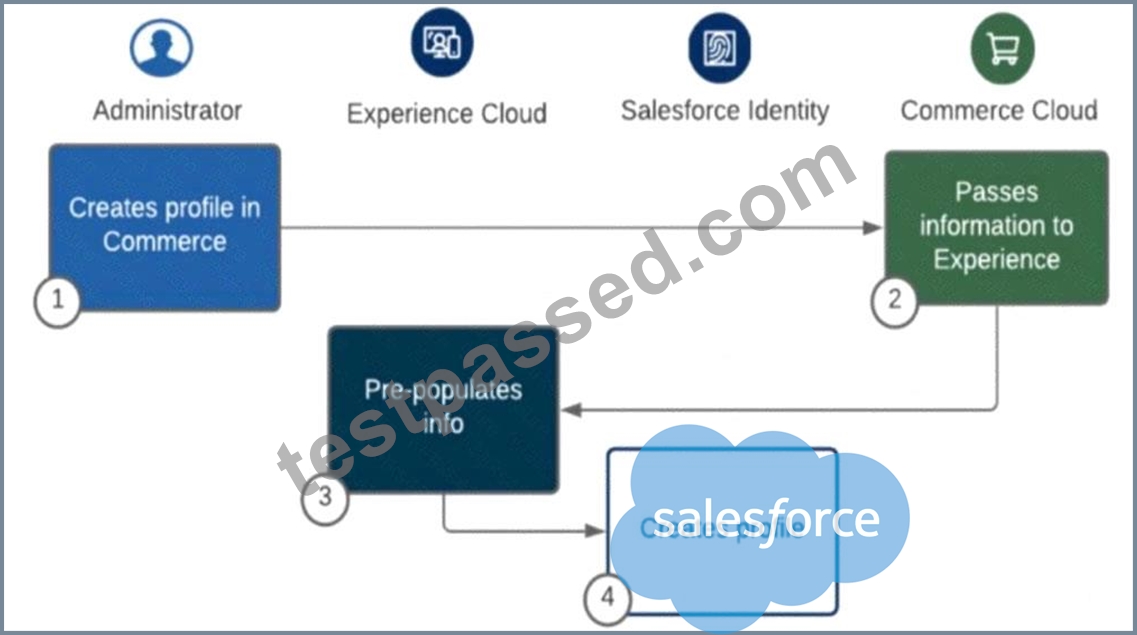
A brand is planning to re-platform their existing website onto B2C Commerce. As part of the re-platform they will create a new social community portal. They are going to implement B2C Commerce, Experience Cloud, and Salesforce Identity.
After reviewing the workflow, which system should a Solution Architect recommend to use as a primary authentication method while attempting to minimize migration of customer profile data?
- A. Salesforce CDP
- B. Salesforce Core Platform/Identity
- C. Salesforce B2C Commerce
- D. Salesforce Marketing Cloud
Answer: B
Explanation:
This answer is correct because it minimizes the migration of customer profile data by using Salesforce Identity as the primary authentication method. Salesforce Identity can act as an identity provider (IDP) for both B2C Commerce and Experience Cloud, and it can store customer profile data in a single place. This reduces the need to duplicate or sync customer data across multiple systems. References: https://help.
salesforce.com/s/articleView?id=sf.b2c_commerce_service_cloud_integration.htm&type=5
NEW QUESTION # 66
Universal Containers is about to expand from their existing product efforts around watches into creating smart watches. These watches are intended to integrate with the users smart phone but also gather and collect health data from the watch and the phone. Universal Containers has never had to manage or work with health related data and are concerned about how to go further while still keeping their users trust.
What is a next step a Solution Architect should suggest to provide UC the kind of understanding they are looking for"?
Choose 1 answers
- A. Speak with a Legal Expert in regards to HIPPA and PHI Data
- B. Run a Journey Mapping Workshop to understand the users' interactions with the system
- C. Does the team need front-end development capabilities?
- D. Run a Consequence Scanning Workshop to understand the impact of the work
- E. Run a Requirements Gathering Workshop to start creating the build requirements
Answer: D
Explanation:
This answer is correct because it is a next step that a Solution Architect should suggest to provide UC the kind of understanding they are looking for regarding how to manage or work with health related data while still keeping their users trust. A Consequence Scanning Workshop is a method that helps identify potential positive and negative consequences of a product or service on people, society, and environment. It can help UC anticipate the impact of their work on their users' trust and privacy, and design solutions that mitigate risks and maximize benefits. References: https://www.salesforce.com/blog/how-relationship-design-works/
NEW QUESTION # 67
An organization wants to implement B2C Commerce, Marketing Cloud, and Service Cloud in a phased manner with the goal of keeping the overall project manageable and achieving a quick return on investment.
Their current legacy commerce system is home grown and has frequent, costly outages- making this the highest priority for replacement. The current marketing platform collects only basic analytics from email marketing campaigns and has no awareness of the larger customer context. Currently, the call center meets most customer needs but the process is time-consuming and forces the agent to interact with multiple disconnected systems.
Which two implementation strategies should a Solution Architect recommend when rolling out an integrated customer experience across B2C Commerce, Marketing Cloud, and Service Cloud?
Choose 2 answers
- A. Implement Marketing Cloud immediately after B2C Commerce in order to leverage the Marketing Cloud Contact Key as the Service Cloud Contact ID when Service Cloud is implemented later.
- B. Implement Marketing Cloud and Service Cloud together in one phase after B2C Commerce to ensure that they share a common view of the customer from the beginning.
- C. Implement all three clouds at the same time; the primary identifiers for all three clouds must be synced to the others from the start in order to achieve a unified experience.
- D. Implement Service Cloud immediately after B2C Commerce in order to leverage the Service Cloud Contact ID as the Marketing Cloud Contact Key when Marketing Cloud is implemented later.
Answer: C,D
Explanation:
C: This implementation strategy allows the company to replace their legacy commerce system first, which is their highest priority, and then integrate it with Service Cloud to provide better customer service. By using the Service Cloud Contact ID as the Marketing Cloud Contact Key, the company can ensure a consistent and unified view of the customer across the Salesforce products when Marketing Cloud is implemented later. D.
This implementation strategy allows the company to achieve a unified customer experience across all three clouds from the start, but it also requires more resources and coordination to implement all three clouds at the same time. The primary identifiers for all three clouds must be synced to ensure data consistency and avoid duplication. References: https://trailhead.salesforce.com/content/learn/modules/marketing-cloud-contact- management/understand-contacts-and-contact-model-relationships
NEW QUESTION # 68
A telecommunications company is implementing Service Cloud and Experience Cloud with a goal to have a single view of their customers. Current system limitations have resulted in many duplicate and incomplete customer records with inadequate data quality in the millions of records. They want this issue remediated when migrating the data to Service Cloud and Experience Cloud.
Which two activities and tools should a Solution Architect recommend to address these concerns when planning the data migration activity and assure it is completed in a timely manner?
Choose 2 answers
- A. Iteratively test smaller loads against a developer or partial copy sandbox and the full load against a full copy sandbox.
- B. Use an ETL tool with a staging database in order to run data cleansing tools to obtain a clean data set.
- C. Q Duplicate Management in Salesforce can be used to identify and manage duplicate records.
- D. Iteratively test smaller loads against a developer sandbox and the full load against a partial copy sandbox.
Answer: A,B
Explanation:
B: An ETL (Extract, Transform, Load) tool is a software that can help extract data from multiple sources, transform it according to business rules, and load it into a target destination, such as Salesforce. An ETL tool can also help run data cleansing tools, such as deduplication, validation, standardization, and enrichment, to obtain a clean data set before migrating it to Salesforce. C. Iteratively testing smaller loads against a developer or partial copy sandbox and the full load against a full copy sandbox can help ensure the data migration is successful and error-free. A developer or partial copy sandbox can be used for testing the data quality, mapping, and transformation rules, while a full copy sandbox can be used for testing the performance, scalability, and integrity of the data migration. References: https://trailhead.salesforce.com/en/content/learn/modules/data-management-basics/data-management-basics-migrate https://help.salesforce.com/s/articleView?id=sf.data_sandbox_create.htm&type=5
NEW QUESTION # 69
A Marketing team plans to support the launch of a new product line. In discussion with the Sales and IT teams, the Marketing team proposed introducing a leads-management process, along with a web-to-lead form for the landing page that supports the product launch.
The leads captured using the form are added to the new nurturing journey in Marketing Cloud and subsequently routed to the relevant sales team once they qualify at a certain threshold.
What are two implications that a Solution Architect should consider prior to implementing this solution?
Choose 2 answers
- A. Engagement history from the lead record will be natively available for contact record in Marketing Cloud
- B. Leads can have detrimental impact on quality of contact records in Sales Cloud
- C. Leads are unique contact records in Marketing Cloud
- D. Need for additional handling of consent, preferences, and compliance for converted leads in Marketing Cloud
Answer: B,D
Explanation:
Introducing a leads-management process and a web-to-lead form can have implications for consent, preferences, and compliance for converted leads in Marketing Cloud. For example, if a lead opts out of email communication in Sales Cloud, this preference should be reflected in Marketing Cloud as well. Similarly, if a lead is converted to a contact in Sales Cloud, the corresponding subscriber record in Marketing Cloud should be updated with the new ID and status. Leads can also have a detrimental impact on the quality of contact records in Sales Cloud if they are not properly deduplicated, validated, and enriched. For example, if a lead is created with an invalid or duplicate email address, this can affect the deliverability and personalization of email messages in Marketing Cloud. References:
* https://help.salesforce.com/s/articleView?id=sf.mc_co_data_integration_best_practices.htm&type=5
* https://help.salesforce.com/s/articleView?id=sf.mc_co_subscriber_key.htm&type=5
* https://help.salesforce.com/s/articleView?id=sf.mc_co_web_to_lead.htm&type=5
NEW QUESTION # 70
......
Step by Step Guide to Prepare for Arch-302 Exam: https://www.testpassed.com/Arch-302-still-valid-exam.html
Salesforce Architect Arch-302 Real Exam Questions and Answers FREE Updated: https://drive.google.com/open?id=1CWYG8S2yIqqjEvBSKtnynGhcJr2R8Uvt